 Credit: ADEM
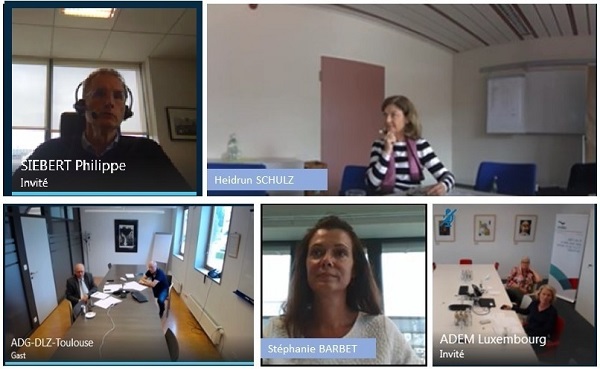
The directors of the public employment services in the Greater Region met virtually on Tuesday to discuss cross-border issues.
The directors of Luxembourg's employment agency ADEM, the Luxembourg Forem Direcorate, the Rhineland-Palatinate-Saar Regional Directorate of the Federal Employment Agency (Germany), the Pôle emploi Grand Est (France) and the employment office of the German-speaking community of Belgium met earlier this week to discuss the current effects of the COVID-19 health crisis on the cross-border job market.
In 2019, the Greater Region counted around 240,000 cross-border workers; it was thus deemed essential for the public employment services to discuss the challenges of the current and future economic situation and to work on joint projects.
During this working session, each public employment service presented the consequences of the health crisis on the development of the job and apprenticeship market. The participants also shared the organisational methods put in place in the employment agencies of each region to maintain the link with the public (eg interviews by videoconference or telephone and physical meetings). All these steps were carried out in strict compliance with the health regulations in order to limit the spread of coronavirus.
The participants affirmed their willingness to continue and strengthen their existing good cooperation. They agreed to work on the development of joint cross-border training and virtual cross-border job fairs. Particular attention will be paid to the young public, who have been particularly affected by the consequences of the pandemic. The participants thus agreed on the implementation of joint actions to fight youth unemployment and to use cross-border learning as a lever.
Heidrun Schulz, head of the Rhineland-Palatinate-Saar Regional Directorate of the Federal Employment Agency, commented: “Over the past few years, we have accomplished a lot for the job market. With all our partners, we have, for example, continuously developed the EURES network. It is important, especially at these times, that we strengthen our cross-border exchanges as well as our cooperation".
For his part, Philippe Siebert, regional director of Pôle emploi Grand Est, pointed out that the “Pôle emploi very quickly developed teleworking from the start of confinement; today it is 3,000 [employees] in the Grand Est who are concerned. The continuity of public service has been maintained for the benefit of our [public] and our businesses. ” He added "that very quickly, with the Regional Council and the State, intervention policies were worked on to face the economic consequences of the crisis".
Stéphanie Barbet, Luxembourg territorial director of the Forem in Belgium, also commented: "We cross-border territories are aware of our interdependence. In the Greater Region, the current health crisis has reaffirmed the importance of cross-border cooperation for our interdependent labor markets. Long-term facilitation of cross-border training paths, cross-border professional paths, pooling our resources seems to me to be an essential basis for future collaborations”.
Robert Nelles, director of the employment office of the German-speaking community of Belgium, added: “It is precisely in times of crisis like the one we are currently experiencing that cross-border cooperation of public employment services is particularly important. Many businesses, and especially border workers, need good information. The mutual exchange between the partners makes it possible to quickly receive information and to transmit it".
ADEM director Isabelle Schlesser concluded: “The exchange showed us once again that the public employment services of the Greater Region are facing similar challenges. Due to the coronavirus crisis, we were forced to change our internal work processes overnight in order to maintain our services to job seekers and employers. We learned a lot during this period, especially in terms of the digitalisation of our services. Now, we must strengthen our collaboration and develop new offers from which the job market in the Greater Region can benefit".