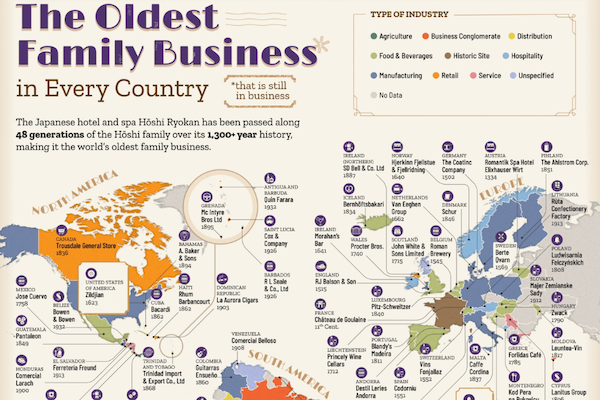
Payroll Prices, a platform providing global payroll and salary insights, has released a study identifying the longest-running family business in every country, revealing that wine and spirits producer Pitz-Schweitzer, founded in 1840, is the oldest in Luxembourg.
The study was based on manual research of news reports on long-standing businesses in each country’s native language. It focused on companies that are still operating and where the founding family retains, or has regained, majority ownership.
The study noted that, "despite the steep economic curve in the early stages of business", around 82% of new firms survive beyond their first year. However, by their tenth year, only about 35% remain active.
The findings show that many businesses from around the world were founded between the Middle Ages and the early modern period and continue to operate today across sectors such as hospitality, agriculture, manufacturing and finance.
The study indicated that the world’s oldest known family business is Kongō Gumi in Japan, a construction company founded in 578, which has operated for more than fourteen centuries and passed through 48 generations. It also noted that Japan is home to a large number of the world’s oldest continuously operating businesses.
In Europe, among the longest-established enterprises are Germany’s Staffelter Hof winery, established in 862, and France’s Monnaie de Paris, founded in 864, as well as Italy’s Marinelli Bell Foundry, Pontificia Fonderia Marinelli, dating back to 1040.
In the United Kingdom (UK) and Ireland, notable examples include R J Balson & Son, a butcher founded in 1515, and Sean’s Bar, which dates back to around 900. In the United States (US), the Shirley Plantation, founded in 1638, is among the oldest continuously operating family enterprises, reflecting the later development of long-standing businesses in North America.
Each region reflects distinct economic traditions. According to Payroll Prices, the oldest family businesses in Luxembourg are typically linked to wine production and hospitality, while in Latin America, early institutions such as mints (coin-making institutions) and financial organisations dominate. In Asia, particularly in Japan, long-standing businesses are often found in construction and traditional sectors, whereas in North America, the oldest enterprises tend to be linked to agriculture and early colonial settlements.
The study also shows that many of these businesses operate in sectors tied to everyday needs and cultural traditions, including hospitality, food and beverage production, agriculture, craftsmanship and banking.
Despite economic and political changes over time, such businesses have maintained continuity through generational succession, a focus on core activities and gradual adaptation to new conditions.
Pasquale Marinelli is part of the Marinelli family, which runs the historic bell foundry Pontificia Fonderia Marinelli in Italy. Today, the business is run by the 26th and 27th generations. According to Payroll Prices, he commented: “It’s a job that dates back to the Middle Ages, and today we continue to work in the way they used to in the Middle Ages […] It’s an art you carry within yourself and must pass on to those who come after you.”
Reportedly, a similar example can be found in Syria, where, the Jebeili family operates a traditional soap-making business established in 1330 in Aleppo. The company continues to produce soap using traditional methods, blending oils by hand and preserving techniques passed down through generations. Family member Hisham al-Jubaili said: “The profession nearly vanished due to the war, earthquakes and displacement. But our passion kept us going.”
Overall, the findings highlight the role of generational continuity, tradition and adaptation in the longevity of family businesses.
The full study by Payroll Prices can be found at https://www.payrollprices.com/en/oldest-family-business-in-every-country/.
UPDATE: This article was updated to include a link to the original Payroll Prices study.