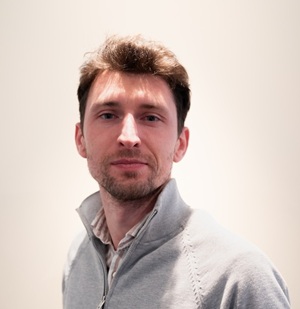
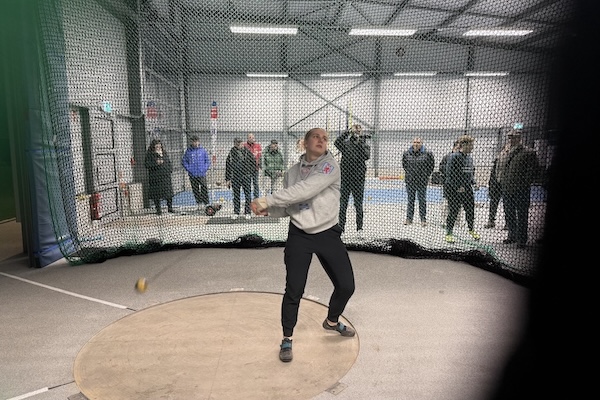
 Sofia Snäll, holder of Luxembourg’s national record in hammer throw;
Credit: Ievgenii Karanov, Chronicle.lu
Sofia Snäll, holder of Luxembourg’s national record in hammer throw;
Credit: Ievgenii Karanov, Chronicle.lu
When a new indoor throwing hall opened at the Boy Konen sports complex in Luxembourg-Cessange in late November 2025, it quietly illustrated a broader shift: Luxembourg is increasingly investing in the infrastructure and support needed to help its athletes compete beyond its borders.
During the inauguration, I also spoke with seventeen-year-old Sofia Snäll, who holds Luxembourg’s national record in the hammer throw. She explained that winter training previously often meant darkness, cold weather and occasionally cancelled sessions, while the new indoor facility now allows athletes to train continually throughout the year. Sofia, who has recently secured an opportunity to continue her sporting and academic development in the United States, also noted that improved facilities in Luxembourg could help attract more young athletes to the discipline. Greater participation, in turn, creates the internal competition that often drives athletic progress.
Interestingly, some planned infrastructure projects have not ultimately come to fruition, for various reasons. One example is the velodrome announced for Cessange in 2008. While that project did not ultimately see the light of day, another velodrome is currently under construction in Mondorf, the hometown of cycling brothers Andy and Frank Schleck.
Building the Structures Behind the Athletes
This broader shift is also reflected in national policy. In February 2024, Luxembourg’s Minister of Sports Georges Mischo presented the main lines of the country’s sports strategy, structured around five key pillars: societal impact, strengthening the sports movement, sport for all, elite and high-level sport and the development of sports infrastructure. Beyond encouraging participation, the strategy also recognises that sporting success at international level depends on building stronger structures around athletes.
Financial support is also increasing. According to Luxembourg’s Ministry of Sport, current expenditure is set to rise from around €41 million in the 2023 budget to about €66 million planned for 2025, representing an increase of roughly 60% in two years. This funding includes targeted support for national federations, local clubs and development programmes. According to the 2026 state budget, €8.8 million is allocated to national sports federations, while clubs receive around €5 million through basic and quality subsidies. Municipal initiatives are also receiving support, with €2.1 million dedicated to sports coordinators working at the local level. These investments aim to strengthen coaching structures, improve athlete preparation and expand the organisational capacity of Luxembourg's sporting landscape.
This approach also places greater emphasis on professionalising Luxembourg’s sporting ecosystem. Talented athletes rarely reach the highest level alone; they depend on coaches, managers, medical staff and well-organised federations capable of supporting their development. Increased support allows federations and clubs to gradually move beyond purely volunteer-based structures and build more sustainable professional organisations.
Some of these changes are already visible. In June 2025, the Luxembourg Tennis Federation announced the appointment of Lionel Ollinger as its first-ever General Director, a milestone for an organisation that had previously relied largely on volunteer work. With support from the Ministry of Sports, the federation was able to create a full-time leadership role aimed at strengthening its professional management and long-term development.
Infrastructure, Support and International Ambitions
Infrastructure development is also visible in larger projects. In December 2025, the City of Luxembourg (VdL) approved the final plans for a major new sports complex in Luxembourg-Hamm, covering around twelve hectares. The project will include a World Athletics Category 1 stadium, several sports halls and training facilities, as well as public recreational areas. With an estimated cost of more than €110 million and completion expected in 2029, the complex is designed to host both national and international competitions while also serving as a daily training environment for athletes.
Luxembourg’s Olympic structures are also gradually strengthening. Through the Luxembourg Olympic and Sporting Committee (COSL), elite athletes receive support programmes designed to help them prepare for major international competitions such as the Olympic Games, European Championships and World Championships. These programmes combine financial assistance with access to coaching, training camps and medical support, helping athletes balance high-performance sport with studies or professional careers.
For a country the size of Luxembourg, such investments are particularly significant. With a population of just over 670,000, the country cannot rely on large numbers of athletes to compete internationally. Instead, success often depends on creating the right environment where talent can develop through high-quality coaching, modern facilities and structured support systems.
Another important aspect of this development is the growing cooperation between national institutions, federations and local clubs. In recent years, Luxembourg’s sporting system has increasingly focused on creating clearer pathways for athletes, from grassroots participation to elite performance. For young athletes, this means that talent identification, coaching and competitive opportunities are gradually becoming more structured than in the past.
Luxembourg’s sporting ambitions are not limited to able-bodied athletes. Through organisations such as the Luxembourg Paralympic Committee and Special Olympics Luxembourg, the country also supports athletes with disabilities in competing at international level. These programmes reflect a broader commitment to ensuring that sport remains accessible while still offering pathways to elite competition.
At the same time, sport in Luxembourg is deeply rooted in everyday life. Across the country, residents have access to a large number of football pitches, tennis courts, swimming pools and multi-sport facilities, many of which are maintained by local municipalities. While these facilities primarily serve recreational purposes, their availability also encourages some young people to take the first steps toward competitive sport.
Luxembourg’s welcoming international community has also contributed to the development of a diverse sporting landscape. Over the decades, expatriate communities have helped establish and grow sports such as squash, cricket, rugby and field hockey. Top Squash opened in Sandweiler in 1989, the Optimists Cricket Club was founded in 1976 and plays in Walferdange, Rugby Club Luxembourg was founded in 1973 and is based in Cessange, while Hockey Club Luxembourg, also based in Cessange, was founded in 1976. Other international sports have also found a place in the Grand Duchy, including polo: the Polo Club Luxembourg was founded in 2004 and operates from the Ecurie de la Pétrusse facilities in Luxembourg-Merl.
Luxembourg already has athletes capable of performing on the international stage. In 2025, sprinter Patrizia van der Weken made history by winning the country’s first-ever medals at both the European and World Indoor Athletics Championships. The same year also brought another milestone when Ruben Querinjean became the first athlete from the Grand Duchy to win a Diamond League race, claiming victory in the 3,000 metres in Brussels. In endurance sport, triathlete Jeanne Lehair added to the momentum by securing her first World Cup victory in November 2025.
Such achievements not only place Luxembourg on the international sporting map, but also provide powerful role models for young athletes beginning their own journey.
For young athletes training in Luxembourg today, seeing compatriots succeed at the highest level makes international competition feel less distant and more achievable.
The indoor throwing hall in Cessange may appear small in the context of global sport. Yet projects like this, combined with stronger structures and support systems, show that Luxembourg is beginning to build the foundations necessary for long-term sporting success. The real challenge now will be maintaining that momentum, ensuring that these efforts continue beyond individual projects or political cycles.