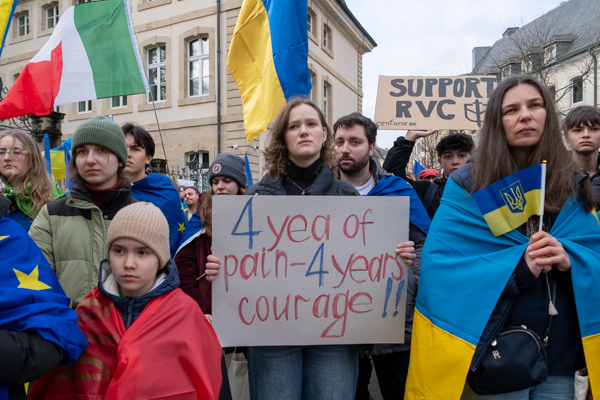
 Credit: Ali Sahib, Chronicle.lu
As Ukraine and the world mark four years since Russia’s full-scale invasion of the Easter European and former Soviet state, the debate has shifted from immediate survival to how the war can conclude in a way that safeguards Ukrainian sovereignty and Europe’s security.
It is possible to state with confidence that 2025 and the opening months of this year have been among the most difficult for Ukraine since the full-scale invasion began. According to Ukrainian energy authorities and international monitoring organisations, Russia intensified its campaign against power generation and transmission facilities to an extent not seen in previous years of the war. Repeated waves of missile and drone strikes targeted thermal power plants, substations and district heating infrastructure, prompting emergency shutdowns and nationwide electricity rationing. The United Nations and humanitarian agencies warned that sustained attacks on civilian energy systems were deepening humanitarian risks, particularly during the winter months.
The consequences were felt far beyond military calculations. In practical terms, this meant days without electricity, water supply interruptions and heating failures for millions of households. I can attest to this personally: friends and relatives in different regions of Ukraine described spending several consecutive days without running water, power or heating in their homes. The situation was compounded by one of the coldest winters since the start of the full-scale invasion, with indoor temperatures in some residential buildings dropping to between five and ten degrees Celsius. What may appear as infrastructure damage in official reports translated, in reality, into prolonged exposure to cold, darkness and uncertainty for ordinary civilians.
Diplomatic Pressure & Parallel Channels
Diplomatic activity has intensified in recent months, even as the fighting continues. The United States has signalled increased interest in exploring a possible pathway towards negotiations, with the then former President Donald Trump publicly stating (in 2024) that ending the war swiftly would be a priority should he return to office, arguing that a negotiated settlement remained achievable. While no detailed proposal has been formally presented as a possible solution that could be agreeable to all sides, Washington’s rhetoric reflects a growing focus on conflict containment and political resolution.
President Volodymyr Zelensky has reiterated that any negotiation must be based on Ukraine’s sovereignty and internationally recognised borders. In recent statements, he has stressed that peace cannot come at the cost of territorial concessions imposed under military pressure and that robust security guarantees would be essential. Kyiv continues to refer to its multi-point peace framework, at times described as an expanded 28-point format, covering territorial integrity, nuclear and energy security, prisoner exchanges and accountability.
The Russian leadership has maintained that negotiations must acknowledge what it describes as new territorial realities, while continuing to link progress to a reduction in Western military assistance to Ukraine. Official Kremlin statements emphasise security considerations and Ukraine’s future status as central issues in any potential talks.
The issue of Ukraine's neutrality and possible membership of NATO, as well as membership of the EU, have taken a relevant back seat while the issue of territorial borders appears to be the most major stumbling block.
Parallel diplomatic contacts have also drawn attention. Individuals associated with Trump, including envoy Steve Witkoff, have reportedly travelled to meet President Vladimir Putin. These contacts have not produced (yet) visible breakthroughs, but they illustrate the existence of informal channels operating alongside official state diplomacy. Recent discussions reportedly taking place in Abu Dhabi further underscore that while the battlefield remains active, conversations about a possible framework for ending the war are ongoing in multiple arenas.
What remains unresolved are the core questions of territorial control, sequencing of sanctions, reconstruction funding and long-term security guarantees. For now, diplomacy and warfare continue in parallel rather than in sequence.
Europe’s Strategic Commitment
Over the past year, Europe’s relationship with Ukraine has moved further from emergency solidarity towards structural integration. The European Union has continued macro-financial assistance, expanded sanctions packages and advanced accession negotiations, while increasing coordination on defence procurement and training. What began in 2022 as crisis management has increasingly taken the shape of long-term policy.
However, due to its very nature and political divisions throughout, the EU has appeared the lack the cutting edge in brokering deals, and has been shaken into action by US action, most notably in relation to defence spending.
French President Emmanuel Macron has argued that Europe must be prepared to assume greater responsibility for its own security, stating that European stability is directly linked to Ukraine’s ability to defend itself. In recent addresses, he reiterated that support for Kyiv should not weaken as diplomatic discussions intensify. “Europe must not be a spectator,” French President Emmanuel Macron said, underlining that security guarantees for Ukraine are inseparable from Europe’s own defence architecture.
German Chancellor Friedrich Merz has emphasised that deterrence remains central to European credibility. Speaking after consultations with Ukrainian President Volodymyr Zelensky, Chancellor Merz noted that “peace cannot mean the legitimisation of territorial aggression”, signalling Berlin’s continued backing for military assistance while also supporting diplomatic channels.
In the United Kingdom, Prime Minister Keir Starmer has reaffirmed that British support will continue “for as long as it takes”, pairing that position with closer coordination with European partners. Now outside the EU, Britain has a separate voice to that of the EU.
NATO Secretary General Mark Rutte has likewise stated that allied support remains essential to ensure that “Ukraine negotiates from a position of strength”, highlighting that diplomacy and deterrence must operate together.
President Zelensky has consistently framed Ukraine’s defence as part of a broader European security framework. Following talks in Brussels, President Zelensky stressed that “Ukraine’s future is in Europe”, linking wartime resilience with long-term political alignment.
Luxembourg’s Consistent Support
Over the past year, Luxembourg continued to position itself as a steady contributor within the broader European response. The government confirmed additional military and humanitarian allocations, bringing its annual support in 2025 to one of the highest levels since the beginning of the full-scale invasion. This included further financial contributions to European defence mechanisms, energy resilience initiatives and reconstruction efforts.
Deputy Prime Minister and Minister for Foreign and European Affairs Xavier Bettel reiterated during EU discussions that Luxembourg’s support for Ukraine remains anchored in the defence of sovereignty and international law. He emphasised that assistance must remain coordinated at European level and legally sound, underlining that solidarity should be sustained rather than episodic. On the other hand, he also recently downplayed Ukraine being fast-tracked as a fully-fledged EU Member State, explaining that due process still needed to be followed.
Minister of Defence Yuriko Backes likewise highlighted the importance of long-term planning and collective procurement mechanisms within the European Union, noting that predictability of support is essential if Ukraine is to maintain both military resilience and strategic confidence.
Luxembourg has also maintained humanitarian commitments, including contributions to energy support mechanisms designed to stabilise Ukraine’s electricity infrastructure following continued attacks. Alongside financial assistance, the country has continued to host displaced Ukrainians under temporary protection arrangements and support integration programmes.
While Luxembourg alone cannot shape the outcome of the war, its consistent engagement reflects a broader European understanding that small states contribute to collective security not through scale, but through continuity and reliability, underlining the principle of the rule of (international) law.
Four years on, predicting the precise trajectory of the conflict remains difficult. Negotiations are discussed, military dynamics continue to evolve and global political shifts add further uncertainty. Yet what has become evident is that Ukraine’s chances of securing a sustainable outcome increase when support from partners remains coordinated and durable. In that sense, the war’s future will depend not only on developments at the front, but also on whether political resolve across Europe endures.