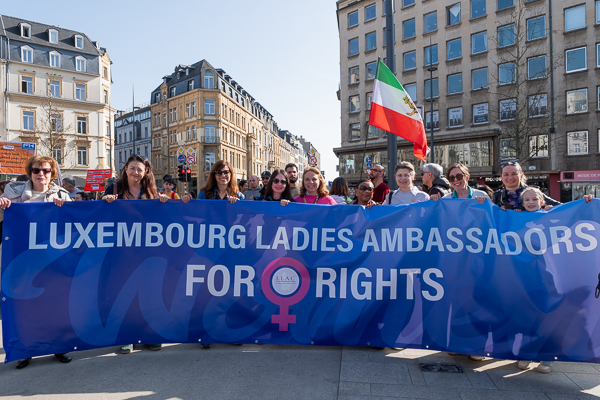
 Feminist March in Luxembourg City on 8 March 2026;
Credit: Ali Sahib, Chronicle.lu
Feminist March in Luxembourg City on 8 March 2026;
Credit: Ali Sahib, Chronicle.lu
Luxembourg recently became one of the few countries in the world to enshrine the right to abortion in its constitution.
A majority of lawmakers voted in favour of this constitutional amendment just days before Luxembourg and many other countries celebrated International Women's Day (IWD) on 8 March.
The timing raises an important question: in a country that often prides itself on equality and social progress, do we still need feminism and actions such as IWD? The short answer is "yes".
Abortion Rights & Access
In 2024, France became the first country to enshrine women's "guaranteed freedom" to abort in its constitution. The move was prompted in part by developments in the United States (US), where the Supreme Court overturned the Roe v. Wade decision and removed the constitutional right to abortion in 2022. The decision sparked concerns about a rollback of women's rights - even in a supposedly developed democratic country.
Even within Europe, abortion access is far from equal. The "My Voice, My Choice" movement recently highlighted that more than 20 million women across the continent lack safe and accessible abortion services. The movement has been campaigning to change this.
Poland currently has one of Europe's most restrictive abortion laws, allowing abortion only in cases where the pregnant woman's life or health is at risk or when the pregnancy results from rape or incest. Similarly, Malta's legislation permits abortion only in very limited circumstances. In my own home country, Northern Ireland, abortion was highly restricted until late 2019, meaning many women were forced to travel to mainland Britain to access care. Since then, the rollout of abortion services has been slow and uneven, although recent figures suggest gradual progress.
Cost can also be a barrier, whether women have to travel abroad or pay for procedures out of pocket. In Luxembourg, the National Health Fund (CNS) covers the cost of abortion, but this is not the case in every European country.
What certain lawmakers and political leaders - often men - appear to overlook is that making abortion illegal does not put an end to abortion; it simply makes it less safe. According to the World Health Organization (WHO), around 73 million induced abortions occur globally each year and 45% of abortions are considered unsafe. In Europe alone, the WHO estimates that around 483,000 unsafe abortions take place annually. The organisation has warned that lack of access to safe abortion care "risks violating a range of human rights of women and girls" and can lead to preventable health complications and maternal deaths.
While abortion has been legal in Luxembourg since 1978 and was liberalised further in subsequent decades, proponents of the recent constitutional amendment argued that the change was necessary to safeguard reproductive rights against potential legislative regression in the future. The amended article of the constitution (translated into English) states: "The freedom to have access to voluntary termination of pregnancy is guaranteed. The law determines the conditions under which this freedom is exercised."
Of course, women's rights and feminism are not solely about abortion. They encompass a wide range of issues, from political representation and economic equality to protection from violence and access to healthcare.
International Women's Day
This year's Feminist March in Luxembourg City on IWD highlighted the continued need to defend and advance women's rights, particularly in the field of healthcare, where "medical blind spots" persist. Speakers welcomed the constitutional protection of abortion rights but called for stronger reproductive healthcare access and better recognition of women's health issues. Participants carried banners reading messages such as "My Body, My Choice", "Equality Starts with Health" and "Keep your politics out of my uterus". Others pointed to issues including medical gaslighting, the slow diagnosis of conditions such as endometriosis, the need for greater research into women and gender minorities' health and the recognition of unpaid - or underpaid - labour.
International Women's Day, observed annually on 8 March since 1911, is both a celebration of the achievements of women and a call to action for advancing gender equality. In Luxembourg, the Journée Internationale des Femmes (JIF) platform was created in 2011 on the occasion of the IWD's 100th anniversary. Bringing together about 20 NGOs, political parties and unions, the platform organises activities around IWD, including the "Marche Féministe" or Feminist March.
The IWD 2026 global theme was "Rights. Justice. Action. For ALL Women and Girls", calling for urgent and decisive action to end impunity, defend the rule of law and deliver equality for all women and girls.
Women's Rights in Luxembourg
Luxembourg has made significant progress in the area of gender equality over the past century. Women gained the right to vote in 1919, making the Grand Duchy one of the first European countries to adopt women's suffrage. Globally, New Zealand was the first self-governing country to grant women the right to vote, in 1893. In Europe, Finland was the first to do so, in 1906, while Liechtenstein was the last, in 1984.
In October 1919, Marguerite Thomas-Clement became the Grand Duchy's first female deputy (MP). In 1967, Madeleine Frieden-Kinnen became the first woman to serve as a government minister in Luxembourg.
In 2006, gender equality between women and men was enshrined in the Luxembourg Constitution. The recent amendment protecting access to abortion builds on this progress.
Today, women hold 21 out of 60 seats (35%) in Luxembourg's Chamber of Deputies (parliament) and five of fifteen ministerial positions (33.3%) in government. The country has also introduced policies aimed at promoting equality, including national action plans addressing both gender equality and gender-based violence.
In 2025, Luxembourg's Ministry of Gender Equality and Diversity (MEGA) - originally called the Ministry for the Promotion of Women - celebrated its 30th anniversary. Recent initiatives include giving a legal basis to the Gender Equality Observatory in 2024 and the opening of the country's first National Centre for Victims of Violence (CNVV) in 2025. (For more on domestic violence in Luxembourg, see my previous opinion piece: Showing Domestic Abuse the Red Card)
Last year, the government also approved a bill to further strengthen women's rights, including removing the mandatory reflection period for abortion, prohibiting virginity testing and certificates and banning hymenoplasty.
Luxembourg ranked 9th in the EU's Gender Equality Index (GEI) 2025. Between 2020 and 2025, the country made progress in most areas, with the exception of health, which recorded a slight decline. Regarding the gender pay gap, the Grand Duchy performs comparatively well in EU surveys, although women still earn less annually than men.
While Luxembourg's gender equality achievements are significant, they do not mean that equality has been fully achieved. Even here, there is still room for improvement.
Beyond Luxembourg: Does the World Still Need Feminism?
Globally, progress remains uneven and, in some cases, fragile. According to UN Women's Director of the Policy, Programme and Intergovernmental Support Division (PPID), Sarah Hendriks, women's rights are regressing worldwide. "As the world navigates democratic backsliding, rising conflicts, economic pressures and shrinking of civic space, there is an increasingly organised pushback at gender equality and regression of women's rights," she said in March 2026, adding that: "Justice systems do not stand apart from those pressures, they actually reflect them."
A recent United Nations report found that women around the world hold only 64% of the legal rights granted to men. In more than half of countries, rape is still not defined on the basis of consent and, in nearly three out of four countries, girls can be legally forced to marry. In 44% of countries, the law does not mandate equal pay for equal work. "A justice system that fails half the population cannot claim to uphold justice at all," said UN Women Executive Director Sima Bahous.
Legal protections have improved in some areas, for example the UN report found that 87% of countries have enacted domestic violence legislation and more than 40 countries have strengthened constitutional protections for women and girls over the past decade. Yet laws alone are not enough. Discriminatory social norms (stigma, victim-blaming, etc.) and a lack of trust in institutions continue to prevent many women and girls from seeking justice.
High-profile cases in recent years have highlighted the persistence of gender-based violence and the importance of survivors being able to speak out and be believed. The mass rape trial involving Gisèle Pelicot in France, for example, shocked public opinion across Europe and reignited discussions about consent and accountability. Gisèle has emerged as a feminist icon for her bravery in waiving her right to anonymity and publicly telling her story. Meanwhile, the ongoing Jeffrey Epstein scandal, which involved the sex trafficking of minors, has shown how systemic failures and power imbalances can allow abuse to go unpunished for years.
These cases, alongside movements such as #MeToo - which gained traction after the 2017 Harvey Weinstein sexual abuse allegations - illustrate the urgent need for social and legal systems that take survivors seriously, ensure accountability and challenge the culture of impunity.
Why Feminism Still Matters
Feminism, as defined by UN Women, is simply "the belief that everyone, regardless of gender, should have equal rights and opportunities". In that sense, feminism is not a radical ideology, as some portray it, but a fundamental principle of equality. It is also a movement that has evolved over time, adapting to new challenges and realities on the path towards gender equality.
Despite decades of progress, no country in the world has yet achieved full gender equality. Some estimates suggest it could take at least another 123 years before women and men reach equality across all areas of life.
Recent research carried out by Ipsos UK and the Global Institute for Women's Leadership at King's College London highlighted a growing generational divide in attitudes towards gender equality. The study found that women and men in Generation Z ("Gen Z" - people born in the late 1990s and early 2000s) hold starkly opposing views. While 53% of Gen Z women surveyed identified as feminists, only 32% of Gen Z men did. The survey also revealed more troubling attitudes: 28% of Gen Z men agreed that a man who stays home to care for his children is "less of a man", and 60% felt that men are expected to do "too much" to support gender equality.
These findings suggest that progress cannot be taken for granted. Education and open dialogue remain essential to challenge persistent stereotypes and harmful ideas about gender roles, including forms of toxic masculinity.
So yes, the world - including Luxembourg - still needs feminism and actions such as IWD. As UN Women reminds us, "Anyone can be a feminist" - and I would argue everyone should be a feminist, in the sense that we should all be striving towards a more equal world.
International Women's Day remains an opportunity not only to celebrate achievements but also to recognise the need to protect, defend and expand the rights for which those before us fought so bravely. And these efforts should continue beyond 8 March.
I am truly grateful to live in a country as progressive as Luxembourg and I welcome the recent decision to enshrine abortion rights in the constitution. Yet even here, there is still work to be done.