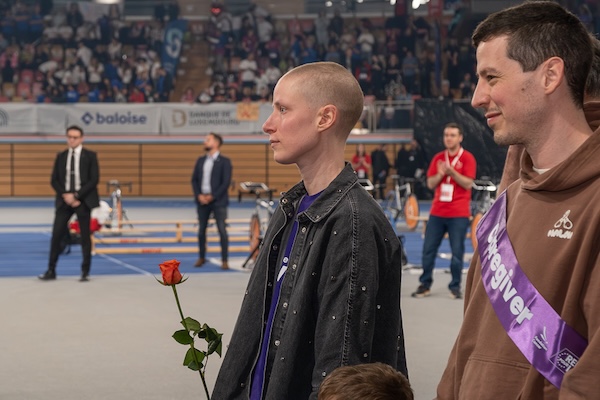
 Relais pour la Vie 2026;
Credit: Ali Sahib, Chronicle.lu
Relais pour la Vie 2026;
Credit: Ali Sahib, Chronicle.lu
"It's always far away until it's close to you," said Andy Schleck, recalling his mother, who passed away from cancer two years ago.
The former professional cyclist said this as he was introduced as ambassador of the "2Wheels4Purpose" initiative, a project aiming to raise €1 million for breast cancer research. The campaign is led by three founders who have each lost loved ones to the disease and are planning to cycle 7,000 kilometres across Europe to raise awareness and funds.
That moment made me reflect on my own family's experience. My grandmother died of breast cancer when I was four years old. It was 1995, nine years after the Chernobyl disaster. She was a school teacher in Kyiv. In April 1986, the scale of the catastrophe was largely concealed by the authorities, and the long-term impact on the health of those exposed across Ukraine and beyond is still difficult to fully assess.
She fought the illness for several years. After her first operation, she returned to work and continued teaching for another year. After the second, she no longer had the strength. At the time, medicine and early diagnosis were far less advanced than they are today. We now have more opportunities for early detection and treatment.
A Global Challenge, Not a Distant One
Cancer is not just a women's health issue. According to the World Health Organization (WHO), it remains one of the leading causes of death worldwide, responsible for nearly one in six deaths. In 2020 alone, cancer accounted for almost 10 million deaths globally, highlighting the scale of the challenge faced by health systems and societies alike. While breast cancer became the most commonly diagnosed cancer that year, lung cancer remained the leading cause of cancer-related death worldwide, accounting for around 1.8 million deaths.
These figures are not just statistics. Lung cancer alone represents nearly one in five cancer deaths globally and remains the most common cause of cancer death among men. The WHO emphasises that many cancers can be successfully treated if detected early. Screening programmes, regular medical check-ups and greater awareness of symptoms all play a crucial role in improving survival rates and reducing the burden of the disease.
Yet despite all this, cancer is still often something we believe happens to others. It remains distant, abstract, something to think about "later". Many people delay or avoid medical check-ups, whether out of fear, denial or simply because life feels too busy.
Recent examples show how critical early detection can be. In December 2025, speaking publicly about his diagnosis as part of a national cancer awareness campaign in the United Kingdom, King Charles said that early diagnosis, effective treatment and adherence to medical advice had allowed his cancer care to be reduced.
Just months later, in April 2026, he addressed the United States Congress during a state visit, continuing to carry out public duties despite his diagnosis, a reminder that with timely treatment, it is possible to maintain an active life.
In Luxembourg, this message is increasingly reflected in public health policy. According to the Ministry of Health and Social Security, around 50% of cancer cases diagnosed between 2014 and 2021 were linked to cancers that can be detected through screening, including breast and colorectal cancer. National screening programmes, now covering people aged 45 to 74, offer free examinations and are designed to identify the disease at an early stage.
And yet, participation remains far from universal. In 2025, tens of thousands of people were invited to take part in screening programmes, but a significant proportion did not respond. This gap between availability and action is where awareness still needs to translate into behaviour.
From Awareness to Action
If there is one clear takeaway from these figures, it is that access alone is not enough, action matters. The WHO emphasises that early detection remains one of the most effective ways to reduce cancer mortality. In practical terms, this starts with simple but often overlooked steps: attending regular check-ups, responding to screening invitations and speaking to a doctor when something does not feel right.
This applies across age groups. For adults, especially from their mid-forties onwards, participation in organised screening programmes can make a significant difference. But awareness should begin earlier. Understanding family history, recognising changes in the body and not postponing medical advice are all part of a more proactive approach to health.
In many cases, the barrier is not availability, but hesitation. Fear of diagnosis, lack of time or the belief that "it can wait" often delays action. Yet cancers detected at an early stage are far more treatable, and in some cases preventable, if identified in time. The WHO also highlights that many cancers are linked to modifiable risk factors, including tobacco use, alcohol consumption, unhealthy diets and physical inactivity, factors that can be addressed through everyday choices.
Support Beyond Diagnosis
Beyond diagnosis, for many people, the experience of cancer continues long after treatment. Survivors often speak of the long and complex journey back to everyday life, one that requires not only medical care, but also support, understanding and community.
In Luxembourg, this collective dimension is reflected in initiatives such as Relais pour la Vie, organised by Fondation Cancer. Held annually, the event brings together more than 15,000 participants, who take turns walking or running over 24 hours in a powerful show of solidarity with patients and their families.
The 2026 edition once again demonstrated the scale of this mobilisation, raising €1,254,463 across 548 teams. Beyond the numbers, however, the event remains defined by the presence of survivors, their stories, and the message that facing cancer is not something anyone should have to do alone.
It is also part of a broader network of organisations and initiatives in Luxembourg working to support patients, raise awareness and promote prevention. These include Europa Donna Luxembourg, which focuses on breast cancer awareness and advocacy, Fondatioun Kriibskrank Kanner, which supports children with cancer and their families, and Think Pink Lux Asbl, which provides support to women and families facing breast, gynaecological and other cancers.
Events such as the LËTZ GO GOLD charity race, which raised more than €700,000 for childhood cancer research in 2025, further demonstrate how community engagement can translate into tangible support. Awareness campaigns, including Pink October and World Cancer Day, also play a key role in encouraging people to seek information, take part in screening programmes and speak more openly about the disease.
In the end, cancer is not just a statistic, a diagnosis or a distant possibility. It is something that touches families, communities and lives in deeply personal ways. The stories shared by survivors, the efforts of organisations and the growing availability of screening all point in the same direction: we have more knowledge, more tools and more support than ever before.
And yet, the most important step remains a personal one.
"It's always far away until it's close to you," Andy Schleck said. The question is whether it really has to be.