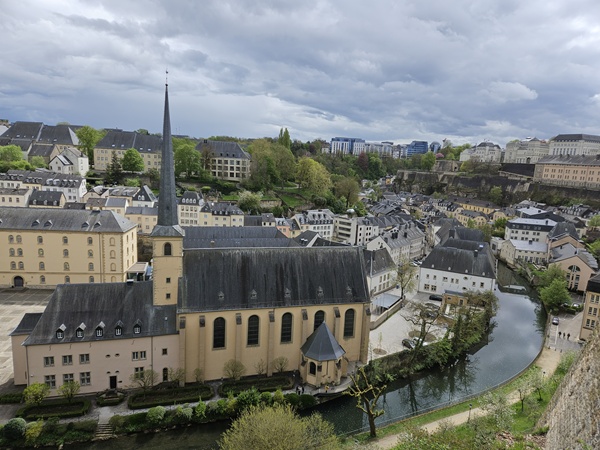
 Luxembourg City;
Credit: Jazmin Campbell
Luxembourg City;
Credit: Jazmin Campbell
About ten years ago, in spring 2016, I began preparing my application for a Master's degree at the University of Luxembourg. I was getting ready to graduate from Queen's University Belfast with a Bachelor in French and Spanish and knew I wanted to continue my studies abroad.
Luxembourg was not an obvious choice. I had never been there and, honestly, it was not on my radar - until a conversation with a lecturer (who later taught me) at an EU Studies Fair in Brussels in February 2016. I applied to two programmes, was accepted onto both and ultimately opted for a bilingual (English and French) Master in European Contemporary History. The rest is, well, history.
Like many people who, for a variety of reasons, move to Luxembourg, I assumed my stay would be temporary; that after my two-year degree, I would most likely move on, perhaps to work for the EU institutions in Brussels. Somewhere along the way, a couple of years studying abroad turned into a decade.
When I first arrived in late summer 2016, Luxembourg felt small - a mixture of a village, a picturesque, fairytale-like capital and a futuristic, almost post-apocalyptic construction site, where it was difficult to meet locals or hear Luxembourgish. I was pleasantly surprised by how close nature always felt, with forests, parks and walking trails never too far from one's door, and I enjoyed how international the country was - sentiments that remain true today.
Despite not having a long-term plan, I quickly found a student job (after realising how expensive Luxembourg was), met my partner and (hopefully) lifelong friends, learned Luxembourgish and gradually built a life here. By the time I graduated in 2019, I felt quite integrated, and it was becoming clear that Luxembourg was no longer a temporary stop.
In many ways, the years that followed were formative. I began working full-time as a journalist, later (temporarily) stepping into a leadership role I would not have imagined for myself when I first arrived. I have had the opportunity to meet and interview fascinating people, including high-profile figures to whom the media would have very limited access elsewhere. I learned to drive here, adopted a cat and a dog, bought a house with my partner and, perhaps most significantly, became a Luxembourger.
Of course, there have also been more difficult moments, such as living through the COVID-19 pandemic away from family, going months without seeing them in person - although I am grateful for technology and that, in "normal" times, they are just a short flight away. Like many people who live abroad, I have also missed certain milestones back "home". These days, I often (somewhat confusingly) say I am "going home" both when travelling to Northern Ireland and when returning to Luxembourg. As cliché as it might sound, I really do feel that part of my heart belongs to both places - and yet, I am not entirely at home in either. Perhaps this feeling will resonate with some of Luxembourg's many other foreign residents.
Over the past decade, I have evolved both personally and professionally, and Luxembourg has transformed as well. The country has become even more international, with English now heard more widely in everyday life, particularly in the capital and in professional settings, as well as in an increasing number of public international schools. Areas such as Belval, where I studied, have continued to develop, and infrastructure has expanded - from new shopping centres such as Cloche d'Or (and, more recently, GridX) to the introduction of free public transport in 2020 and the ongoing expansion of the tram network.
At the same time, daily life feels more fast-paced than it once did. The population has grown, the workforce has become even more transnational and tourism has increased. While this brings diversity and opportunity, it can also create a sense of transience; it may be easier to "get by" without fully integrating, but perhaps harder to build deep, lasting connections.
The cost of living has also risen noticeably. The housing crisis, in particular, has intensified, and eating out has become more costly. Of course, this should be viewed in the context of broader global challenges over the past decade - from the pandemic to geopolitical tensions and energy crises. Regardless, even small everyday expenses add up more quickly than they used to, even if I am arguably better off financially today than as a student.
On the other hand, Luxembourg also offers more than it did ten years ago. While I never found the country boring, there is a wider range of cultural, social and recreational activities (art workshops, yoga/pilates classes, etc.), as well as a growing food scene - even if vegan options remain somewhat limited. In many ways, both Luxembourg and I have "grown up" together.
Looking back, it is striking how quickly time has passed. Ten years have gone by in what feels like the blink of an eye, leaving behind a collection of moments and milestones. I arrived in Luxembourg as a student with no clear long-term plan. Ten years on, I have stayed because of the opportunities, the people I met along the way and the life I have been able to build here. The Grand Duchy is not perfect - no country is - but it has given me far more than I could have anticipated when I first applied, somewhat on a whim, to that Master's programme back in 2016.
Reaching the ten-year mark feels like a natural moment to pause and reflect - not just on the big milestones, but on the smaller ones too - and to realise just how far both Luxembourg and I have come.
Luxembourg may not have been part of my original plan, but it has, in many ways, become home. And I look forward to seeing what the next decade brings.