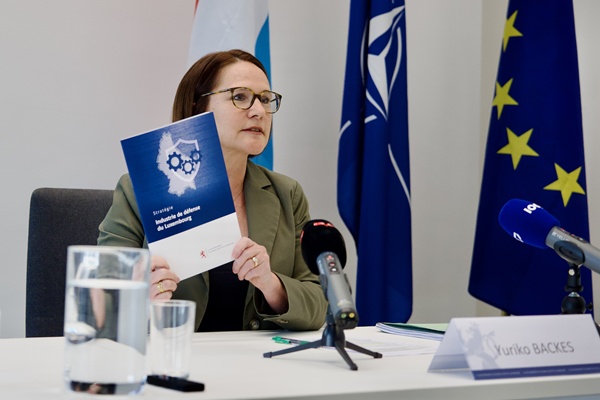
 Yuriko Backes, Luxembourg's Minister of Defence;
Credit: MAE
Yuriko Backes, Luxembourg's Minister of Defence;
Credit: MAE
On Thursday 26 March 2026, Luxembourg's Minister of the Economy, SMEs, Energy and Tourism, Lex Delles, and the Minister of Defence, Yuriko Backes, presented Luxembourg's first Defence Industry Strategy at a press conference.
This strategy, developed jointly by the Ministry of the Economy and the Directorate of Defence, with the support of the Ministry of Higher Education and Research and the Directorate for Foreign Trade, defines a vision, sectoral priorities and guidelines to support the development of defence-related industrial and technological activities.
The authorities noted that, faced with a "severely degraded" security environment, NATO and EU countries must intensify their efforts to guarantee Euro-Atlantic security. They added that the need to revitalise deterrence and collective defence capabilities goes hand in hand with the political commitment made at the NATO summit in The Hague to increase investments in defence and security in the broadest sense. In this context, Luxembourg aims to ensure that defence spending benefits its national economy as much as possible. This is the objective of Luxembourg's new Defence Industry Strategy, which reportedly reflects the government's commitment to facilitating the development of a national defence industry while ensuring an economic and societal return on defence expenditures, which are expected to increase in the coming years.
The strategy provides a framework for identifying priority technological areas, sectors of expertise and industrial capabilities to be strengthened in the land, air, space and cyber domains. It defines guidelines to strengthen the involvement of Luxembourg's defence technological and industrial base and to position national industries and research institutes so that they can contribute to the security of Luxembourg, Europe and NATO. Among the strategic areas identified are advanced materials and innovative manufacturing, autonomous systems, robotics and artificial intelligence (AI), cybersecurity, space technologies applied to defence, logistics and military mobility, circularity and strategic materials recycling, as well as data, AI and quantum technologies. The strategy also aims to encourage the establishment of new businesses.
Aware of the country's limited size, the government said it is relying on innovation as the main driver of industrial development. By building on existing strengths and addressing identified gaps, the government plans to establish an "innovation pipeline" for the defence sector. The strategy thus provides: targeted support for startups and scale-ups and their integration into European value chains; the inclusion of the defence sector in national talent attraction initiatives; the systematic analysis of intellectual property resulting from public research to identify transferable technologies; and the role of "first customer" that the Ministry of Defence could assume, where possible, to facilitate companies' entry into this complex market and help them become major players and trusted partners for Luxembourg, European and transatlantic defence.
To finance innovation, a "Defence Innovation Fund" will be established and, in parallel, a "Defence Campus" will be created to host companies and public research institutions. Project management and company support will be jointly provided by the Ministry of the Economy and the Directorate of Defence.
A new legislative framework will govern the production of defence-related goods, guaranteeing legal certainty, clear obligations for companies and appropriate controls, according to the authorities. The implementation of the strategy will be overseen by an interministerial committee, ensuring consistency, accountability and compliance with international commitments.
While the authorities stressed that cooperation between countries and the complementarity of EU and NATO efforts are crucial, they added that Luxembourg must be able to protect its essential security interests. Luxembourg must therefore possess the necessary knowledge and capabilities to safeguard its own security and continue to contribute credibly to the collective effort. A solid foundation of research institutes and businesses is expected to ensure that Luxembourg has the know-how, technologies and capabilities to defend itself. The necessary defence capabilities are essential for this, stressed the authorities. Therefore, the key security interests identified within the framework of this Defence Industry Strategy are as follows:
- maintaining strategic decision-making autonomy;
- securing the supply of raw materials and sensitive technologies;
- promoting local research and innovation;
- ensuring the resilience of critical supply chains and value chains;
- strengthening the Luxembourg defence technological and industrial base;
- contributing to European and Allied collective security.
"With this first national strategy, Luxembourg is taking a crucial step: we are laying the foundations for the development of an innovative and resilient defence industry, capable of strengthening our strategic autonomy while creating new economic opportunities for our businesses and research institutions. By focusing on innovation, integrating our stakeholders into European and Allied value chains, and developing essential skills, we are making Luxembourg a credible partner, capable of providing concrete solutions for Luxembourgish, European and Allied defence," stated Minister Delles.
"To defend our essential security interests, we must rely on a solid Luxembourgish defence technological and industrial base," added Minister Backes. "This is why Luxembourg must raise its ambitions and further integrate its national stakeholders into the supply and value chains of our partners within the EU and NATO."