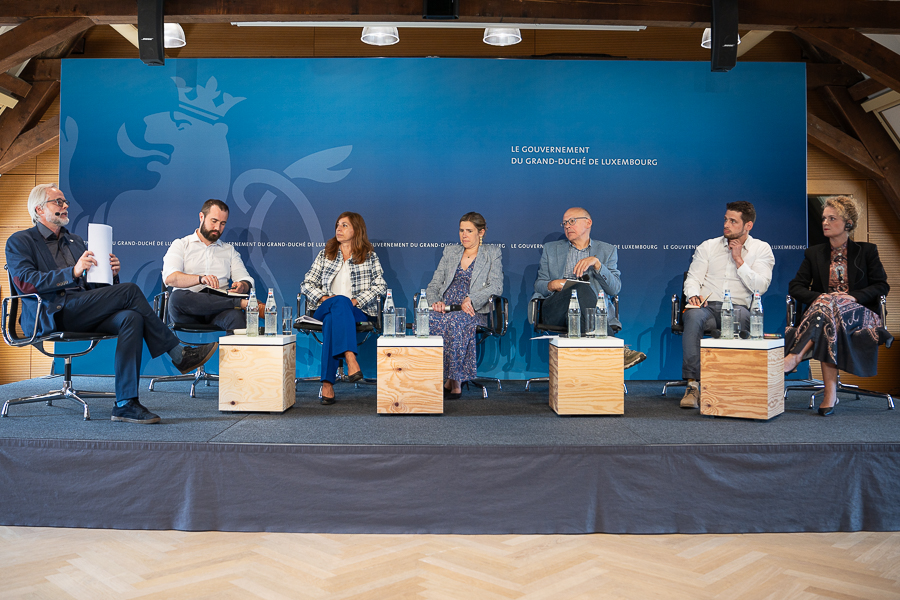
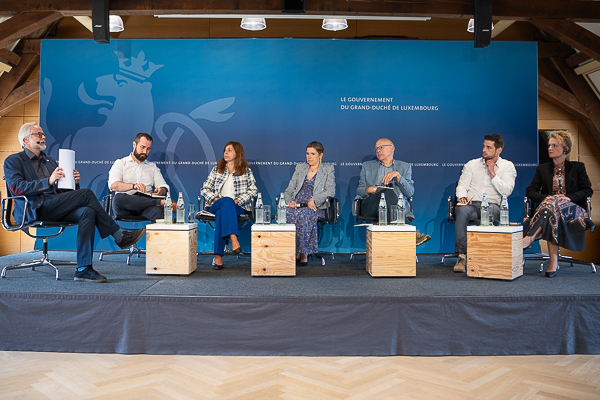
 (L-R) Christophe Langenbrink; Misch Pautsch; Anne Calteux; Elisabeth Margue; Marc Schoentgen; Sidney Wiltgen; Flutura Kusari;
Credit: Ali Sahib, Chronicle.lu
(L-R) Christophe Langenbrink; Misch Pautsch; Anne Calteux; Elisabeth Margue; Marc Schoentgen; Sidney Wiltgen; Flutura Kusari;
Credit: Ali Sahib, Chronicle.lu
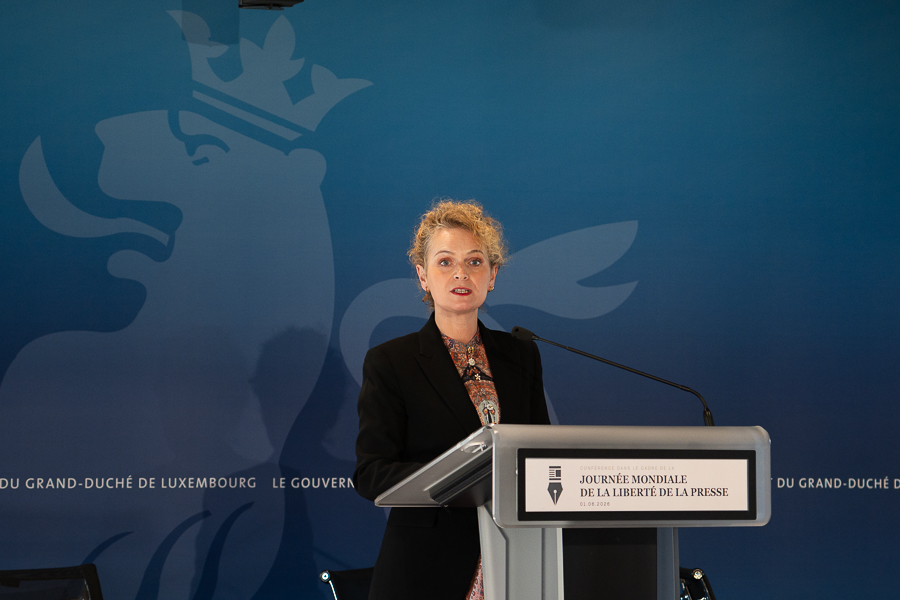
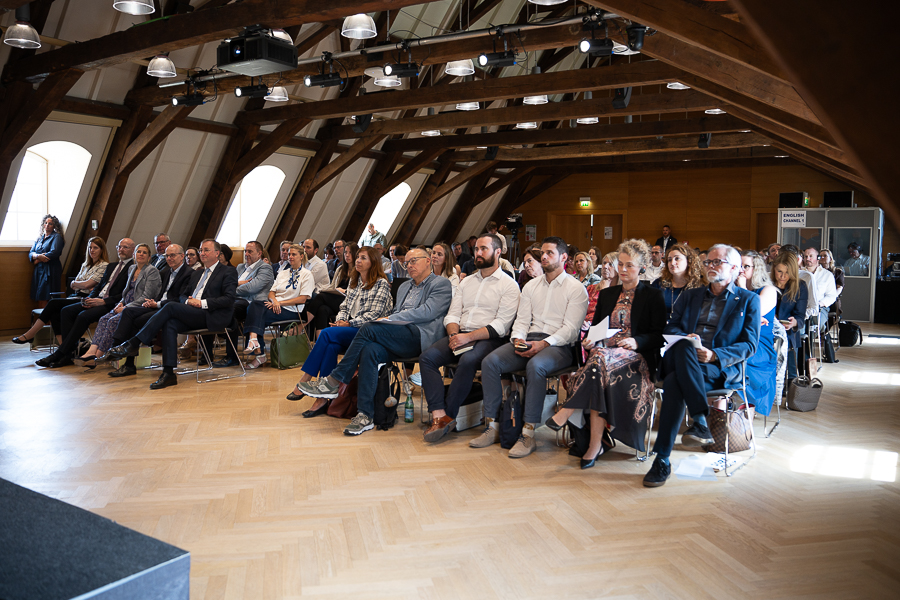
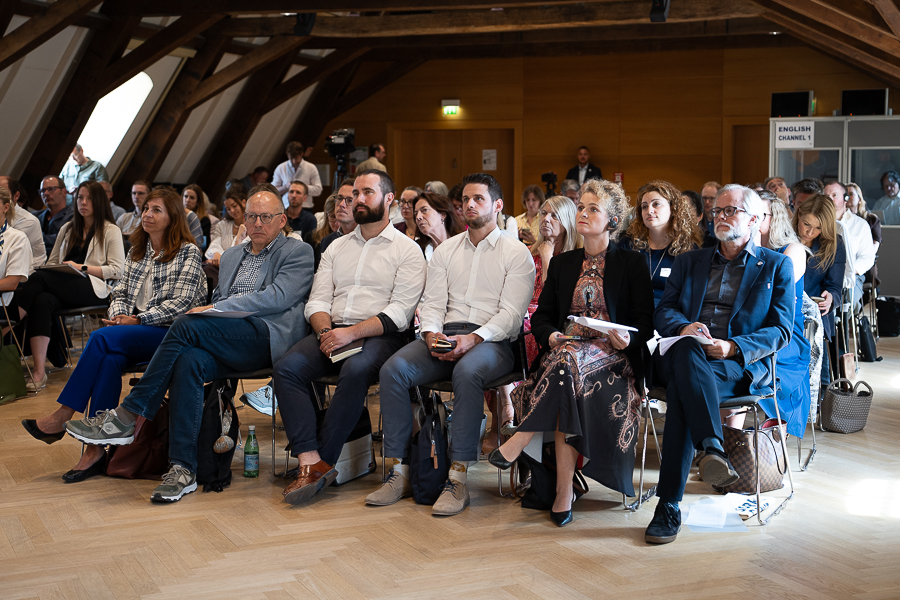
On Monday 1 June 2026, Luxembourg’s Government Information and Press Service hosted a conference on the framework of World Press Day at the Cultural Centre of Neumünster Abbey in Luxembourg-Grund.
The conference, organised by Luxembourg’s Government Information and Press Service; the Media, Connectivity and Digital Policy Department; and the Luxembourg National Commission for UNESCO, focused on the erosion of press freedoms worldwide and the impact of legislation on the ability of journalists to undertake investigations.
Attended by Luxembourg Prime Minister Luc Frieden, Minister Delegate to the Prime Minister, responsible for Media and Connectivity, Elisabeth Margue, Representative of the European Commission in Luxembourg, Anne Calteux, along with members of the Luxembourg Press Council, Luxembourg Association of Professional Journalists, the Centre for Political Education and the European Centre for Press & Media Freedom, the conference also featured an overview of UNESCO’s World Report on Global Trends in Freedom of Expression and Media Development and keynote speech from Flutura Kusari, member of the European Centre for Press & Media Freedom.
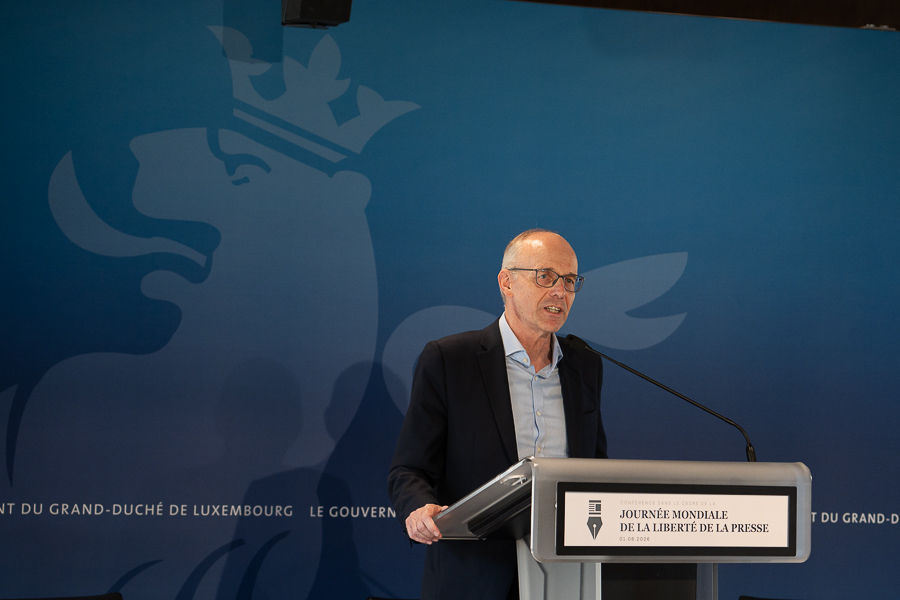
The conference, moderated by Christophe Langenbrink from the Department of Media, Connectivity and Digital Policy (SMC), within Luxembourg Ministry of State, was opened with a speech from Prime Minister Frieden in which he thanked the press, noted the development and requirement to monitor the use of artificial intelligence (AI) as a tool of the press, and highlighted the importance of the press’ position as a vital part of all democracies.
He quoted American James Madison, author of the USA’s First Amendment, who redefined the concept of a free press in a republic, and said: “A popular Government, without popular information, or the means of acquiring it, is but a Prologue to a Farce or a Tragedy, or perhaps both.”
Prime Minister Frieden added: “Knowledge will forever govern ignorance, and the people who mean to be their own governors must arm themselves with the power which knowledge gives. Knowledge always dominates ignorance. And this is where freedom of expression, freedom of speech and freedom of the press, are very important ideas, especially in a democracy.”
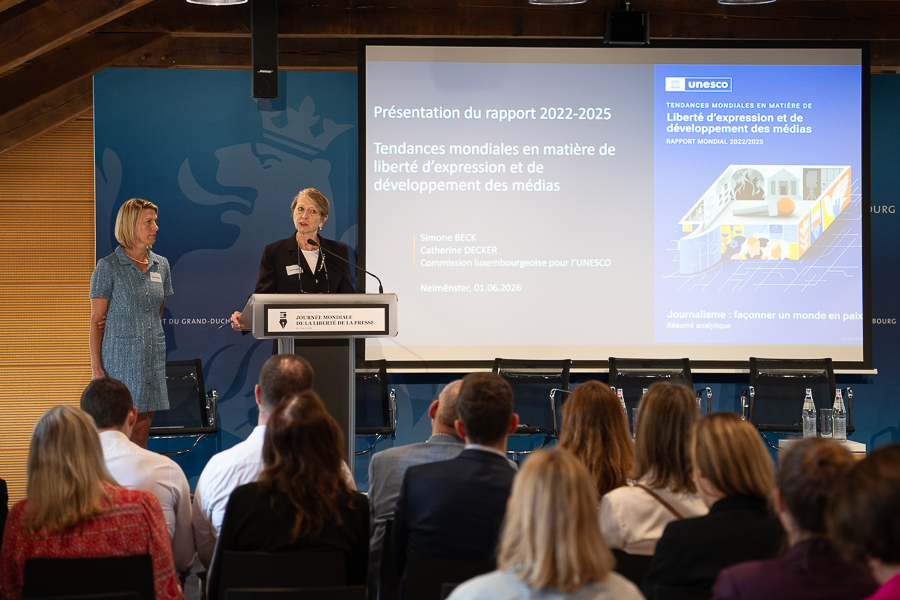
Simone Beck, President of the Luxembourg Commission for UNESCO, and Catherine Decker, Secretary General of the Luxembourg Commission for UNESCO, then provided an overview of UNESCO’s World Report on Global Trends in Freedom of Expression and Media Development (2022 to 2025).
The report, described by Simone Beck as being built around five themes - freedom of expression, the economic sale of the media, the security of journalists, digital transformation and disinformation - highlighted that the values of information as a public good and information integrity are facing unprecedented pressures. She highlighted progress in the overall availability of information through digital transformation but stressed that “traditional models are a bit in crisis” as sales of printed media decline and advertising moves to new models of distribution, placing pressure on the capacity of journalists to undertake investigations and report on them.
Catherine Decker then provided information on Luxembourg’s involvement in UNESCO's International Programme for the Development of Communication (IPDC - Programme international pour le développement de la communication) and how it supports free press and human rights. She also noted that the UNESCO report reminds us that journalism is not only an economic sector but an essential democratic infrastructure.
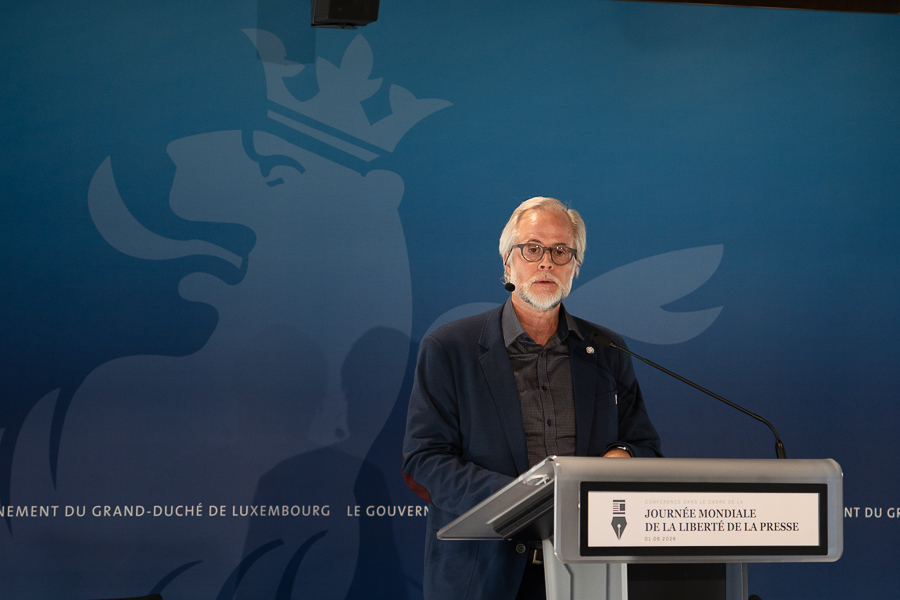
The conference’s keynote speech was then delivered by Flutura Kusari, who thanked the organisers for their invitation to speak on this occasion about media freedom. She began by stressing that, at present, it feels as if there is not much to celebrate and referenced the study on democracies, known as the Varieties of Democracy (VDEMP) which is published and written by the University of Gothenburg, in Sweden.
She said: “The findings for 2025 are absolutely shocking. The level of democracy for the average citizen in Western Europe and North America is at its lowest point in more than 50 years, primarily due to ongoing autocratisation in the United States. The United States has lost its long-standing status as a liberal democracy for the first time in over 50 years...The European Union has been significantly affected…The situation is alarming and of course should concern all of us.”
Flutura Kusari noted that the decline in the level of democracy is reflected in media freedom through both direct and indirect threats. She emphasised that Europe is “lucky to have excellent credible platforms” and is able to provide safety for journalists in Europe, primarily because of the Council of Europe platform dedicated to the safety of journalists and the mapping of “media freedom”, undertaken through the documentation of the most serious threats across almost the Council of Europe region.
“Verbal attacks, harassment and smear campaigns remain the most common forms of press freedom violations. Digital threats continue to rise. Government and public officials were increasingly identified as perpetrators,” Flutura Kusari remarked, adding: “Public service media remained vulnerable to political interference and financial instability. Women journalists were particularly affected by online abuse. And Russia's war against Ukraine remains the greatest threat to journalists in Europe.”
Flutura Kusari then moved on to the subject of SLAPPs (Strategic Lawsuits Against Public Participation) and highlighted that according to the Coalition Against SLAPPs in Europe, more than 1,000 SLAPPs have been documented over the last decade, with the most common SLAPPs litigants being individuals or entities in position of power, especially businesses, businessmen and politicians.
She remarked: “This is a form of mob censorship. It is organised pressure designed to force journalists into censorship, to push them out of public debate, or to deter them from covering some certain topics. What is most disturbing is that political leaders, often not only they fail to denounce such language and behaviour but actively foster these hostile online environments.”
“This is precisely why journalists, civil society and the public at large must stand up whenever the judiciary is attacked. And then there are countries that are doing well in safeguarding media freedom as a key pillar of democracy. And Luxembourg is one of them. This is due first and foremost to the political will to guarantee media freedom and to respect and promote the role of journalists,” she added.
In closing, Flutura Kusari stressed: “At a time of autocratisation, at a time when autocratisation is advancing across the world, defending media freedom is not simply a matter of protecting journalists. It is about protecting every citizen's right to know, to participate and to make informed choices. It is about safeguarding democratic societies for future generations. So the question before us is not whether we can afford to invest in media freedom. The question is whether our democracies can afford not to.”
The event then continued with a panel discussion on journalist safety and anti-SLAPP measures, moderated by Christophe Langenbrink and including contributions from Minister Margue, Anne Calteux, Flutura Kusari, Misch Pautsch, President of the Luxembourg Press Council, Sidney Wiltgen, President of the Luxembourg Association of Professional Journalists and Marc Schoentgen, Director of the Centre for Political Education.
Following closing remarks from André Bauler, Vice-President of the Chamber of Deputies, the event concluded with a networking session allowing guests to interact and discuss the conference’s themes with the participants.