 Credit: MECO
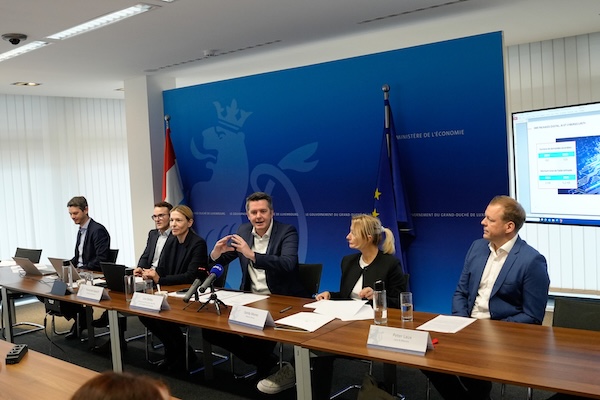
On Monday 11 May 2026, Luxembourg’s Minister of the Economy, SMEs, Energy and Tourism, Lex Delles, presented the overview of state aid granted by the Ministry of the Economy during 2025, highlighting that these instruments helped mobilise nearly €1.2 billion in investments in the Luxembourg economy.
According to the ministry, 2,326 aid applications were approved in 2025, compared to 1,811 in 2024. In total, €315 million in capital grants and €125 million in tax credits were awarded, representing an overall amount of €440 million in aid.
“State aid plays an essential role in enabling companies to invest, modernise and adapt to major transitions. In 2025, it helped mobilise nearly €1.2 billion in investments in the Luxembourg economy. Our instruments target companies of all sizes and at all stages of development: from business creation to start-ups, from SMEs to industrial companies. Our objective is to provide support adapted to the concrete needs of businesses in order to strengthen their competitiveness, resilience and innovation capacity,” said Lex Delles.
Digital Transition as a Competitiveness Driver
The digital transition represented one of the main areas of support for companies in 2025. In total, 799 applications were approved in this field for an amount of €128.4 million, including €5.6 million in direct grants and €122.8 million in tax credits.
The SME Packages Digital, AI and Cybersecurity recorded significant growth, with 533 applications approved in 2025 compared to 382 in 2024, for a total amount of €5.2 million. According to the ministry, this development reflects the growing interest of SMEs in digitalisation, artificial intelligence and cybersecurity projects.
Since 2025, the SME Packages have been modified and the voucher system has been replaced by aid covering 70% of eligible costs for projects ranging between €3,000 and €25,000, in order to support investment projects of varying scale.
The Fit4AI programme was also introduced to support companies in analysing their artificial intelligence needs. In addition, temporary aid supported tourism establishments in the digitalisation of accommodation records, with 94 establishments supported in 2025.
Ecological & Energy Transition
The ecological and energy transition recorded the highest aid amounts in 2025, with 357 approved applications for a total amount of €172 million, including €170 million in grants and €2 million in tax credits.
The main scheme implemented in this field in 2025 concerned support for the electrification of production processes in the manufacturing industry. According to the ministry, this scheme aimed to support industrial companies in projects related to the electrification of production processes by covering not only investment costs but also operational costs.
In total, six projects were selected for a total amount of €102.2 million. The expected climate impact is estimated at 271,096 tonnes of CO₂ avoided over ten years.
Under the environmental and climate protection aid scheme, 79 applications were approved for an amount of €20.6 million, generating €75.6 million in investments. Support for photovoltaics also continued through a fourth call for projects, with 37 projects selected and a planned installed capacity of 14.5 MW.
The development of charging infrastructure for alternative-fuel vehicles was also supported, with 52 applications approved for a total amount of €5.2 million. These projects foresee the installation of 357 charging stations, including 124 accessible to the public, with a total capacity of 24 MW.
In addition, it was decided in 2025 to extend this scheme for two years. Hydrogen refuelling stations and mobile charging stations also became eligible.
Research, Development & Innovation
In the area of research, development and innovation, 87 applications were approved in 2025 for a total amount of €87.1 million, generating €192.6 million in investments. This support mainly concerns research and development projects, as well as process or organisational innovation projects, feasibility studies and innovation within SMEs.
The year 2025 was also marked by the entry into force of the law of 6 June 2025, which renewed the framework for research, development and innovation aid. According to the ministry, this reform introduced thematic and competitive calls for projects, encouraged collaborative cross-border projects and simplified procedures for SMEs.
Online procedures via MyGuichet were also adapted, with an approximately 40% reduction in the amount of information requested.
Business Creation & Support for Start-Ups
The ministry continued its support for business creation and entrepreneurial innovation. In 2025, 303 applications were approved in this field for a total amount of €9.2 million.
The aid scheme for first-time business creation, introduced in 2023, continued to expand. In 2025, 283 applications were approved for a total amount of €3.4 million. Since its launch, this mechanism has supported 524 projects for a total amount of €6 million.
The Fit4Start programme also confirmed its attractiveness. Its sixteenth edition attracted nearly 500 applications. In total, sixteen start-ups were selected for aid amounting to €2.6 million.
The aid scheme for young innovative companies supported four applications in 2025 for a total amount of €3.2 million.
SMEs at the Centre of Support Measures
Small and medium-sized enterprises remained at the centre of the Ministry of the Economy’s aid policy. In 2025, the specific SME aid scheme resulted in 780 approved applications for a total amount of €29.5 million, generating €178 million in investments.
Across all schemes combined, SMEs represented 2,037 approved applications, or 96% of approved requests, for a total amount of €102.2 million. According to the ministry, these figures illustrate the central role of SMEs across all aid schemes, whether related to productive investment, digitalisation, sustainability, innovation or consultancy services.
Two entrepreneurs, Sandy Mores of Maison eTerna and Peter Laux of Laux & Meurers, shared their experiences during the press conference, respectively regarding the first-time business creation aid and the SME Package AI.
Outlook
Minister Delles also presented several outlook measures for 2026. Since 4 January 2026, the new photovoltaic pre-financing scheme has been operational. The installers’ register received 240 applications, with an average processing time of two days.
In parallel, 279 subsidy applications for photovoltaic installations were received, representing €2.2 million in support for solar panels and €564,000 for batteries.
Among the ongoing projects are the European “de minimis” register, the draft law relating to aid for energy renovation works on functional buildings, the draft law aimed at strengthening the productivity, competitiveness and resilience of Luxembourg companies, the SME framework law, as well as a preliminary draft law relating to aid for start-ups and scale-ups.
The ministry is also continuing work related to developments in the European state aid framework, particularly in the context of the greenhouse gas emissions trading system, the Clean Industrial Deal State Aid Framework (CISAF) and the revision of the General Block Exemption Regulation.
“The needs of companies are evolving rapidly, and our instruments must evolve with them. Our priority is to continue simplifying, targeting and adapting aid schemes so that they remain accessible, efficient and useful for companies. This is how we can support investment, innovation and the sustainable competitiveness of Luxembourg,” concluded Lex Delles.