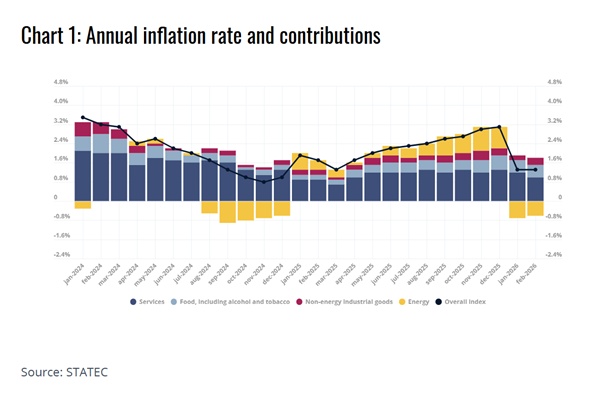
 Credit: STATEC
On Wednesday 4 March 2026, Luxembourg's statistical institute, STATEC, confirmed that annual inflation stood at 1.3% in February 2026.
According to STATEC, this stability is the result of both a weaker contribution from services and a less negative contribution from energy prices than in January 2026.
The food aggregate (including alcohol and tobacco) recorded the strongest annual growth, with a 3.1% increase compared to February 2025. Several sub-components stood out in particular: fresh meat (+7.9% year-on-year), vegetables (+2.4%) and chocolate (+11.9%). On the downside, pasta (-6.1%), cereals (-3.2%) and vegetable oil (-3.1%) saw price decreases. Food prices remained virtually stable (-0.1%) compared with the previous month, although this masks increases and decreases at a detailed level that offset each other.
The aggregate for non-energy industrial goods showed the sharpest monthly increase (+3.4%) due to the end of the winter sales, which led to prices returning to their usual levels. The "clothing and footwear" division recorded a sharp monthly increase of 19.3%. Compared to February 2025, clothing prices rose by 0.7%. Other categories were also affected by the end of the sales, notably household appliances, jewellery and watches, and personal and household equipment. Excluding the effect of the sales, the monthly change in the aggregate for non-energy industrial goods would have been +0.3%. Due to Valentine's Day, prices for plants and flowers rose by 9.0% compared to January, but remained below the level of February 2025 (-0.7%).
In February 2026, energy prices fell by -7.7% compared to one year earlier, mainly due to the drop in electricity prices in January, excluding the government's contribution to network usage tariffs. Electricity and gas prices remained stable compared to the previous month, while the downward trend in fuel prices observed over the previous three months came to an end: the price per litre of diesel rose by 2.8% in one month, and petrol by 2.0%. The price of heating oil rose by 5.4% compared with January, but remained 8.9% below the level of February 2025.
Service prices rose by 2.2% over one year. Package holiday prices increased by 2.9% compared with February 2025 and by 5.2% compared with the previous month. Communication service prices increased by 2.8% compared to January 2026, which can be explained by the end of several promotions for bundled Internet access and telecommunications services. Meanwhile, residential rents (current leases) rose by 1.3% over one year, which had a visible impact on the overall inflation rate due to its high weighting (6.7% of the consumer price index in 2026), according to STATEC.
The annual inflation rate remained stable at 1.3% for the month of February 2026. The general index excluding energy fell from 2.1% to 2.0%. The general index for February, expressed on a base of 100 in 2025, stood at 100.45 points. The half-yearly average of the index linked to the base date of 1 January 1948 fell from 1035.63 to 1034.45 points. The next indexation will be triggered when the value of 1038.79 is reached.