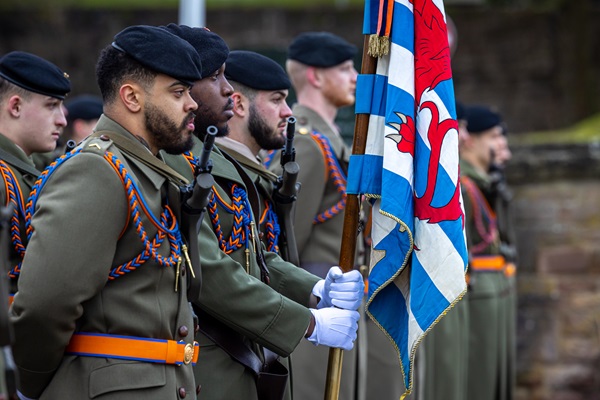
 204th passing out parade at the Military centre in Diekirch;
Credit: © Armée luxembourgeoise
204th passing out parade at the Military centre in Diekirch;
Credit: © Armée luxembourgeoise
On Wednesday 17 December 2025, the Luxembourg Government Council (Cabinet) announced the approval of a package of measures entitled “Recruitment and Attractiveness of the Army”, aimed at strengthening the Luxembourg Army’s recruitment and retention capacity.
The Luxembourg Ministry of Defence reported that given a severely deteriorated international security environment, Luxembourg must continue its defence policy efforts and contribute to strengthening deterrence and collective defence. Under the NATO 2025 defence planning process, Luxembourg has been assigned new capability objectives, with an unprecedented impact in terms of financial, human and material resources.
Budget-wise, this build-up translates into a defence effort reaching 2% of GNI in 2025, progressing to 3.5% by 2035, as agreed at the NATO Hague Summit, dedicated to funding core defence requirements.
“Given the increasingly unstable geopolitical context and in order to meet NATO requirements for forces and military capabilities, the need for qualified military personnel has never been more urgent. Collective security and national sovereignty now rely more than ever on the voluntary commitment of men and women prepared to serve with dedication, integrity and reliability,” emphasised Luxembourg Minister of Defence, Yuriko Backes.
She added: “Our personnel are at the centre of all our efforts – their commitment to our security must be adequately compensated.”
The ministry said that to strengthen personnel across all Army career paths, it is necessary to significantly increase the attractiveness of military service and broaden recruitment channels.
The package, proposed by Minister Backes, will be implemented in phases over the coming years and comprises two components: one targeting volunteer soldiers and the other targeting career and expert military personnel. Note that legislative adjustments are required for these measures to come into effect and they can only be enacted after approval by the Chamber of Deputies.
During its session on Wednesday 17 December, the Government Council (Cabinet) adopted a preliminary bill to enhance elements of remuneration for volunteer soldiers. The bill proposes a substantial increase of 23 index points (p.i.), equivalent to a minimum of €530 per month, to the gross base pay of volunteer soldiers. Furthermore, the annual increase in monthly pay per year of service will rise from 3.7 to 4 p.i. Finally, the demobilisation bonus, paid when volunteer soldiers leave military service, will increase throughout their service.
Examples:
• A volunteer soldier at the start of their career, in the first year of service, currently has a gross base pay of €2,166.19. The proposed adjustment would raise this to €2,718.98, an increase of around 25%.
• A volunteer soldier in the fourth year of service at the rank of First Chief Soldier will see pay rise from €3,170.83 to €3,732.83.
Additional allowances include, where applicable:
• Operational availability monthly bonus: 23.08 p.i. – €531.81
• Demobilisation bonus: 48 months at 13 p.i. per month of service – €14,378.31; in the event of re-engagement (extension of service), €4,147.59 for each additional 12-month period, equivalent to 15 p.i. per month
• Pay increases for participation in peacekeeping operations
• Retention of other (non-)monetary benefits, such as free medical care
In a later phase, the measures package aims to strengthen the operational capability of volunteer soldiers. Consequently, all volunteer soldiers will become deployable and receive an operational readiness bonus of 23.08 p.i. (€531.81 per month), in addition to base pay. The initial active military phase will be extended from four to five years.
Finally, admission conditions for volunteer soldier careers will be adapted, including:
• Recruitment of non-resident EU nationals
• Possibility of exemption from French or German language requirements, while knowledge of Luxembourgish remains mandatory
For career military personnel (officers, non-commissioned officers, corporals), the package provides:
• Military commissioning reform, allowing civilian personnel to be added to the Army based on professional qualifications
• Review of admission conditions for medical officers
• Creation of temporary officer and non-commissioned officer careers
• Potential pay enhancements for career military personnel
This measures package complements Bill 8068 on the Luxembourg Army Operational Compensation Regime, currently in the legislative process, which also introduces:
• A significant monetary allowance for volunteer soldiers
• A substantial increase in allowances for career personnel participating in military training and exercises