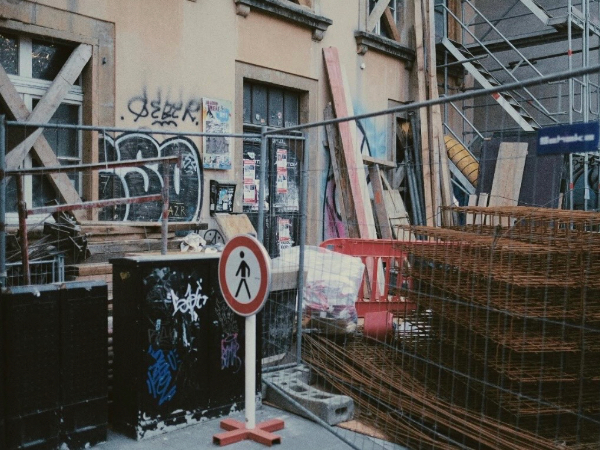
 Credit: Steven Miller, Chronicle.lu
From the Medieval fortifications of the Casemates to the Gothic origins of Notre-Dame Cathedral and the Neo-Renaissance of the Gare, the history of Luxembourg City is ingrained in its rich tradition of architectural styles. Yet, while the contrasting glass and steel of the Kirchberg plateau represents the country’s continual focus on the future, the ongoing gentrification of Luxembourg’s other buildings appears to be a subject strategically erased by the authorities and property developers of the Grand Duchy.
In most countries, buildings of historical or architectural significance are classified under a protective listing system usually administered by the government. Listed buildings are categorised into grades reflecting their relative importance. These classifications often protect both a building’s exterior and, in many cases, its interior, by restricting alterations, extensions or demolition without prior consent, ensuring that the character, heritage and the historic fabric of a building are preserved.
In Luxembourg, similar protections exist but it is becoming increasingly clear that, in the case of residential buildings, they are easily circumvented to facilitate razing the property so that it can be replaced with a more modern building, generating more income for its owners and removing the requirement to maintain a building which would represent a historical piece of the country’s architectural heritage.
Luxembourg’s protected-building legislation is often commonly circumvented through the degradation or replacement of windows because windows sit at the intersection of “structure”, “appearance” and “maintenance”, where the law is at its weakest and legal enforcement is uneven. Take a walk through a residential area of the capital city, such as Limpertsberg, and you will likely see at least one old building primed for development and one left boarded up as if its owners are yet to decide what to do with it. If its facade is in good condition, one need only wait a matter of time before the window frames suddenly appear to have been damaged beyond repair.
Under the current legislation, windows are often not individually itemised in the protection listings, are treated as replaceable elements and can be considered part of energy-efficiency upgrades. This creates what can only be described as a legal ambiguity. Often during the redevelopment of a property, the majority of the structure will be removed, leaving only the facade intact. It is at this point when the windows seem to become a focal point for the developers.
Like a form of attrition, original window frames are often left to rot when a property is not occupied or as already mentioned, miraculously damaged. This degradation enables the replacement of the window structures (frames, lintels, shutters) but as seems to be the most common solution in Luxembourg, ends up resulting in the complete demolition of the original facade. This conveniently allows for the construction of a completely new building without any need to incorporate the original facade.
Now let be me straight, not all buildings are protected and not all buildings are worthy of protection. However, I find it strange that the process of redeveloping any of these residential buildings, protected or not, regularly seems to involve the protracted and expensive process of maintaining the building’s facade, only for the window frames to eventually appear as if someone with a hammer really didn’t like the way they looked. This can’t be classed as casual, street-level vandalism when the window frames on the third storey of a building have received the same destructive treatment as those on the ground floor. This is calculated.
Any new building in the city must be approved by the City of Luxembourg’s Urban Planning Service. The issuing of a permit to undertake the work requires a technical review involving land-use regulations, building codes and an evaluation in line with heritage and protected site restrictions. For listed or protected buildings this also involves a consultation with the Department of Cultural Heritage before the city’s Mayor can grant or refuse the building permit. Recommendations from municipal council can also be involved in this decision making process.
Is it too much of stretch of the imagination to assume that any plans submitted and any review undertaken would take note of what is going to be protected/maintained/upgraded in line with the building preservation legislation and to ensure that this is adhered to and, if not, appropriate action is taken when this doesn’t happen? Right now, it appears as if shoulders are shrugged and the demolition continues without consequence.
The fragmentation of the responsibilities between municipalities, the National Institute for Architectural Heritage (Institut national pour le patrimoine architectural - INPA), energy authorities and planning departments allows for scenarios where a single authority can approve window replacement and for another to later claim any loss of heritage value was unavoidable. This creates a situation where no single body bears responsibility for the loss. This is compounded by nuances within Luxembourg law which appear to not effectively penalise intentional neglect and rarely seems to force owners to repair rather than replace. From here, intentional neglect can be weaponised as a financial strategy and the choice of replacement over repair unfortunately becomes inevitable and without repercussion.
Luxembourg’s cities, towns and villages contain a unique mix of architecture, which mirrors the diversity of their populations and preserves their history in physical terms. Yet, in many cases, these are being replaced with modern buildings which neither reflect the history , culture or the overall aesthetic of their location. There is the viable argument about environment considerations in relation to areas such as energy efficiency but there are no discussions about the cost of this in the face of the carbon footprint behind ripping down a structurally sound building to replace it with a brand new concrete and steel structure.
Luxembourg undeniably has a housing problem. There is a distinct shortage of available and affordable properties for both existing residents and those moving to the country. Yet, instead of sufficient emphasis being placed on creating new means of accommodation, there appears to be an ongoing desire to invest in and green light the destruction of existing properties simply to build new properties in their place. This choice of gentrification over redevelopment is quickly erasing a distinct part of the country’s history and culture.
Given that Luxembourg appears to patriotically cling to its historical heritage and its distinct cultural roots, why is it that when it comes to preserving architecture, the authorities and developers are happy to game the system to effectively maintain a property market without adding to it?
One answer to that is the relationship between supply and demand and it’s influence on existing property values. When so many have gambled so much on obtaining and controlling the property here there is little political desire to rock the boat. However, as Luxembourg begins to struggle with state funding deficits such as that already projected for the pension system, it will at some point have to provide accommodation for the additional workers needed to help the country grow and maintain the required tax intake.
If the country continues down the road of destroying and rebuilding on the same spots again and again, while dragging its heels in building the levels of accommodation need to meet the projections for Luxembourg’s future, the existing system will eventually fail. Is it really unreasonable to suggest that more should be done to both renovate existing properties and invest in the construction of new properties in places where there is no need to destroy what already stands?
Maybe it’s time we hammered the building legislation into shape instead of hammering windows to avoid the tricky discussions about what is being lost to everyone and what is only being gained by a few.