Non-domiciled residents of the UK, and many others, will be affected by the changes being brought in with the UK's Finance Bill 2016, as explained at a STEP Benelux Lunch and Learn event on Monday held at the Cercle Munster in Luxembourg-Grund on Thursday lunchtime, but their tax liabilities can be reduced with careful inheritance and tax planning.
Louise Benjamin of STEP Benelux introduced the organisation's January Lunch and Learn topic, Life Assurance in Estate Planning for UK Clients, and the speakers, Steve Sayer, an independent wealth planner based in the UK, and Simon Garbutt, from Lombard International Assurance, who made presentations looking at some of the insurance-based planning techniques available to UK clients, particularly those individuals who are domiciled or deemed domiciled, or may become so under the 2017 rules.
Simon Gorbutt, who specialises in cross-border wealth planning for high net worth individuals with a special focus on UK residentvand expatriate clients, introduced what he described as the "non-dom (r)evolutions which he said has changed significantly over the last 10-15 years. In 2007-08 and before, the system was straight-forward as UK resident non-domiciled individuals were not taxed, but then the Remittance Basic Charge of STG 30,000 was introduced in 2008-09. In 2012-13, a new STG 50k charge was introduced, which became STG 60k and then STG 90k. From 2017/18 will see further restrictions, with RBC becoming redundant.
The draft Finance Bill 2016 will see that no permanent non-dom status will exist from April 2017, with changes to trust taxation too, as well as different rules for Arriving and Returning UK RNDs. The trust taxation changes will affect (Settlor Interested) offshore trusts; however, these could very well be delayed to the Finance Bill 2017 instead.
For returning RNDs born in the UK, they will be treated as UK domiciled whenever resident. For Arriving RNDs, other changes will affect them as well.
In the scope of advice for clients, he suggested they be careful regarding the treatment of "split years" counting towards the 15 year threshold, as well as considering the possibility of worldwide estate becoming subject to UK IHT. As a result, inheritance planning for long-term UK residents is expected to increase from this year.
Steve Sayer, who specialises in UK inheritance tax and related areas, talked about this 15-year rule and the effect on trusts. For those clients hit with UK inheritance tax, life assurance can help reduce tax liabilities and plan for future generations. He talked about Loan Trusts and Discounted Gift Trusts, used for retaining access, an Accumulation and Maintenance Plan and a Flexible Legacy Plan, both used for retaining control, and are both products offered by Lombard.
Loan Trusts offer tax deferral and allow growth outside the estate, as the money is invested in a life assurance policy. Discounted Gift schemes were introduced to provide guidance for insurers as to how discounts should be calculated. Life assurance policies can also be used in Accumulation and Maintenance Plans by controlling when one's children can have access to the benefits of such policies, with the benefits of previous tax planning rules and without the restrictions of some later rules (Whole of Life policies). He stressed that Flexible Legacy Plans can be used in conjunction with other types of planning too.
The presenters were speaking at the STEP Benelux January 'Lunch and Learn' event at Cercle Munster in Luxembourg-Grund on Thursday lunchtime. STEP is the premier global trust and estate planning organisation dedicated to informing and educating estate planning and administration professionals.
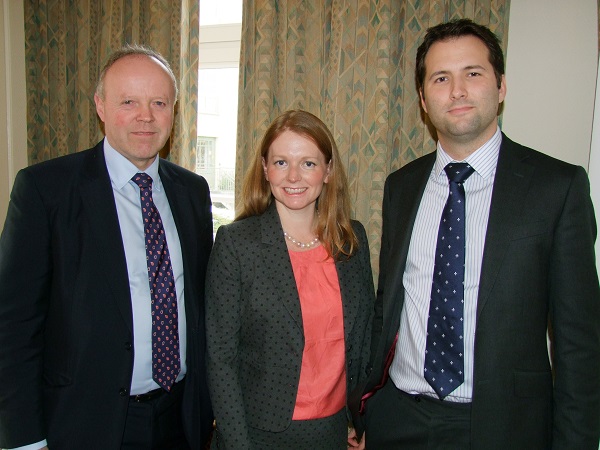
Photo by Geoff Thompson (L-R): Steve Sayer, Lombard; Louise Benjamin, STEP Benelux; Simon Gorbutt, Lombard.