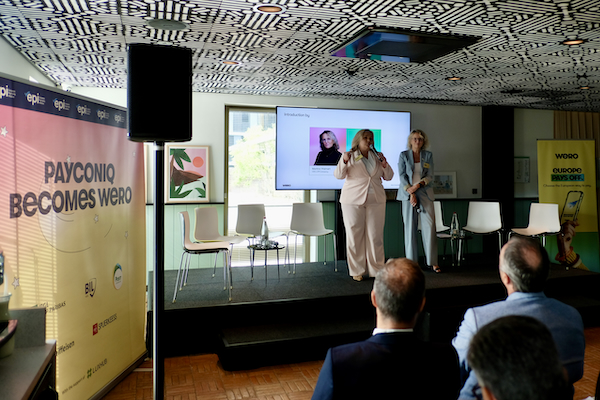
 (L-R) Jacqueline Boucher, Payconiq International CEO; Martina Weimert, European Payments Initiative (EPI) CEO;
Credit: Steven Miller, Chronicle.lu
(L-R) Jacqueline Boucher, Payconiq International CEO; Martina Weimert, European Payments Initiative (EPI) CEO;
Credit: Steven Miller, Chronicle.lu
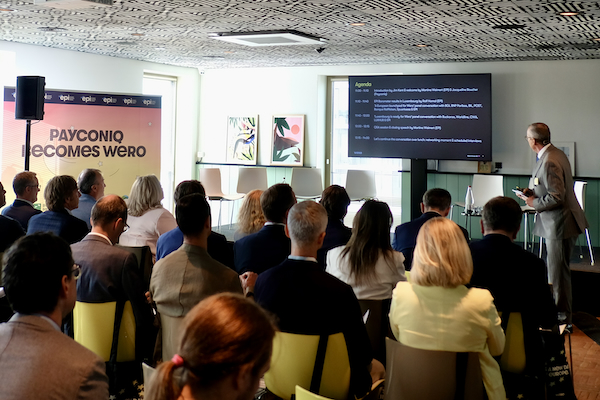
On Wednesday 2 September 2026, the European Payments Initiative (EPI) hosted a press conference at Mama Shelter in Luxembourg-Kirchberg to detail the migration of digital payment platform Payconiq to EPI’s Wero platform.
The event, hosted by presenter Jim Kent, welcomed members of the press and representatives of the five banks in Luxembourg which offer Payconiq services, as well as a variety of business and technical representatives to discuss the impact of the changes to the popular digital payment platform.
EPI CEO Martina Weimert and Payconiq International CEO Jacqueline Boucher welcomed the guests to the event and noted the importance of the new changes to Luxembourg’s digital payment landscape and how the move from the Payconiq platform to Wero helps to align the consumers, merchants and banking partners in Luxembourg with the other European countries - France, Germany, Belgium and soon the Netherlands - already utilising Wero’s digital payment services.
Ralf Hamal then detailed how studies were undertaken to ascertain payment habits and requirements for the Wero service in Luxembourg, noting the existing popularity of person-to-person payment transfers in the country, and the involvement of five of Luxembourg’s major banks - Spuerkeess, Raiffeisen, POST, BGL BNP Paribas and BIL - in implementing the service for their customers and meeting their unique requirements, which often include the complexities of cross-border banking.
There then featured a panel discussion with representatives of the five banks who responded to questions involving the migration work undertaken, the technical challenges uncovered, how customer support will function and what additional functionality Wero will provide in the future.
Claude Wurth, Vice President & Head of Business Unit Account-based Payments at Spuerkeess, remarked that despite Payconiq being a popular and successful person-to-person payment system in Luxembourg, the additional functionality offered by Wero benefits the customer through its flexibility, including its ability to accept email addresses for transfers as well as mobile phone numbers, improved transaction speed and its multi-bank support, as well as its design which gives a greater element of future proofing for improvements and functionality.
Fernand Lepage, Chief Operating Officer at BGL BNP Paribas, spoke of the ubiquity of mobile phones and mobile banking and how this has changed the payment landscape. He stressed the importance of ease-of-use to the consumer but also the fundamental requirement of maintaining a secure payment platform. He noted that other payment solutions offer these but highlighted the desire to have a “European solution”.
“Today with Wero, I have a friend in France, I have to give him some money, I do not know his bank account. I cannot send money from my Visa card to his Visa card; I do not know how it works but I can do it with Wero… I think that is important for our clients.”
On the subject of payment security and the importance of the role of the bank in payment transfers, Sandrine de Vuyst, Head of Retail and Private Banking at Raiffeisen remarked: “Clients know that when they initiate a payment that there is a regulated institution behind it, which is safeguarding their deposits, their assets, their money, which is protecting their data, and who will help them whenever something goes wrong. In an environment where unfortunately fraud and cybercrime are becoming increasingly sophisticated, trust is now not just a nice to have, but it is really something which has to be embedded in the product.”
A second panel discussion then took place which focused on the technical migration from Payconiq to Wero and the impact of these changes on businesses and consumers.
When asked about the benefit to merchants in moving from Payconiq to Wero, Ludovic Francesconi, Chief Member and Strategy Officer at EPI, said: “What we are doing with the introduction of Wero in Luxembourg is that we combine the best of both worlds. We can combine the success story of Payconiq, which is very strong with local players already today, and we will, of course, leverage on this, but we can also add the scale of Wero when it comes to bringing new acceptance players, new acquirers on the market, and making sure that all merchants in Luxembourg tomorrow will accept Wero, not only in e-commerce, but also in-store.”
Hakan Sekulu, CEO of Worldline in Luxembourg, added: “To make Wero successful… what we need is a strong customer adoption, easy integration, frictionless checkout, and of course, an easy omnichannel acceptance.”
In a press release, EPI detailed that throughout September 2026, Wero will become progressively available to Luxembourg consumers and merchants, as participating banks, payment service providers and other organisations across the Luxembourg payments ecosystem move through the different phases of the migration. Payconiq’s payment platform will end on 30 September 2026.
To ensure a smooth transition, existing Payconiq QR codes on invoices and in-store will remain usable until the end of the year and can be scanned directly through the Wero app. EPI emphasised: “This interoperability is a key part of the migration, enabling consumers to transition naturally from Payconiq to Wero.”
About EPI
EPI (or European Payments Initiative) is supported by eighteen European banks and payment service providers. Beyond the shareholders, over 50 institutions in Europe are now members of EPI. They have joined forces with a common goal: to offer a unified mobile payment service, to all European companies and citizens, Wero. EPI intends to enable European consumers and merchants and to carry out all types of retail transactions simply, via a resolutely sovereign digital wallet.
 Credit: Steven Miller, Chronicle.lu