 Credit: Ali Sahib, Chronicle.lu
In 2026, several European countries, particularly those in close proximity to Russia and Ukraine, have experienced episodes of unidentified drones entering their airspace. Following the events of the last seven days, it appears that Luxembourg is very much in the flight path of this potential threat and this raises some uncomfortable questions.
This year, Romania, Germany, Moldova and now Luxembourg have all recorded incidents where drones of unknown origin have caused disruption. In 2026, Romania has so far recorded six incidents where Russian drones were shot down after entering the country’s airspace. On 4 August, an explosives-laden drone was found in a restricted cargo area near the southern runway of Leipzig (Halle) Airport in Germany. This caused significant disruption to flights and ultimately led to Germany attributing the incident to Russia involvement and suspecting that the intended target was an aircraft carrying military supplies to Ukraine. In September, Moldova has so far recorded three incidents involving suspected Russian drones, one of which forced the temporary closure of the country’s airspace.
These incidents follow similar drone-related disruption at Belgian airports in 2025.
On Friday 18 and Monday 20 September, Luxembourg Airport was forced to temporarily suspend flight operations following reports of unauthorised drone activity, causing a number of flights to be cancelled and forcing Luxembourg’s authorities into action. This followed reported sightings of drones near Medernach and other locations in Luxembourg.
On Thursday 24 September Luxembourg Prime Minister Luc Frieden led a press conference which detailed the country’s response to the events. Unfortunately, the information given raised as many questions as it answered.
At present, the origin and type of drone are still unknown to the Grand Duchy’s authorities but Prime Minister Frieden stressed “there has not been any imminent danger for the population.” This may be the case, and the authorities should take credit for their swift response to these events, but, as the Prime Minister also stated: “We have been confronted with a new reality here in Luxembourg,”
Not all drones represent a threat
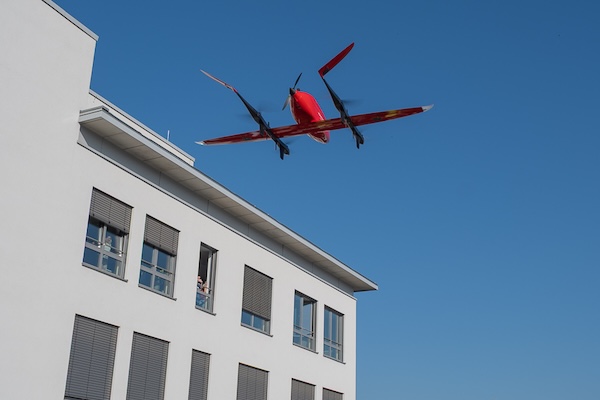
There are many types of drone, with many uses for each type. Beyond the military applications of surveillance, reconnaissance and short-range attack, private and civilian drones are used for photography and video, deliveries, property inspection, mapping and agricultural monitoring. They also come in many forms: fixed-wing, multirotor, FPV (First Person View) and mini. Ordinarily, the larger the drone, the more likely it is for military or commercial use.
The use of drones in the military sense has increased significantly since the beginning of the Russian invasion of Ukraine in February 2022, with Ukraine taking advantage of the technology to make significant strikes on both invading Russian forces and on specific targets in Russia.
Ukraine has achieved this primarily due to the ability of drones to perform certain military tasks at a reduced cost, mainly because they are cheaper to build, repair, replace and power, and they are also - depending on their type - more difficult to detect and track using traditional military methods. For similar reasons, this approach has been echoed in Iran’s response to the ongoing conflict with the United States in the Middle East.
While the use of such drones in the theatre of combat is impressive, it is not without unintended problems. Estonia, Finland, Latvia and Lithuania have all experienced issues with drone incursion this year but many of these have been related to Ukrainian drones which have suffered technical malfunctions while undertaking missions intended to strike targets in Russia or Russian targets in Ukraine. These incidents only serve to highlight the infancy of the technology as a weapon.
How to spot a drone
Drone sightings unfortunately carry a lot of similar characteristics to sightings of UAP (Unidentified Anomalous Phenomena), or “UFOs” for us older generations. Drones, regardless of their type, are considerably smaller than even single-seater aircraft, and with the added factors of distance, poor light and some similar characteristics to aircraft (such as flashing lights), what may appear to be a drone may be something else entirely.
The Luxembourg government announced that in March of this year it implemented a “Drone Plan” to deal with the ongoing threat of the technology. It has also confirmed that specific equipment has been purchased to deal with potential threats, and it has sought advice from neighbouring countries on how to coordinate both defence and response to these issues.
For private and commercial drones, the EU utilises the Direct Remote Identification (Direct Remote ID) protocol, an identification system akin to a digital licence plate. If one’s drone weighs 250 g or more or is equipped with a camera, the drone operator must register with Luxembourg’s Directorate of Civil Aviation. The system, a requirement for EASA states since 1 January 2024, is implemented on the drone itself and broadcasts identifying and flight information during flight, including the drone operator's registration number, the drone's unique serial number, the drone's position and altitude, its flight direction and ground speed and the location of the remote pilot (or, in certain circumstances, the drone’s original take-off point).
This is all good and well but, as the old saying goes, “All is fair in love and war”. This is why Luxembourg authorities have so far been unable to categorically identify the origin of the drones involved in the recent security incidents. It is also unlikely to speculate until hard evidence is available.
The government did reveal that the drones observed at Luxembourg airport were spotted visually by airport staff but did not offer any additional specific details as to the size/type of drone spotted. Nevertheless, it is not unreasonable to deduce that if the size of drone(s) was significant enough to be observed with the naked eye, it is unlikely they were either commercial or private in origin. The lack of Direct Remote ID would also imply this.
A new form of defence
So how does one catch a drone or prevent it from entering protected airspace such as that at an airport or around critical infrastructure, be it commercial, private or nefarious in nature? This is not an easy task for even the largest armies in the world and, as Prime Minister Frieden noted, it really does represent “a new reality”.
The EU published an action plan on “Drone and Counter Drone Security” in February 2026, which calls for stronger detection, coordinated responses and greater European counter-drone capability. The recent actions of the Luxembourg authorities, and its collaboration with neighbouring countries, suggests that this action plan has been the basis for the Grand Duchy’s own “Drone Plan”.
NATO appears to be leading the way in developing an approach to dealing with the threat, offering framework contracts for tactical and deployable Counter-Unmanned Aircraft Systems (C-UAS), and offering NATO allies and partner nations “a faster, simpler route to acquire a proven defensive capability”.
At present it is notable that the governments of the countries affected by drone incursions are reticent to point the finger and remain restrained in their sharing of information relating to these incidents, at least to the public. We can ask “Who” and “How” but the authorities know that making this information public can be detrimental to defence efforts - unnecessarily revealing one’s hand to those who wish to do harm.
Even after detection, the authorities face challenges in dealing with any incursion, particularly with larger drones. These cannot simply be shot down or grounded through the use of blocking signals as they are often flying over residential and commercial areas, posing a risk to the people and property below. Greenpeace Luxembourg recently questioned the security of critical infrastructure, such as the Cattenom Nuclear plant, after the recent drone sightings. This may seem a touch extreme but the environmental association’s worries are well founded following Russia’s drone strikes on Chernobyl and attacks at the Zaporizhzhia nuclear power station in Ukraine.
What now?
For the moment, vigilance is the best anyone can offer. Luxembourg’s authorities are now patently aware of the issue and appear to be reacting in the most realistic and sensible manner. The lack of information may be frustrating for the public, particularly when it comes to the impacts experienced in air travel, but this is where we are in the fight against a fledgling threat such as drone warfare.
The public needs to be sensible and not fall into the UAP paranoia trap of anything unidentified in the air being a threat.
Pascal Peters, Director General of the Luxembourg Police, advised at the government’s recent press conference that one can often hear a drone before one can see it. But there is no immediate need to contact the police, even if the object has lights. However, if the flight behaviour of the object is unusual, or there are other characteristics which seem strange, people are advised to use the police’s 113 number to report what they have they have seen. Additionally, for general information about drones, one can contact the police or call the "Ligne bleue" on 244 244 244.