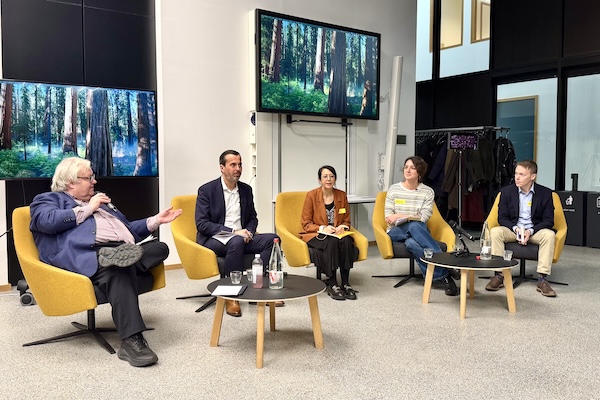
 (L-R) Prof Robert Harmsen, University of Luxembourg; Jean-Pierre Schmit, Bahá’í Lëtzebuerg; Talia Melic, Organisation for Economic Co-operation & Development; Anna Toplyski, Citizens for Ecological Learning & Living; Kelsey O'Connor, STATEC Research;
Credit: Ievgenii Karanov, Chronicle.lu
On Friday 6 November 2026, the Bahá’í Community in Luxembourg held its annual "Exploring Community-Building in Luxembourg" event at the University of Luxembourg's Maison des Sciences Humaines in Esch-Belval.
Organised in collaboration with the UNESCO Chair in Human Rights of the University of Luxembourg, the event brought together over 50 participants from various organisations and institutions to explore how people from different cultural backgrounds can move beyond simply living side by side towards actively shaping their communities together. Held two years after the introduction of Luxembourg's intercultural living-together law, the event focused on how community-building and volunteering can strengthen social cohesion, drawing on experiences from different sectors and research findings from the Organisation for Economic Co-operation and Development (OECD) and STATEC Research.
Opening the event, Professor Robert Harmsen, Dean of the Faculty of Humanities, Education and Social Sciences at the University of Luxembourg, reflected on the development of the community-building initiative since its beginnings in 2022. He described Luxembourg as a broadly harmonious but fragmented society, where different communities often remain within their own spaces without establishing connections. He stressed that community-building should be understood as an ongoing process rather than a fixed destination, shaped through dialogue, meetings and shared activities. Professor Robert Harmsen noted: "The journey is as important if not more important than the destination."
Pascal Jossi, from the Bahá’í Office of Public Affairs of Luxembourg, outlined how the initiative had evolved through exchanges with organisations, academic reading groups and a community-building book club. He explained that the discussions had gradually shifted towards intercultural living-together, focusing on how people and organisations could contribute to shaping a shared sense of "we". He highlighted three elements of community-building: an outward-looking approach, learning through action and reflection, and a balance between formal and informal structures. Pascal Jossi emphasised: "People have to take ownership of this process."
Talia Melic, representing the Organisation for Economic Co-operation and Development (OECD), presented findings from research mapping more than 40 area-based initiatives aimed at transforming neighbourhoods across OECD countries. She explained how these initiatives combine economic development, improvements to public spaces and community cohesion, highlighting examples from Germany, Finland and the United Kingdom where residents helped develop shared spaces and participated in joint projects. Emphasising the importance of local involvement, Talia Melic said: "Initiatives really need to be community owned and led to be transformative." She also stressed that volunteering and community participation can strengthen social connections, develop practical skills and give residents a greater sense of ownership over their neighbourhoods.
Professor Robert Harmsen then moderated a roundtable discussion featuring Jean-Pierre Schmit of Bahá’í Lëtzebuerg, Anna Toplyski of Citizens for Ecological Learning and Living (CELL), Kelsey O'Connor of STATEC Research and Talia Melic. The panellists discussed how community-building initiatives work in practice, the relationship between social cohesion and wellbeing, and the balance between institutional support and grassroots participation.
Jean-Pierre Schmit shared his experience of developing a neighbourhood community over approximately four years, explaining that initial attempts to organise formal meetings attracted few lasting participants. Instead, he found it more effective to connect with residents through existing neighbourhood celebrations and language cafés, gradually building relationships through informal gatherings and shared activities. He highlighted the importance of mutual support and a sense of belonging, recalling how one resident who had previously felt isolated came to feel connected after getting to know neighbours. Jean-Pierre Schmit emphasised that community-building requires people to take initiative and develop relationships rather than relying solely on formal structures.
Anna Toplyski explained how CELL supports citizen-led initiatives addressing ecological challenges, including community gardens and local projects, while encouraging shared decision-making. She argued that the climate crisis is closely linked to social inequality and that building resilient communities requires changes in how people cooperate and make decisions. Stressing the importance of collective action, Anna Toplyski said: "In order to find the solutions, we have to start listening to each other." She also noted the need to involve marginalised groups more effectively and allow communities time to experiment, reflect and learn from their experiences.
Kelsey O'Connor, a wellbeing economist at STATEC Research, discussed the importance of measuring societal progress beyond economic indicators. He explained that Luxembourg's wellbeing framework considers eleven dimensions, including social relationships, housing and work-life balance. Highlighting the importance of wellbeing as a measure of societal progress, he stressed: "If wellbeing improves, we experience progress." Kelsey O'Connor also highlighted research linking volunteering and other forms of helping behaviour to greater life satisfaction and stronger community resilience, noting that people who knew their neighbours generally experienced better psychological wellbeing during the COVID-19 pandemic.
Talia Melic emphasised that governments should support community initiatives without imposing predetermined solutions, allowing residents to identify their own needs and priorities. She noted that neighbourhood development can combine economic opportunities with stronger social relationships, citing examples where locally owned businesses were more likely to employ residents and other businesses supported community activities. Reflecting on the importance of shared narratives across different cultural backgrounds, she observed: "Even in places with great cultural diversities, there are things that people can find in common to have a common story." Identifying shared values, she added, can help communities develop a collective vision for their future.
The event continued in the afternoon with interactive group workshops on community-building and intercultural living-together, followed by a plenary session and closing remarks.