
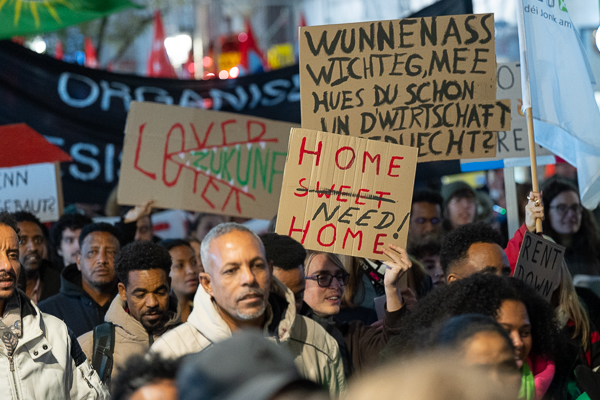
 Credit: Ali Sahib, Chronicle.lu
For many Europeans, finding an affordable home has become more than a financial challenge: it can determine when they begin living independently, start a family or make plans for the future.
I experienced this first-hand while searching for a home to rent in Luxembourg. Finding an apartment suitable for a family of four for less than €1,500 a month, even outside Luxembourg City, proved remarkably difficult, particularly when trying to find somewhere that met our expectations for everyday living.
Having two adults earning an income makes such costs somewhat easier to manage, although it certainly does not make them insignificant. But what about someone living alone? For young people hoping to move out of their parents' home, the financial challenge can be considerably greater. Many have to consider the relatively new concept of co-living, a modern take of renting a bedsit, where one shared a bathroom and (sometimes had access to) kitchen facilities. And if renting is already difficult, buying a property can seem even further out of reach.
These difficulties are not unique to Luxembourg. Across Europe, housing affordability has become a growing concern, raising questions about why the problem has persisted for so long and whether the measures being introduced can make a meaningful difference.
A growing European challenge
According to Eurostat's Housing in Europe 2025 report, house prices across the European Union (EU) increased by 53% between 2010 and 2024, while rents rose by 25%. Over the same period, construction producer prices increased by 56%, reflecting the rising cost of building new homes.
In 2024, households across the EU spent an average of 19% of their disposable income on housing. For people earning less than 60% of the national median income, however, this proportion reached 37%, highlighting the particularly heavy burden faced by lower-income households.
The figures do not tell the same story in every country. Housing markets differ considerably, as do household incomes and expenses, and the availability of affordable accommodation. Nevertheless, the overall trend illustrates how housing costs have become an increasingly important issue across the EU.
One explanation is that the construction of new homes has not always kept pace with demand. Population growth, changing household needs, rising construction costs and the availability of suitable land can all influence the balance between housing supply and demand. In some places, the consequences of earlier periods of limited construction are still being felt today.
Spain provides one example. In its State Housing Plan for 2026-2030, the Spanish government acknowledged a structural housing shortage exceeding 400,000 homes, citing estimates from the Bank of Spain.
The document links this shortage to more than a decade of weak construction activity following the country's property crisis, alongside higher material costs, a shortage of skilled workers and population growth. It also identifies tourist accommodation, temporary rentals and vacant properties as factors that can further reduce the housing available to permanent residents.
Ireland faces its own challenges. According to the OECD Economic Survey of Ireland 2025, the country's population increased by more than 550,000 people between 2011 and 2022, while its housing stock expanded by only 117,000 dwellings. It recently changed the law regarding short-term rentals, trying to open up more housing for long-term rentals; and it also recently launched an initiative in specific towns to tax unoccupied buildings, encouraging owners to make them available to those seeking housing, either by renting or by selling.
The OECD linked this imbalance to a prolonged period of insufficient housing investment following the global financial crisis. Although housing construction has since recovered, the report highlights the lasting consequences of a period when supply failed to keep pace with population growth.
Spain and Ireland therefore illustrate different aspects of a wider European problem. Their experiences cannot simply be applied to Luxembourg, but they demonstrate why housing shortages can take years to develop and why reversing them is rarely straightforward.
What is Europe doing about it?
The scale of the problem has also prompted action at EU level. In December 2025, the European Commission presented its first European Affordable Housing Plan, aimed at increasing housing supply, encouraging investment and simplifying construction procedures.
The European Commission estimates that the EU needs around 650,000 additional homes annually to meet demand. Its proposals also address short-term rentals in areas facing housing shortages and support for young people and vulnerable households.
These initiatives recognise that housing affordability is no longer solely a national concern. However, their effectiveness will depend on how European measures are translated into action by national governments and local authorities.
Luxembourg faces its own pressures
Luxembourg's situation is particularly striking because of the country's high housing costs. According to Eurostat, housing costs in Luxembourg were 78% above the EU average in 2024. This comparison includes expenses such as electricity, water and heating, rather than rent or property prices alone.
National research provides further context. In its October 2025 report, Luxembourg’s Housing Observatory (Observatoire de l’Habitat) noted that the number of households increased by approximately 78,000 between the 2001 and 2021 censuses, compared with around 60,000 new homes built between 2001 and 2020.
Although the periods differ slightly, the figures illustrate the pressure created when the number of households grows faster than the housing supply.
More recent figures suggest that the rental market remains under pressure. According to the Observatoire de l'Habitat, advertised apartment rents increased by 5.8% in the second quarter of 2026 compared with the same period in 2025.
These are asking rents for properties advertised on the market, not necessarily the amounts ultimately paid by tenants. Nevertheless, they are particularly relevant to people currently searching for accommodation.
For those already renting, remaining in the same home may be more manageable than re-entering the market. For young adults looking for their first apartment, or families needing additional space, the available options can be considerably more difficult to afford.
This brings us back to the question of what happens when housing becomes an obstacle to making ordinary life decisions. How long should someone have to save before moving out? How far from work should a family be expected to live? And how realistic is home ownership for people who have stable jobs but cannot accumulate a sufficient deposit?
Growing calls for change
These concerns have also become increasingly visible in Luxembourg's public debate.
On Friday 13 November 2026, hundreds of demonstrators took to the streets of Luxembourg City to protest against the housing crisis. The march, organised by Kollektiv Logementskris, received the support of 33 organisations, including trade unions, youth associations and non-governmental organisations.
In their joint statement, the organisations criticised the pace of structural reforms. They pointed, among other things, to the timetable for introducing a tax on undeveloped land, the planned national register of buildings and housing, and the ongoing discussions concerning rent regulation.
Their concerns followed a meeting between representatives of Kollektiv Logementskris and Minister Claude Meisch on Tuesday 10 November, during which the collective presented 20 demands.
Earlier, on 27 October, the government presented a five-point housing roadmap during the first meeting of the Housing Monitoring Committee, chaired by Prime Minister Luc Frieden. The priorities include mobilising unused land and housing, accelerating construction, increasing public investment, improving access to housing and ensuring balanced relationships between tenants and landlords.
The government's position also deserves consideration. In its statement published on Wednesday 11 November, Luxembourg's Ministry of Housing and Spatial Planning said that it shared the objectives behind most of the demands and had already begun work on relevant reforms.
The ministry reported that €474 million had been allocated to affordable housing in 2025, compared with €224 million in 2024. It also outlined planned legislative changes, including reforms concerning residential leases and the sale of properties before completion, expected to be presented in 2027.
Minister Meisch acknowledged the concerns of young people while emphasising that reforms must follow the necessary legislative and administrative procedures.
Both perspectives raise an important question: how can governments balance the time required to introduce lasting reforms with the immediate needs of people struggling to find somewhere affordable to live?
Building more homes requires investment, planning, infrastructure and cooperation between different levels of government. Measures involving taxation, land use and rent regulation also require careful consideration. There is no reason to expect a housing shortage that developed over many years to disappear overnight.
Yet recognising the complexity of the problem should not mean accepting indefinite delays. Clear priorities, realistic deadlines and measurable progress matter, particularly to those whose lives are affected by the shortage today.
My own experience of searching for a family home in Luxembourg is only one small part of a much larger European picture. But it has made me more aware of how easily something as fundamental as finding a place to live can shape other decisions.
Housing is not simply another expense in a household budget. It is the foundation on which people build their independence, relationships and future plans.