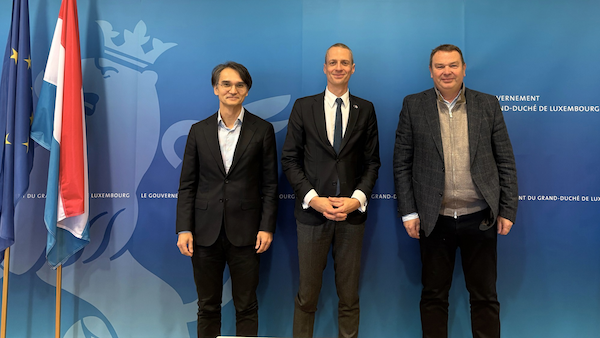
 (L-R) Dr Gaston Trauffler, Head of Industrial Policy at FEDIL; Serge Wilmes, Luxembourg's Minister of the Environment, Climate and Biodiversity; René Winkin, Director of FEDIL;
Credit: FEDIL
On Friday 13 November 2026, representatives of the Federation of Luxembourg Industrialists (FEDIL) met with Luxembourg's Minister of the Environment, Climate and Biodiversity, Serge Wilmes, to raise concerns about the reform of the European Union's Emissions Trading System (ETS) and the protection of industries whose processes remain difficult to decarbonise.
According to FEDIL, the meeting at the Ministry of the Environment was open and constructive, with the federation reiterating its full support for European climate ambitions while calling for the protection of industries whose processes remain difficult to decarbonise. FEDIL warned that without such protection, Europe would export its emissions along with its jobs.
As the international community gathered in Antalya for COP31, FEDIL reiterated that climate action was a necessity and that it supported the political agenda underpinning it. The federation also advocated accelerating action wherever existing and accessible technologies could be deployed, including electric mobility, renewable electricity generation and storage, the electrification of industrial processes and the strengthening of the electricity grid.
FEDIL also reaffirmed its long-standing commitment to energy efficiency in industry through the deployment of new solutions, often developed and offered by industry itself. The objective was to genuinely reduce emissions by improving performance, rather than simply relocating production, which would only improve the statistics while the problem itself remained global.
Regarding the current reform of the ETS, the central issue was the treatment of industries whose processes remain difficult to decarbonise. For these industries, the technological and economic conditions are far from being in place. Low-carbon hydrogen is available neither in sufficient quantities nor at competitive prices, while carbon capture, utilisation and storage (CCU/CCS) remain at the pilot project stage, without transport or storage infrastructure on the required scale.
FEDIL warned that removing the free allowances protecting these industries from international competition would make their production excessively expensive. This would be particularly serious in export markets, which are not covered by the Carbon Border Adjustment Mechanism (CBAM), and would further increase the cost of raw materials for downstream European industries. Deindustrialisation in European countries, already clearly visible, would accelerate as a result.
The federation also highlighted the potential impact on employment in European countries with a high concentration of industry. It pointed to Germany, where it said industry was currently losing around 15,000 jobs per month. Every industrial site closing in Europe meant jobs lost in Europe and emissions shifted elsewhere, often to countries with less stringent standards.
FEDIL stressed that the issue went beyond climate policy alone, noting that the European Union had set itself the objective of strengthening its industrial sovereignty. This objective would become increasingly difficult to achieve as basic industries such as steel, chemicals, cement and glass disappeared, despite forming the foundations of the value chains Europe sought to secure.
The federation further argued that the incentive to relocate production was inherent in the ETS, as a carbon price imposed only by Europe would push production towards regions that did not apply one. It noted that climate action was global and warned that the EU's pioneering role should not ultimately become an example that no other country would want to follow.
FEDIL therefore called for an approach based on realism, favouring genuine climate action rather than statistical exercises. This required a deliberate choice in favour of modernising and strengthening industry in Europe, accelerating the deployment of accessible solutions for the industries concerned and improving the alignment of climate policies globally.
Specifically, the federation called for the unconditional retention of free allowances, noting that these were already allocated on the basis of highly demanding benchmarks that rewarded the best-performing installations.