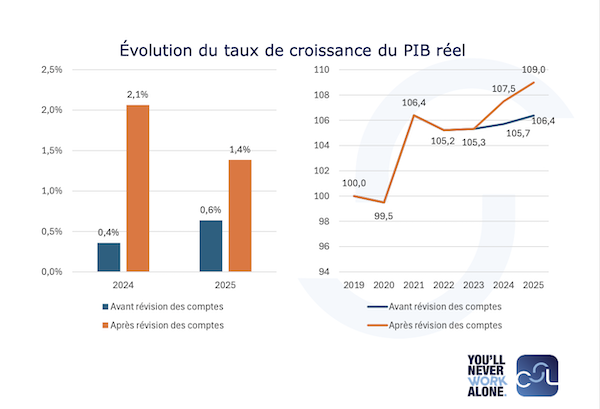
 Evolution of the real GDP growth rate;
Credit: CSL
On Wednesday 25 November 2026, Luxembourg's Chamber of Employees (Chambre des Salariés - CSL) presented its opinion on the draft state budget for 2027 and the multiannual financial programme for 2026-2030, highlighting concerns over tax fairness, employment, public investment, housing and poverty despite the country's relatively healthy public finances.
Economic Situation and Labour Market
According to the CSL, Luxembourg's economic situation is more favourable than previously estimated. The figures used in the draft state budget predate the revision of the national accounts, which revealed that Luxembourg's economic growth in both 2024 and 2025 exceeded that of the eurozone.
The CSL noted that before the revision, the share of capital in gross domestic product (GDP) had been underestimated, while the share of employee remuneration had been overestimated. Consequently, the chamber argued that the government had adopted measures based on incorrect assumptions.
While job creation has accelerated, employment growth remains weak and largely driven by the public sector. The CSL expressed concern over increasingly precarious employment, pointing to a net loss of 2,690 permanent positions compared with a net increase of 9,230 fixed-term positions between June 2025 and June 2026.
Unemployment has also increased considerably, although forecasts point towards an improvement. While unemployment remains significantly higher among people with lower levels of education, the CSL noted that the recent increase is entirely attributable to rising unemployment among people with higher education qualifications.
Public Finances
The CSL described Luxembourg's budgetary situation as “generally healthy, particularly in comparison with other European countries”.
However, despite the planned individualisation of taxation, personal income tax and value-added tax (VAT) together are expected to account for 49.7% of central government revenue in 2030, compared with 48.6% in 2026. The chamber warned that the imbalance between household and corporate contributions to public finances could increase further.
The CSL also highlighted the increase in state contributions to the Employers' Mutual Insurance Scheme (MDE), which are expected to exceed €400 million in 2027, an increase of €130 million, accounting for nearly 45% of its current revenue.
Public Investment
The share of public investment in central government expenditure is projected to decline from 13.8% in 2025 to 12.4% in 2027 and 12.2% in 2030.
Relative to GDP, public investment is also expected to decrease from 4.8% in 2025 to 4.2% in 2030.
Housing, Environment and Defence
Compared with the previous multiannual budget, planned expenditure by the Ministry of Housing for 2027 has increased from €572 million to €746 million. However, expenditure is expected to decline after reaching a peak of €752 million in 2028.
The CSL noted that the increase is largely attributable to the acquisition of properties sold off-plan (VEFA) and, to a lesser extent, subsidies for affordable housing developed directly by public housing providers, including the Fonds du Logement and the Société Nationale des Habitations à Bon Marché (SNHBM).
The chamber argued that structural reforms necessary to stabilise the housing market remain absent. These include property tax reforms, rent caps, the establishment of a national housing register, systematic rent registration and measures to bring vacant properties back onto the market.
The CSL also highlighted that expenditure from the Military Equipment Fund (FEM) considerably exceeds expenditure from both the Special Fund for Affordable Housing and the Climate and Energy Fund (FCE) throughout the 2026-2030 period.
Social Situation
The CSL described the risk of poverty in Luxembourg as a pressing issue, pointing out that 40.5% of single parents with children and 36.7% of couples with three or more children face the risk of poverty.
While welcoming increased funding for certain social benefits, including family allowances and the social inclusion income (REVIS), the chamber stressed the importance of ensuring adequate salaries and pensions before social assistance becomes necessary.
The CSL also called for improved access to social benefits, measures to reduce the number of people who do not claim benefits to which they are entitled and better protection for insufficiently covered groups, particularly young people.
Fiscal Policy
The CSL criticised the planned corporate tax reductions, questioning the financial impact and effectiveness of measures such as unlimited loss carryforward, increased investment tax credits and lower corporate income tax.
Regarding the latter, the chamber questioned the government's estimated tax revenue loss of €70 million, suggesting that the figure could reach €300 million.
The CSL also criticised the reintroduction of accelerated depreciation for property investments, arguing that the measure had previously contributed to rising housing prices rather than the creation of affordable housing. According to the chamber, the greatest tax benefits would go to large-scale property investors rather than individuals purchasing a second property.
The CSL nevertheless acknowledged two positive measures: the adjustment of personal income tax brackets by one indexation tranche; and the extension of the minimum holding period for movable assets to qualify for capital gains tax exemption from six to twelve months.
However, the chamber considered these measures insufficient to achieve greater tax fairness.