 Credit: Ievgenii Karanov, Chronicle.lu
When I received Luxembourg's new guide on how to prepare for 72 hours of self-sufficiency in an emergency, it brought back memories of the weeks leading up to Russia's full-scale invasion of Ukraine in February 2022.
At the beginning of that year, Ukrainian authorities were advising people to prepare emergency bags containing essential supplies for several days, in case the worst happened. At the time, it was difficult to believe that we might actually need them. The possibility of a full-scale war was being discussed increasingly openly, but imagining what it would mean for our everyday lives was another matter.
I was thousands of kilometres away, covering the Winter Olympics in Beijing, watching developments back home from a distance. My wife was in Ukraine, where our family was making preparations that still seemed almost unnecessary. Her parents had fuel canisters, so they filled them with petrol just in case. My wife gathered all our important documents in one place, ready to take them if we had to leave quickly.
The recommended list was practical: medication, drinking water, food, comfortable clothing, power banks and a radio, along with essential documents and other basic supplies. These were ordinary things, but putting them together meant acknowledging that something extraordinary might be about to happen.
I returned to Kyiv on 23 February 2022, on one of the last flights to arrive before the invasion. The following morning, the preparations that had seemed unlikely to be needed only days earlier took on an entirely different meaning.
When warnings still seemed distant
I remember how, in the weeks before the invasion, various experts appeared on Ukrainian television, discussing what people should include in their emergency bags. There were recommendations about food, water, medication, documents and other essentials. Such discussions gradually became part of everyday news coverage.
Yet knowing what to prepare and believing what you might actually need were two completely different things. Life continued, people went to work and families made their usual plans. The warnings were there, but the consequences were difficult to imagine until they became reality.
One memory that has stayed with me is how people rushed to cash machines in Kyiv on 24 February, trying to withdraw money as the invasion began. It demonstrated how quickly something as ordinary as access to cash could become a concern.
That experience changed the way I look at emergency recommendations. I no longer see them simply as lists of items that might never be used. They are practical measures that can make an already difficult situation slightly more manageable.
Preparing for 72 hours in Luxembourg
Luxembourg is not alone in encouraging residents to prepare for emergencies. Latvia's Ministry of Defence published its first 72-hour crisis preparedness brochure in June 2020, later updating it in 2024 with additional guidance on family emergency plans and essential supplies. Sweden distributed an updated version of its "In Case of Crisis or War" brochure to 5.2 million households in November 2024. In March 2025, the European Commission also presented its Preparedness Union Strategy, which includes plans to develop guidelines to help people remain self-sufficient for at least 72 hours.
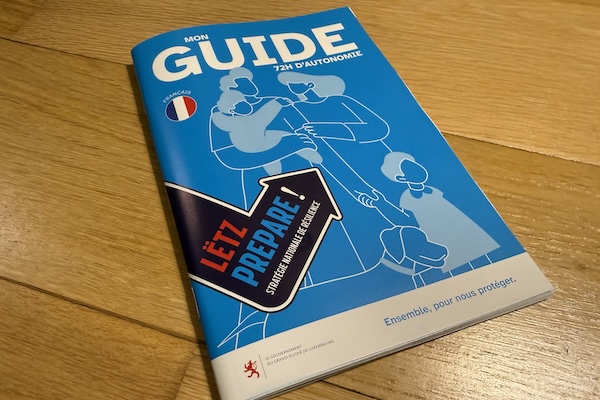
In Luxembourg, the new "My Guide to 72 Hours of Self-Sufficiency", published as part of the national resilience strategy "Lëtz prepare!", addresses a wide range of potential emergencies. These include a range of natural disasters, third party attacks or accidents, including storms, floods, major power cuts, pandemics, cyberattacks, terrorist threats and industrial or nuclear accidents.
The guide explains that such events can disrupt access to essential services, including drinking water, electricity, telecommunications and transport. Its central recommendation is that households should be able to meet their basic needs independently for at least 72 hours.
The reasoning is straightforward. During the first three days of a crisis, emergency services may need time to assess the situation, organise their response and prioritise assistance for vulnerable people. Households that have prepared in advance can reduce their immediate dependence on those services.
The practical checklist recommends at least three litres of water per person per day, non-perishable food, essential medication, a first aid kit, blankets, suitable clothing, torches, spare batteries, power banks and a battery-powered or wind-up radio. It also includes copies of important documents, useful telephone numbers, hygiene products and cash.
The guide recommends adapting these supplies to the needs of children, elderly people, pets and anyone requiring regular medication. It also advises checking expiry dates at least twice a year and keeping the kit somewhere safe and accessible.
One particularly useful section describes a fictional 72-hour power outage in Luxembourg. It shows how a loss of electricity could affect much more than lighting: mobile networks, public transport, water supplies, heating, electronic payments and cash machines could also become unavailable.
This example brought back my memories of Kyiv. In particular, I was struck by the inclusion of cash in the official checklist. It is a small detail, but one whose importance I remember very clearly.
The guide also explains how residents can receive official warnings through LU-Alert, including mobile notifications, SMS messages, Cell Broadcasts, sirens and other communication channels. It stresses the importance of following instructions from public authorities, checking information before sharing it and keeping telephone lines available for emergency services.
Importantly, preparation is not limited to buying supplies. The guide encourages every household to draw up a personal emergency plan, including contact details, meeting points and arrangements for situations in which family members cannot communicate or return home as usual.
Preparation without panic
Here in Luxembourg, I sometimes run into a neighbour in our building's underground car park. Her garage contains an impressive amount of stored supplies. Whenever I see it, I find myself wondering whether I should install some shelves in our own garage and gradually put aside things that might prove useful in an emergency.
I have not done so yet. But after reading the guide, the idea seems increasingly reasonable. It does not necessarily require a major investment or an enormous amount of storage space. Even setting aside a few essential items and discussing an emergency plan with family members would be a start.
Another point emphasised in the Luxembourg guide is the importance of helping others. Preparedness is presented not only as an individual responsibility but also as a collective effort. Checking on neighbours, helping vulnerable people and sharing useful information can make a difference when emergency services are under pressure.
I think this is an important message. Having experienced the first days of a full-scale invasion, I know that plans do not always unfold as expected. Circumstances change, communication becomes difficult and people have to make decisions with limited information.
Of course, the circumstances facing Luxembourg today are not the same as those Ukraine faced in February 2022. The Luxembourg government's guide does not suggest that a particular disaster is imminent. It is intended to help residents prepare for a range of possible disruptions.
But that distinction does not make the recommendations any less relevant. If anything, preparing in a calm environment, without the pressure of an immediate threat, offers an opportunity to think more clearly about what a household might need.
Four years ago, I struggled to believe that an emergency bag could become a necessity. Today, when I look through Luxembourg's 72-hour guide, I no longer ask whether such preparations are excessive. I ask whether my family is prepared.
The full English-language guide is available on the Lëtz prepare! website.