 Credit: Jonk Entrepreneuren Luxembourg © Pierre Levy / www.levygraphie.lu
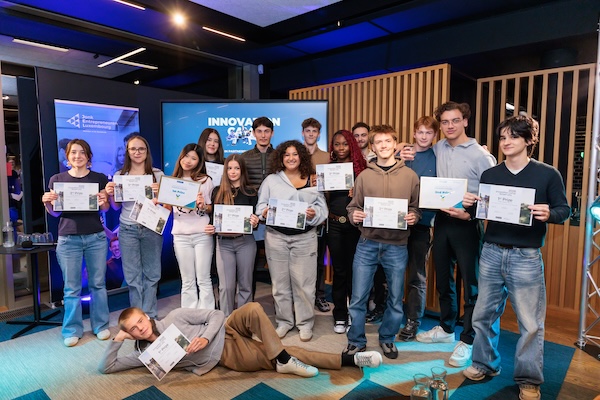
Jonk Entrepreneuren Luxembourg (JEL) has announced that, in collaboration with Schroeder & Associés, it organised an Innovation Camp in Kockelscheuer on Thursday 12 November 2026, bringing together 45 students from Luxembourg secondary schools to develop ideas for more sustainable and practical cities.
The event focused on the challenge "Smart City – Imagine the City of Tomorrow!", encouraging students to find solutions to urban issues such as housing, mobility, renewable energy and water management.
Divided into ten teams, participants took part in a LEGO Serious Play workshop led by Marcin Kanaiaburka, founder of LetzBricks. Using LEGO bricks, students explored problems and developed ideas without relying on mobile phones or artificial intelligence (AI) tools.
In the afternoon, the teams further developed their proposals before presenting them to a jury of five professionals.
Thierry Flies, Managing Director of Schroeder & Associés, highlighted the importance of involving young people in urban planning. "We too often plan according to our own vision, whereas in reality, we are building for young people and for the future. It is therefore essential to listen to how young people imagine the city of tomorrow," he said.
The first prize went to GreenGrow Commune, a sustainable neighbourhood concept combining affordable housing, green spaces, local businesses and employment opportunities. The proposal also included renewable energy, green buildings and a rainwater collection and reuse system designed to reduce flood risks.
Second place went to Piece by Peace, which proposed installing kinetic flooring in busy public spaces to generate electricity from pedestrians' footsteps. The team suggested using the energy to support electric bicycle stations and encourage sustainable transport.
Meanwhile, the third-place project, Smart Stormwater, focused on intelligent rainwater management. Using sensors and data analysis, the proposed system would monitor water flows, anticipate flooding and store rainwater for reuse in agriculture and municipal services.
A fourth team received the Jury's Favourite prize for its vision of a greener city, with fewer spaces dedicated to cars, more cycling and pedestrian infrastructure, solar panels and measures to protect biodiversity.
The Innovation Camp forms part of JEL's educational initiatives, allowing students to work on real-world challenges alongside professionals while developing creativity, teamwork and problem-solving skills.