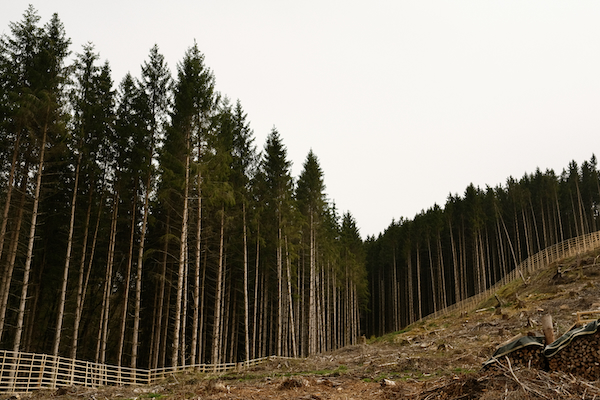
 Forest management in Clervaux, northern Luxembourg;
Credit: Steven Miller, Chronicle.lu
Forest management in Clervaux, northern Luxembourg;
Credit: Steven Miller, Chronicle.lu
Luxembourg’s land mass is covered by approximately 92,000 hectares of forest, blanketing around 35% of the country’s land and defining the landscape of the north of the Grand Duchy. Sadly, less than fifteen percent of those trees can be described as being in a state of good health and this presents a major risk.
As the number of wildfires across Europe in 2026 continues to grow to record-breaking proportions, and in the midst of warnings about dangerously low rivers levels and country-wide drought, Luxembourg faces an environmental problem which is only a spark away from being a potential disaster.
Warnings about the poor condition of Luxembourg’s trees have been sounded for years by the country’s nature and environmental groups. Since 1984 Luxembourg’s Nature and Forestry Administration (ANF) has been monitoring the condition of Luxembourg’s forests on a yearly basis, creating a “Phytosanitary Inventory” detailing the condition of the foliage, the colour of the leaves or needles, the presence of parasites or fungi and any other observable damage or risks to the country’s trees.
Over the course of 20 years these studies have recorded a dramatic shift in the health of Luxembourg’s forests, with the observed number of fully healthy trees dropping from a value of around 80% in 1984 to just under 15% today.
According to the most recent study in 2023:
⁃ 14.5% of trees showed no damage (damage class 0);
⁃ 18.2% of trees were slightly damaged (damage class 1);
⁃ 55.0% of trees were moderately to severely deteriorated (damage class 2);
⁃ 2.3% of trees were declining or dead (damage classes 3 and 4).
ANF noted that the weather conditions during the reference period for the 2023 study were similar to those of the previous four periods and were characterised by high temperatures and long periods of drought, which meant already weakened trees continued to suffer and their phytosanitary condition had deteriorated further.
According to the ANF, additional factors contributing to this dramatic decline include the impact of air pollutants, forest management, tree age and the adaptability of each tree based on its species and/or environment.
The impact of each of these factors is arguably different but the outcome undeniably leaves Luxembourg’s forest (and their associated ecosystems) in a precarious place.
Despite efforts the issue grows
Looking at each contributory factor, in terms of air pollutants, since 1990 the Luxembourg Informative Inventory Report has provided long-term emissions data from across the country and the results show a huge improvement in the overall air quality. Yet, despite this, the overall number of healthy trees has continued to decline.
Forest management has moved on leaps and bounds in the past 20 years, with improvements in forest monitoring, species diversity, protection for older trees and the introduction of legal frameworks. But, again, the population of healthy trees continues to fall.
Fundamentally, this leaves weather conditions and climate change as the main culprits in the observed degradation. Decisively, there is little a country the size of Luxembourg can do about mitigating such global effects, other than adopting the best practices to demonstrate what can be done, and by educating the population about the impact of their lifestyles on the climate and the environment. Sadly, Luxembourg has quite the reputation for saying and not doing when it comes to undertaking meaningful environmental action.
Climate change not only affects short and long term weather patterns, it also modifies the environment, allowing certain parasites to prevail where they would previously have been unable to make a foothold. One example of this is the 100,000 m2 of spruce monoculture in Niederfeulen, which was completely destroyed by bark beetles. To regenerate this area, the Hëllef fir d’Natur Foundation is driving a campaign where several interventions are planned on two-hectare plots, including planting birch coppices, mixed oak forests and beech stands, promoting natural regeneration and converting coppices into high forest. This, along with other measures being implemented is worthy of mention but truthfully only beneficial to a tiny percentage of Luxembourg’s overall forest area.
Droughts & Wildfires
Europe’s ongoing droughts are another concern. The continent has been experiencing recurring drought conditions since 2018, with the period of 2018 to 2020 representing the most extensive drought seen on the continent in at least 250 years. In Luxembourg there are currently bans on water extraction, with authorities urging residents to be prudent about water use.
This prolonged lack of rain has huge implications on the health of the country’s trees. Often viewed as natural buffers against climate change through the storing of carbon, cooling the local climate, regulating the groundwater and ensuring the health of the soil, Luxembourg’s trees are becoming more brittle and transforming into literal fuel for the fire; fires which release stored carbon into the atmosphere, further fuelling the vicious cycle of wildfires we currently see unfolding across major areas in Europe today.
Ironically, the wildfires currently being experienced across Spain were preceded by the country’s wettest January in the last quarter of a century. Rainfall 175% higher than usual allowed for a great accumulation of plant biomass, which has now dried out because of the high temperatures and extreme drought being powered by climate change.
While Luxembourg has not yet experienced catastrophic wildfires, it has not been immune to the effects of high temperatures and drought, and vegetation fires are becoming a common occurrence here during the summer months. 2022 in particular saw a high number such incidents, with the CGDIS dealing with 24 incidents between the months of May and August (Source: 112.lu).
Approximately half of those occurred in northern municipalities where there are logistical challenges in how to deal with them partly due to to the terrain and also lack of proximity, and access, to fire-fighting equipment. Should a significant forest fire occur in, for example, the Our Nature Park (Parc naturel de l'Our), the emergency services will likely require assistance from neighbouring countries in tackling it. Mercifully, 2026 has not seen similar levels but, when looking at European-wide statistics, there has been a significant increase in both the number and scale of such fires across the continent.
According to the European Forest Fire Information System (EFFIS), as of 1 July 2025, Europe had seen 196,407 hectares burnt since the start of that year - more than double the 77,900 hectares burnt during the same period in 2024. At that point, a total of 1,040 fires were recorded during the same period (compared to 688 in 2024).
With the authorities in Spain and France reporting that the recent wildfires there have already broken records, it is hard to ignore the alarming rate and scale at which these environmental disasters are occurring so close to home.
How can Luxembourg prepare?
In 2024, Luxembourg-based cargo airline Cargolux launched Aquarius Aerial Firefighting (Aquarius AFF), a business unit to support international efforts. The airline said: "Extreme weather patterns, global warming and their consequences, such as wildfires, are an increasing issue for global communities,” and stated that Aquarius AFF "aims to provide assistance in the fight against devastating wildfires that threaten human lives, natural resources and significantly contribute to global CO2 emissions."
The CGDIS also continues to upgrade its ability to respond to emergency incidents; recently announcing the introduction of 76 new vehicles to its fleet. Although not all of these are specifically located or configured to deal with wild or forest fires, the implications of such incidents do necessitate the need for a variety of emergency vehicles (ambulances, off-road and support vehicles) to be available and the CGDIS should be praised for investing in such upgrades.
In the capital, the VdL has joined with Luxembourg's Ministry of the Environment, Climate and Biodiversity, the Nature and Forest Agency (ANF) and the Luxembourg Institute of Science and Technology (LIST), to plant a new experimental forest as part of the research project "FORLUX - Health, adaptation and resilience of Luxembourg City forests". This will see nearly 3,500 trees will be planted on a one-hectare site in "Eecherfeld" in the Muhlenbach district, allowing for the study and comparison of several types of mixed forests. The plots will be equipped with sensors to collect data on tree health and air quality in relation to weather conditions, the amount of water infiltrated into the soil and the carbon stored in the trees and soil. This system will allow for the observation of the resilience and evolution of different types of tree in the face of climate change, as well as their potential role in protecting groundwater quality.
The Ministry of the Environment, Climate and Biodiversity said the project will allow it to assess the resilience of municipal forests to the major climate disturbances observed over the past five years and to support the adaptation of forest management to current and future weather conditions across the country.
All of these initiatives are commendable but there is another significant risk factor.
The greatest risk is ignorance
State and private investment in forest management and emergency response is, in the current climate (pun firmly intended), absolutely necessary but one of the most useful forms of mitigation is simple common sense, and the secret to ensuring this lies in educating the public on the risks of wildfires.
The CGDIS has published a list of prevention tips for the public and farmers and calls on the country’s residents to be vigilance and responsible in relation to the use of barbecues, open fires, using vehicles in forest areas and discarding lit cigarettes. Thanks to the impacts of climate change these habits now have to be observed year round because prolonged warm and arid periods can occur at any point, in any season. It is no longer just a summer problem.
It is our job as residents to understand the risks which are all around us. Even with well-trained, well-equipped emergency services and significant investment in environment management, there is now the potential for naivety and ignorance to damage the country’s ecosystems and people’s lives.
In a time of prolonged drought and rising temperatures, we need to teach that long term consequences can be sparked in an instant.