Today, Friday 12 August 2016, is International Youth Day; Adecco has published a survey which aimed to determine the perception of the future employment prospects of young people, as well as knowing the skills and knowledge that they consider necessary to get a job in general, or the job of their dreams in particular.
The Adecco Group survey shows that 77% of Young Adults Confident they will Find Work in 1st Year after Studies.
The survey finds that - in stark contrast to the prevailing narrative – most are confident they will find work quickly, and believe they are equipped with the right skills to land their dream job. Work experience is what they need most to succeed.
The survey covered 9,572 young adults, aged between 18 and 30 years of age across 13 countries, to gauge expectations about the world of work and their awareness of the skills required by the labour market. Almost 8 out of 10 (77.47%) respondents believe they will find a job within a year of finishing their studies.
Young Swiss adults are the most confident (89.66%), followed by their peers in the USA (84.38%), while their Spanish counterparts are the least so (57.84%), understandable given a youth unemployment rate of 45.8%.
Almost three quarters (73.08%) of respondents feel they are equipped with the right skills. Germans are the most confident (89.11%), while the Japanese emerge as the most insecure (31.54%). Regarding the specific skills needed for the future of work, languages (56.68%) and practical experience (53.70%) are cited as most relevant, with digital skills third (41.48%). More than two-thirds (68.45%) say they have a dream job in mind. When asked what they needed most to get it, work experience was ranked first. As to aspirations over the next 10 years, financial stability comes first, followed closely by being in their dream job and working for a socially responsible company.
Respondents’ optimism appears surprising considering the current talent mismatch worrying employers: 40% claim they cannot find the right skills for their businesses. However, the survey showed young people are heading in the right direction and have an understanding of the priorities required to get onto the job ladder.
In a world of continuous change, knowledge and hard skills become obsolete more quickly. Similarly, soft skills such as creativity, openness to continuous learning and social intelligence become increasingly important. Work experience is fundamental for the development of soft skills. Previous research by the Adecco Group has found that countries with established systems of vocational training, such as Switzerland and Germany, are particularly successful in tackling youth unemployment.
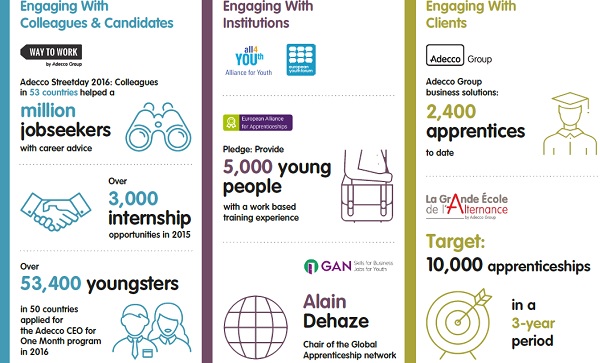
Solutions are needed urgently. In the short term, the private sector can support young people through guidance and internships. In the medium term, however, structural reforms are required to update traditional formal education systems and integrate them with vocational schemes, such as apprenticeships.
Alain Dehaze, Adecco Group CEO, said: “I encourage young people to keep thinking big, holding onto their dreams and building the foundations for their future. However, youth employment is a shared responsibility. Public-private alliances are essential to design education systems able to shape profiles with the skills the labour market needs, in the interest of young people and society as a whole”.