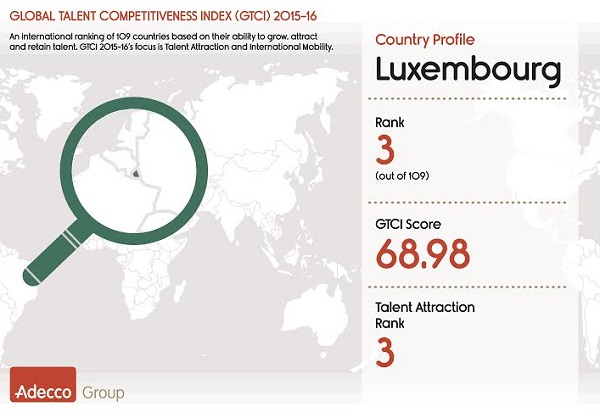
The INSEAD business school today released the Global Talent Competitiveness Index (GTCI) 2015-16, in which it was revealed that Luxembourg has retained third place from the previous year.
The annual study was based on research in partnership with the Adecco Group and the Human Capital Leadership Institute of Singapore (HCLI) and this year focused on 'Talent Attraction and International Mobility'.
Under this theme, findings examined the link between movement of talent and economic prosperity, with mobility deemed vital in filling skill gaps and a high proportion of innovative, entrepreneurial people found to have been born or studied abroad. Unsurprisingly, the top ranking countries of Switzerland (1st); Singapore (2nd) and Luxembourg (3rd) are those that have proved attractive destinations for high-skilled workers.
New types of migrations flows have indicated that decision makers will need to shape policies and strategies to cater to the concerns of their constituencies as well as the longer-term interests of their citizens, with Alain Dehaze, CEO of Adecco Group stating: "The world of work is changing faster than ever, bringing both great opportunities and challenges."
"With the dynamics of global labour markets shifting rapidly, the GTCI is increasingly relevant for key influencers looking for quantitative instruments and recommendations to help boost competitiveness and bridge the labour challenges they face; even major economies such as China, Germany and Brazil will not be spared from severe labour shortfalls," Dean of INSEAD, Ilian Mihov, said of the results. "We are encouraged that the GTCI 2015-16 emphasis on the importance of vocational education has generated positive feedback across the world, and we are now seeing vocational training emerging as a cornerstone in many policy approaches. In the coming years and beyond, we look forward to continually engage our global audience in high-quality dialogue as part of our efforts to help key decision makers and influencers boost talent competitiveness and prosperity."
Nearly 25% of the populations of both Luxembourg and Switzerland were born abroad, reflecting the former's Talent Attraction Rank of 3 and overall GTCI Score of 68.98 which saw it preserve its ranking of 3rd out of 109 countries. The other top 10 countries also proved to be open to talent mobility in terms of externally-born population proportions, including the US (4), Canada (9), New Zealand (11), Austria (15) and Ireland (16).
The top 20 of the GTCI has experienced little change since the 2014 edition of the report, with the exception of Czech Republic joining the fold at number 20, New Zealand significantly improving its performance, and Canada and Ireland experiencing modest declines.
Paul Evans, The Shell Chair Professor of Human Resources and Organisational Development, Emeritus, at INSEAD, and Academic Director and co-editor of the Global Talent Competitiveness Index, noted: “Our global data analysis shows it takes more than pay to attract and retain talent, also from abroad — the quality of management practices is increasingly important. While higher educational opportunities remains a key factor of talent attraction and retention, an increasingly important pull factor lies in the professionalism of companies and management practices, exemplified by highly ranked Nordic countries which score particularly high on meritocracy, professional management and attention to employee development. This is especially important for the millennial generation who will become the creative leaders of the future."
Analyses of the scores registered by individual countries revealed eight key patterns:
- Mobility has become a key ingredient of talent development: creative talent cannot be fully developed if international mobility and ‘brain circulation’ are not encouraged.
- The migration debate needs to move from emotions to solutions: countries will find it advantageous to address movements of people through a talent perspective.
- Management practices make a difference in attracting talent: apart from monetary incentives and standard of living, another important differentiator in talent attraction is the professionalism of management and investment in employee development.
- While people continue to move to jobs and opportunities, jobs are now moving to where the talent is: some countries have started to attract the attention of international investors because of creative talent at a reasonable cost: China, South Korea, Philippines and Vietnam in the Asia Pacific region; Malta, Slovenia, Cyprus and Moldova in the European region; Turkey, Jordan and Tunisia in the MENA region; and Panama in Central America.
- New ‘talent magnets’ are emerging: While the US, Singapore and Switzerland have long been attractive to talent, competition may become fierce among emerging talent hubs such as Indonesia, Jordan, Chile, South Korea, Rwanda and Azerbaijan, as more aspire to join these increasingly attractive destinations.
- Low-skilled workers continue to be replaced by robots, while knowledge workers are displaced by algorithms: as mobility continues to be redefined in new ways, notably through technology, knowledge workers are affected and this shift signals that entire sectors of activity may be displaced. Some people may have to work virtually for different employers from their homes, while others have to retrain and move far to obtain jobs.
- In a world of talent circulation, cities and regions are becoming critical players in the competition for global talent: agility and branding of cities seem to be more critical differentiators than size as an increasing number of large cities adopt imaginative policies to attract global talent.
- Scarce vocational skills continue to handicap emerging countries: gaps in vocational skills continue to exist in emerging countries such as China, India, and South Africa, and particularly in Brazil where talent capabilities show signs of weakening on all fronts. This is also true for some high-income countries such as Ireland, Belgium and Spain.
Photo by GTCI