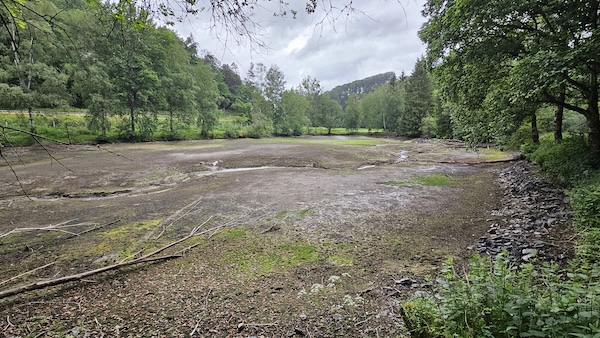
 The Rossmillen ponds, located in the hamlet of Rossmillen, within the municipality of Weiswampach, in the canton of Clervaux;
Credit: Hëllef fir d’Natur Foundation
The Rossmillen ponds, located in the hamlet of Rossmillen, within the municipality of Weiswampach, in the canton of Clervaux;
Credit: Hëllef fir d’Natur Foundation
On Wednesday 24 June 2026, the Hëllef fir d’Natur Foundation announced the launch of a renaturation project for the Rossmillen ponds, located between Weiswampach and Clervaux in the Éislek region in northern Luxembourg.
Hëllef fir d’Natur detailed that the first visible step is the complete drainage of the three ponds, which is essential to allow the drying of sediments ahead of the planned ecological engineering works. The ultimate goal is to restore ecological continuity and the natural dynamics of the Wemperbach, transforming a landscaped park-type area into a fully functioning nature reserve.
A site at the heart of Luxembourg’s Éislek region
The Rossmillen ponds, owned by the Hëllef fir d’Natur Foundation, are located in the hamlet of Rossmillen, within the municipality of Weiswampach, in the canton of Clervaux. Situated in the Wemperbach valley (Luxembourgish: Wemperbach), they form one of the few natural water bodies on the Luxembourg Ardennes plateau. This stream, a tributary of the Clerve, drains the high plateaus of the Éislek, a region of hills and forests characteristic of the Luxembourg Ardennes. Previously considered more a leisure area than a genuine biotope, the site is now set to undergo a profound ecological transformation.
Why drain the ponds?
Hëllef fir d’Natur observed that in recent weeks, residents of northern Luxembourg may have been surprised to see that the three Rossmillen ponds have dried up. They revealed that this drainage is not accidental: it is the first operational step in a renaturation project led by the foundation in partnership with the relevant authorities.
The sediments accumulated at the bottom of the ponds — also known as silts or muds — must be allowed to dry out before any mechanical work can take place. This drying process, which may take several months depending on weather conditions, will significantly improve access for construction machinery and reduce the impact of earthworks. Without this preparatory phase, the expected ecological benefits could not be achieved under proper technical conditions.
Restoring the Wemperbach to Its natural course
Hëllef fir d’Natur said that at the heart of the project is the diversion of the Wemperbach away from the three ponds. At present, the stream flows directly through the ponds, effectively turning it into a series of artificial impoundments. Combined with existing cascades, these barriers form an impassable obstacle for migratory fish species — trout, minnows, and bullheads — preventing them from completing their life cycles.
Restoring the ecological continuity of watercourses is recognised as one of the most effective measures for conserving aquatic biodiversity. By allowing the Wemperbach to return to its original riverbed and bypass the ponds, the project will restore free movement of fish and sediments along this section.
Re-meandering: a key measure with multiple benefits
The foundation explained that restoring the stream to its natural course will also allow the Wemperbach to regain its meandering dynamics. A winding watercourse across its floodplain is far more than a simple drainage channel: it is a living ecosystem in which each bend creates a diversity of habitats — deep pools, riffles, gravel banks and floodplain zones — supporting a wide range of species.
The scientifically documented benefits of re-meandering include:
• reduction of flood risk: meanders slow down water flow and promote infiltration into floodplains, reducing downstream flooding;
• natural water filtration: riparian vegetation and associated wetlands act as natural filters for nitrates and suspended solids;
• habitat diversity: the alternation of calm and fast-flowing zones creates a mosaic of habitats favourable to macroinvertebrates, amphibians and bird species;
• thermal regulation: shading from riparian vegetation helps maintain water temperatures suitable for salmonids, particularly brown trout;
• carbon storage: restored wetlands act as significant carbon sinks, contributing to climate change mitigation.
Reshaping the banks
The third component of the works concerns the morphological transformation of the ponds themselves. In their current configuration, the steeply sloped banks (trough-like profiles) are poorly suited to amphibian reproduction — such as frogs, newts and midwife toads — which require gently sloping, sun-warmed shoreline zones accessible from land. Gradual reshaping of the banks will create belts of emergent aquatic vegetation (reeds, rushes and sedges) essential for egg-laying and larval development of these species, several of which are listed under Annex IV of the European Habitats Directive.
From leisure area to functional nature reserve
In its current state, the Rossmillen site resembles a landscaped recreational park more than a nature reserve. The ongoing project aims to reverse this logic by prioritising ecological value over conventional aesthetic appeal. The Hëllef fir d’Natur Foundation, which manages more than 2,050 hectares of nature reserves across Luxembourg, applies its established methodology for restoring aquatic environments at this site, similar to interventions carried out in other Ardennes valleys such as the Trëtterbaach and the Our valley.
“This project represents a concrete investment in the restoration of aquatic ecosystems in northern Luxembourg. By returning freedom to the Wemperbach, we are contributing to local biodiversity resilience and water quality for future generations,” said Hëllef fir d’Natur Foundation.