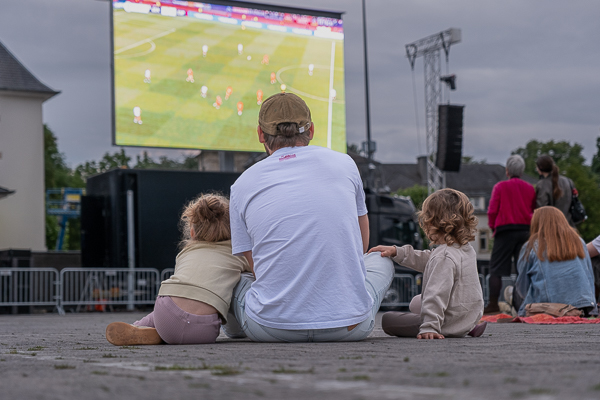
 Credit: Ali Sahib, Chronicle.lu
As the FIFA World Cup kicks off across the United States, Mexico and Canada, some of the tournament's biggest talking points have already emerged long before the opening whistle.
I still remember how difficult it could be simply to reach a World Cup.
While covering the 2022 FIFA World Cup in Qatar, one of my colleagues spent three days stranded in Warsaw after an error in the Hayya registration system prevented him from obtaining the QR code required to board his flight. At the time, the digital entry system was one of the most discussed aspects of the tournament, with supporters anxiously checking whether their applications had been approved before travelling.
Ahead of FIFA World Cup 2026, which kicks off on Thursday 11 June 2026, the challenges surrounding access to a World Cup have taken on a different dimension. Before a single match has been played, reports have emerged of visa difficulties affecting members of official delegations, enhanced screening procedures for some participating teams, ESTA visa waiver being revoked and even the denial of entry to a FIFA referee selected for the tournament; we understand that the reason given in that particular case was that Somalia is on the list of countries that nationals are barred entry to the US - surely FIFA and the US should have resolved this before he travelled?
It is a reminder that the modern World Cup is no longer simply a football competition. It is a global event involving politics, security, technology, logistics, commerce and diplomacy on a scale unmatched by almost any other sporting occasion. Maybe the next Summer Olympics in Los Angeles in July 2028 could be facing similar challenges?
That scale will be greater than ever before at FIFA World Cup 2026. For the first time, 48 national teams will compete across three host countries in a tournament featuring 104 matches. US President Donald Trump recently compared the competition to hosting "104 Super Bowls", and while the comparison may sound exaggerated, it perhaps comes closer to reality than many football supporters would like to admit.
FIFA's decision to introduce the first half-time show in World Cup history is perhaps the clearest example of that shift.
More Than Football?
One of the most striking developments ahead of the tournament has been FIFA's willingness to embrace elements traditionally associated with North American sports and entertainment.
When announcing plans for the final at MetLife Stadium in New Jersey, FIFA President Gianni Infantino confirmed that the match would feature the first-ever halftime show in World Cup history. Produced in cooperation with the international advocacy organisation Global Citizen, the performance is expected to involve several major artists, although the full line-up has yet to be revealed.
The move reflects a broader trend. In the United States, major sporting events are often designed as entertainment spectacles as much as sporting contests. The Super Bowl half-time show has become a global event in its own right, attracting audiences far beyond American football fans. By introducing a similar concept at its flagship tournament, FIFA appears eager to expand the World Cup's appeal beyond its traditional football audience.
The governing body has also placed increasing emphasis on fan festivals, music performances and commercial activations around host cities. None of this is entirely new - concerts and entertainment programmes have accompanied previous World Cups - but the scale of the 2026 tournament and its North American setting suggest that these elements may receive greater prominence than ever before.
For European supporters accustomed to football being the undisputed centre of attention, the coming weeks may offer a glimpse of how the sport evolves when it enters a market where it still competes with the NFL, NBA, MLB and NHL for headlines, audiences and commercial attention.
Football Comes to America
One of the more intriguing questions surrounding FIFA World Cup 2026 is whether it will accelerate football's growth in a country where the sport still competes with American football, basketball, baseball and ice hockey for public attention. Even the terminology reflects this difference: while much of the world calls it football, in the United States it remains widely known as "soccer", a term also used in Ireland, Australia and Japan.
Yet the sport's position in North America is very different from what it was twenty years ago. Major League Soccer has expanded steadily, attracting new investors, larger crowds and increasing international attention - it is now big business. Lionel Messi's arrival at Inter Miami in 2023 significantly raised the league's global profile, while FIFA has increasingly viewed the United States as one of its key growth markets.
The country also served as host of the expanded FIFA Club World Cup in 2025, widely viewed as a dress rehearsal for the World Cup. The tournament produced mixed results, with some matches attracting impressive crowds while others exposed the difficulty of filling large stadia for fixtures involving less globally recognised clubs. Nevertheless, it offered a glimpse of both the opportunities and challenges awaiting football's biggest competition.
Whether the FIFA World Cup 2026 ultimately transforms the sporting landscape remains to be seen. However, with the tournament spread across North America and expected to attract millions of visitors and billions of viewers worldwide, FIFA will be hoping that football / soccer, emerges from the summer with an even stronger foothold in the United States than it had before the opening match.
Heat, Hydration and Conditions
Not all pre-tournament discussions have focused on football, security or entertainment. Weather conditions have also emerged as a recurring concern, particularly for matches scheduled in some of the warmer host cities across the United States and Mexico, often timed to maximise television audiences in countries when their teams are playing, with some arguing this is putting player welfare at risk.
Several players, coaches and medical experts have raised questions about the impact of high summer temperatures on performance and recovery, especially given the demanding travel schedule and the expanded 48-team format. While many matches will take place in modern stadia equipped to mitigate extreme conditions, others will be played in environments where heat and humidity could become significant factors.
Organisers have sought to reassure participants that player welfare remains a priority. Nevertheless, concerns have persisted in the build-up to the tournament. One issue that attracted considerable attention involved stadium regulations concerning water bottles. Just days before the opening match, FIFA faced criticism after introducing restrictions on reusable bottles entering stadia , citing safety concerns. Following the backlash, the organisation clarified that supporters would still be allowed to bring one factory-sealed plastic water bottle of up to 560 ml into venues, while refillable hard-sided containers would remain prohibited.
The debate highlighted broader concerns about spectator comfort / welfare during a tournament expected to be played in high summer temperatures. Although FIFA has pointed to the availability of water inside stadiums and pledged not to charge above normal venue prices, some heat experts argued that restrictions on reusable bottles could increase the risk of heat-related incidents among supporters.
Such issues are unlikely to decide the tournament on their own. However, as Qatar 2022 demonstrated in very different climatic circumstances, environmental conditions can become an important part of the World Cup narrative, with pitch-side cooling fans installed at stadia for player welfare. Over the course of a month-long competition, heat, travel, recovery time and squad depth may prove almost as important as tactics and individual talent.
The Main Attraction
Ultimately, however, the success of World Cup 2026 will be judged not by security arrangements, half-time shows or television audiences, but by what happens on the pitch.
Defending champions Argentina arrive among the bookmakers' favourites, alongside Spain, France, England and Brazil. Spain will seek to build on the momentum created by their UEFA Euro 2024 triumph, while France continue to possess one of the deepest squads in international football. England once again carry the hopes of a nation still waiting for a first major trophy since 1966, while Brazil will attempt to end a World Cup drought stretching back to 2002.
An intriguing historical statistic may work in favour of some teams. Since the inaugural World Cup in 1930, no nation has ever won the tournament under a head coach who is a non-national. That could strengthen the cases of Argentina's Lionel Scaloni, Spain's Luis de la Fuente and France's Didier Deschamps. By contrast, England are coached by German manager Thomas Tuchel, Brazil by Italian Carlo Ancelotti and Portugal by Spanish coach Roberto Martínez.
History, however, also suggests caution when discussing favourites. Few predicted Morocco's remarkable run to the semi-finals at the FIFA World Cup in Qatar in December 2022, where they became the first African nation to reach the last four before eventually finishing fourth after defeats to France and Croatia. Every World Cup tends to produce at least one surprise package, and the expanded 48-team format may create even greater opportunities for unexpected stories.
The tournament itself will also look different. For the first time, 48 nations will compete across 104 matches, significantly increasing the number of teams and fixtures. While the larger format offers more countries the chance to participate, questions remain about how it will affect competitiveness over the course of a month-long tournament. While it increases the possibility for more/all squad members to play at least once in the tournament, certainly for the stronger teams who may rest players / rotate squads in the early games at least, it does increase the chance for one-sided games.
As Qatar 2022 demonstrated, predictions made before the opening match often age poorly. Injuries, momentum, tactical adjustments and individual moments of brilliance can quickly reshape expectations. Local conditions may also play a role, with high summer temperatures in parts of North America potentially favouring some teams more than others. For all the analysis and bookmaker odds, the World Cup remains one of the few sporting events where almost anything can still happen.
Security, Borders and Politics
Security and border issues have also become an unexpected part of the pre-tournament conversation. In recent weeks, international media have reported on a fatal shooting near England's team base in Kansas, while organisers in Mexico have faced questions about security arrangements amid ongoing concerns related to cartel violence in parts of the country.
Several participating teams have also reportedly encountered unusually thorough arrival procedures. Delegations from countries including Uzbekistan and Senegal were subjected to extensive screenings upon entering the United States, with authorities carrying out detailed baggage inspections and deploying police dogs as part of security checks.
One of the most widely discussed incidents involved Somali referee Omar Abdulkadir Artan, who had been selected as one of seven African referees for the tournament and would have become the first Somali official to referee at a FIFA World Cup. According to reports, Omar Artan was denied entry to the United States, questioned for several hours and later returned on a flight without being given a clear explanation. Questions have also been raised over visa procedures affecting some members of the (non-playing) Iranian delegation.
None of these developments are directly related to the football itself. Nevertheless, they illustrate the logistical, political and security challenges facing organisers of a tournament spread across three countries, multiple legal jurisdictions and thousands of kilometres.
Watching the World Cup in Luxembourg
Following the tournament from Luxembourg will present its own challenges. While some matches will kick off at convenient evening hours, many fixtures are scheduled for midnight, 03:00 or even 06:00 CET, making the 2026 World Cup one of the least accessible editions for European television audiences in recent memory.
Those wishing to watch matches in a social setting will nevertheless have several options. The City of Luxembourg plans to open a World Cup fan zone at the Glacis from the Round of 16 onwards, although by that stage 89 of the tournament's 104 matches will already have been played. Elsewhere, venues such as Kyosk and The Game in Luxembourg-Kirchberg, Oscar's Bar & Kitchen in Luxembourg-Grund and Casino 2000 in Mondorf-les-Bains are among those expected to screen matches throughout the competition.
Several municipalities are also planning public screenings. Bettembourg will show the semi-finals and final on a giant outdoor screen at Parc Jacquinot, while outdoor screenings are also planned in Differdange and Hesperange. In Bertrange, World Cup broadcasts will form part of the Summer am Duerfgaart programme from 4 July 2026.
For many supporters, however, the reality of this World Cup may ultimately be late nights, early mornings and carefully planned alarms rather than traditional evening kick-offs.
Yet despite the visa controversies, security concerns, half-time shows, political debates and awkward kick-off times, billions of people will still tune in over the coming weeks. Over the next five weeks, from 11 June to 19 July 2026, the world's attention will gradually shift from politics, logistics and security towards the football itself.
For all the changes surrounding the modern World Cup, its greatest strength remains unchanged. The tournament still possesses a unique ability to stop the world and place football - or soccer - at the centre of the global conversation.