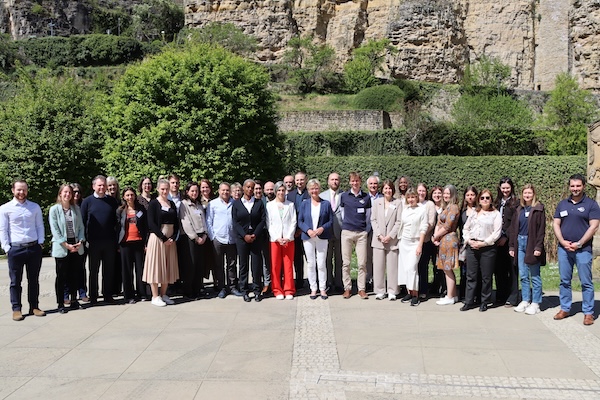
 Group photo;
Credit: Luxembourg’s Directorate for Consumer Protection
Group photo;
Credit: Luxembourg’s Directorate for Consumer Protection
On Friday 24 April 2026, Luxembourg’s Directorate for Consumer Protection announced that Luxembourg hosted an informal meeting of National Enforcement Bodies (NEBs) responsible for enforcing air passenger rights across the European Union (EU).
The first day of the meeting took place at Luxembourg Airport and focused on exchanges between European enforcement authorities and operational stakeholders from Luxembourg’s aviation sector. NEB representatives met with officials from lux-Airport, including its Chief Executive Officer Alexander Flassak, as well as representatives of lux-Airport services and Luxair, said the directorate.
Reportedly, discussions focused on the possible causes of flight delays and cancellations, distinguishing between situations under the responsibility of airlines and those beyond their control, such as adverse weather conditions or strike action in other countries, which may affect flights departing from or arriving in Luxembourg.
These exchanges were complemented by a guided tour of airport facilities, including operational areas (airside), where flight-related activities take place, as well as the Operations Control Centre, which coordinates and monitors air operations in real time.
The second day, held at Neumünster Abbey, focused on the exchange of practices between national enforcement authorities. Participants discussed concrete cases involving delays, cancellations, denied boarding and extraordinary circumstances, as well as solutions provided in response to passenger complaints, noted the directorate.
On this occasion, Luxembourg’s Minister for Consumer Protection Martine Hansen underlined the importance of effective, consistent and harmonised enforcement of passenger rights at European level, based on close cooperation between national enforcement bodies. “Passenger rights must be understandable, predictable and effectively enforced. This requires close cooperation between national authorities and a pragmatic, practice-based approach,” she said.
In the context of the ongoing revision of Regulation (EC) No 261/2004, discussions also addressed the need to maintain a clear and predictable legal framework, applied consistently across the EU, in order to ensure a high level of passenger protection and strengthen public confidence.
The meeting concluded with a session dedicated to the rights of persons with reduced mobility, organised in cooperation with the Directorate of Civil Aviation (DAC) and the Office for the Supervision of Accessibility of Products and Services (OSAPS). Discussions focused on the practical and consistent implementation of the existing legal framework, as well as the challenges encountered in practice.