 Credit: United Nations webpage
On Wednesday 15 April 2026, following a proposal by Luxembourg’s Minister of Justice, Elisabeth Margue, the government approved a draft law to amend the Penal Code and strengthen the fight against cyberviolence.
According to Luxembourg’s Ministry of Justice, in response to the rapid increase in violence committed in the digital space, Minister Margue emphasised: “Impunity cannot be tolerated. Online violence is very real violence for victims, with serious and lasting consequences. In the face of these developments, the rule of law has a duty to act and to protect everyone against all forms of violence. In order to strengthen protection in the digital space and to enable more effective prosecution of perpetrators, the provisions of our Penal Code must be modernised and supplemented.”
Cyberviolence refers to the use of information systems to commit, facilitate or threaten acts of violence likely to cause physical, sexual, psychological or economic harm. The draft law proposes to introduce new criminal offences specifically adapted to digital realities, including:
-
the non-consensual distribution of sexual content, including through the use of “deepfakes”;
-
the unsolicited sending of content depicting genital organs or intimate parts (cyberflashing);
-
online stalking;
-
sexual harassment, including online;
-
group or mob harassment.
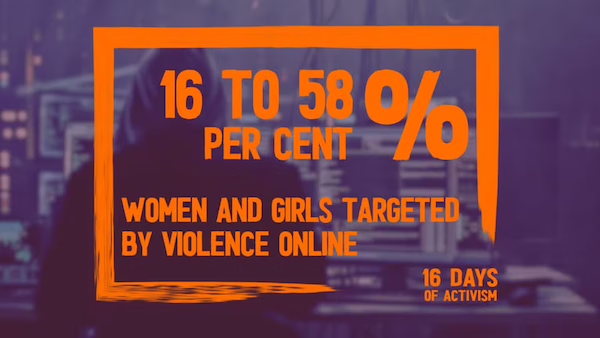
International studies show that gender-based cyberviolence particularly affects women, with between 16% and 58% reporting having experienced it. The viral nature and persistence of digital content significantly increase its impact, a phenomenon further intensified by the rise of artificial intelligence (AI) and content manipulation techniques.
Although the current provisions of the Penal Code are technologically neutral, they do not always adequately address the specific nature and severity of these forms of violence, nor ensure sufficient protection for victims, noted the ministry. The draft law aims to address these gaps and provide a more appropriate criminal response. It forms part of the transposition of Directive (EU) 2024/1385 of 14 May 2024, as well as measures announced by the ministry under the national action plan on gender-based violence.
The ministry said that coercive control, defined as a pattern of repeated behaviour intended to significantly restrict a victim’s freedom of movement or to control their daily life through threats or psychological, economic or financial pressure, will also be introduced as a separate offence in the Penal Code.