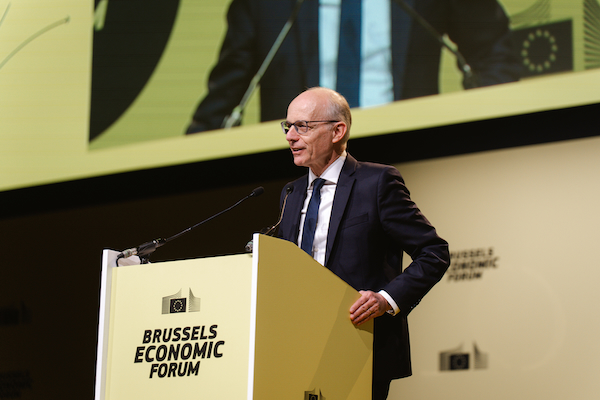
 Luxembourg Prime Minister Luc Frieden attends the Brussels Economic Forum on Thursday 7 May 2026;
Credit: ME
Luxembourg Prime Minister Luc Frieden attends the Brussels Economic Forum on Thursday 7 May 2026;
Credit: ME
On Thursday 7 May 2026, Luxembourg Prime Minister Luc Frieden attended the Brussels Economic Forum, where he gave the opening speech on the subject of artificial intelligence (AI) in Europe.
Luxembourg’s Ministry of State reported that in his speech, Prime Minister Frieden emphasised that AI is “here to stay and it is not just another technological cycle”. He noted that the technology will drive a fundamental transformation that will redefine our economies and societies “in profound ways”; bringing opportunities, new ways to research and drive innovation, as well as new ways to develop products and services and improve wellbeing and drive progress.
In his speech, Minister Frieden questioned how Europe will participate in the adoption of AI and highlighted how the global AI race is currently one between the United States and China. He said: “Europe is not destined to be third. We can lead – if we act together. And I would say, we must lead because we need artificial intelligence of Europe, by Europe, for Europe – if I may borrow a distinctly American expression.”
Minister Frieden remarked: “We need an artificial intelligence that reflects our uniquely European values. Because if AI will ultimately come to influence all spheres of life, then it must align with our way of life. Europe is known throughout the world for its values and principles: freedom, democracy, rule of law. And the use of AI must be grounded in those.”
He added: “Humans are central to making the AI revolution a success. And that is where Europe’s most intrinsic value comes in: human dignity – the conviction that every person possesses inherent worth and value simply by being human. If we want to build such an AI of Europe, one grounded in European values, it must be an AI by Europe. If not, we risk that the AI solutions we adopt are based on other values – especially in an increasingly competitive international environment.”
The Luxembourg Prime Minister then moved on to the subject of data and technology sovereignty, in which he remarked the subject “is not just about borders”. He noted that to be sovereign, is to be free to make one’s own choices. And in the AI age, that freedom comes with control – control over data, infrastructure and models. He questioned: “Who holds the data? Who operates the cloud? Who builds the models?”
He stressed that Europe’s success will depend on three things:
• the scale at which citizens and companies adopt AI solutions;
• the speed with which we enable them to do so;
• the ability to mobilise public and private investments.
Minister Frieden stressed: “On AI adoption, let us face the reality: there is a lot of talk, but there are only a few companies – or governments for that matter – that have fully integrated AI solutions into their core operations. If this does not change, we may very well build Gigafactories, but they risk remaining ghost factories with no customers. Governments can lead the way by stimulating demand through their own procurement. That is why I welcome the European Commission’s call on EU institutions to procure sovereign cloud services. And I am particularly happy that Luxembourg companies were among those selected to deliver on that call. This is an important milestone, because it turns the public sector’s operational needs into an opportunity to lead the way by showing private companies the possibilities, awarding valuable contracts to local champions and creating demand that in turn drives supply.”
He continued: “That brings me to my second priority: speed. Progress and innovation are rarely linear and never predictable. AI does not reward perfectionists, it rewards the fast – those who try, fail and try again. And while Europe loves plans, our competitors deploy first and refine later. Where we see failure as the end of progress, they see it as part of progress. So, let us dispel the myth of the ‘perfect’ AI strategy, drop the pen, roll up our sleeves and get going. Because speed matters in more ways than one. First, the faster you move, the faster you gather data. If you fail fast, you can learn fast. If you fail slowly, you become irrelevant before you can improve.“
On the third priority for Europe, Minister Frieden emphasised that to lead in the global AI race requires the unlocking of the large amounts of capital lying dormant in European banks. He noted: “We must turn yesterday’s savings into fuel for tomorrow’s innovation. Europe sits on €12 trillion in household savings. But most of that money flows into real estate and government bonds, rather than investments in startups because our financial culture remains risk-averse, because pension funds and banks prefer safe assets and because our regulations make it harder to invest in deep tech. All of this starves our innovation ecosystem of the capital it needs – giving way to an unnecessary paradox: Europe produces world-class AI research but has very few global AI companies. We need a savings and investment union that caters to our financing needs, especially in AI – and we need it fast. Let us start by doing less – instead of adding national layers on EU regulations, let us stay true to one European standard and end gold-plating.”
He also suggested that thought needs to be given to earmarking small amounts of pension funds for deep tech investment, to make AI startups easily accessible for retail investors and to celebrate risk-taking; giving founders a second chance when they fail.
He said: “Those changes will allow AI startups to tap into financial opportunities and allow them to scale much easier and much faster.”
In closing, Minister Frieden said that if Europe can create demand for AI solutions, if Europe can speed up AI adoption across companies and governments, if Europe can unlock savings to finance AI startups, he was convinced that Europe could not just keep up with the US and China – it could compete and outperform them.
“My government is fully committed to that European effort. Our entire AI strategy is deliberately thought, designed and executed in a European mindset,” said Minister Frieden.
“In this new age of AI, no country can win alone. But together, Europe can. And together, Europe will.”