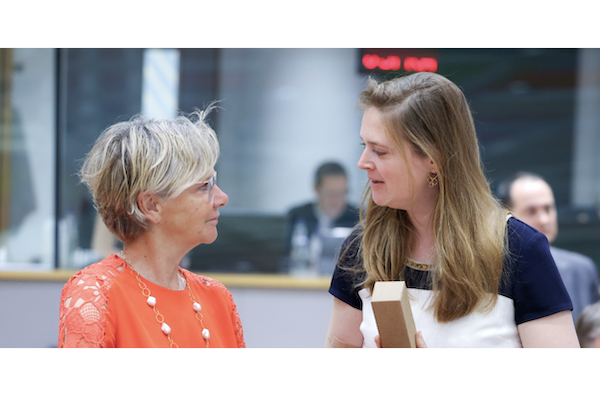
 (L-R) Martine Hansen, Luxembourg's Minister of Agriculture, Food and Viticulture; Anne-Catherine Dalcq, Minister of Agriculture and Rural Affairs, Wallonia, Kingdom of Belgium;;
Credit: EU
(L-R) Martine Hansen, Luxembourg's Minister of Agriculture, Food and Viticulture; Anne-Catherine Dalcq, Minister of Agriculture and Rural Affairs, Wallonia, Kingdom of Belgium;;
Credit: EU
On Tuesday 26 May 2026, Luxembourg's Minister of Agriculture, Food and Viticulture, Martine Hansen, participated in a meeting of the European Union (EU) Agriculture and Fisheries Council in Brussels, Belgium.
According to Luxembourg's Ministry of Agriculture, Food and Viticulture, the main topic of the meeting was the availability and affordability of fertilisers in the European Union amid ongoing market volatility and supply chain disruptions. Agriculture ministers discussed the European Commission’s recently presented fertiliser action plan, which aims to strengthen the EU’s strategic autonomy in fertiliser use.
Minister Hansen warned that the current situation could have serious consequences for the liquidity of agricultural holdings, potentially leading to abandoned production and a further weakening of food sovereignty. She called for effective short-term measures ahead of the 2026/2027 agricultural campaign and stressed the need for maximum flexibility for member states to adapt measures to sector-specific needs.
The minister also highlighted the importance of reducing dependence on fertiliser imports in the medium and long term, notably through better use of organic materials available in Europe. She expressed support for the circular economy, bio-based fertilisers, biogas production and the development of “Renure”-type fertilisers, while also calling for resilient fertiliser production.
Regarding food labelling, Minister Hansen noted growing consumer interest in food quality and origin. She voiced support for a “Buy European” approach through EU/non-EU origin labelling, which she said would respond to the expectations of both farmers and consumers.
Luxembourg also supported the presidency’s compromise proposal within the context of the “Food and Feed” Omnibus Package concerning import tolerances for residues of plant protection products, with the aim of ensuring fair conditions for European farmers.