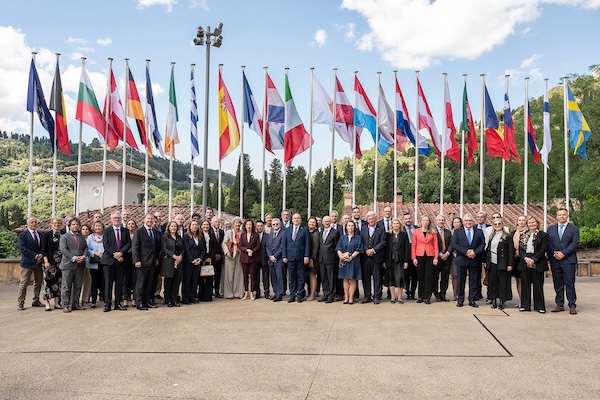
 Stéphanie Obertin, Luxembourg Minister for Research and Higher Education, with attendees at the official 50th anniversary celebrations of the European University Institute (EUI) in Florence (Italy);
Credit: EUI
Stéphanie Obertin, Luxembourg Minister for Research and Higher Education, with attendees at the official 50th anniversary celebrations of the European University Institute (EUI) in Florence (Italy);
Credit: EUI
On Friday 8 May 2026, Luxembourg’s Ministry of Research and Higher Education reported on the attendance of the Minister for Research and Higher Education, Stéphanie Obertin, at the official 50th anniversary celebrations of the European University Institute (EUI) in Florence (Italy).
The ministry reported that on Thursday 7 May 2026, Minister Obertin joined numerous European political leaders, representatives from academia and members of civil society at the event, which included a high-level official ceremony and a ministerial summit bringing together member states, dedicated to the role of universities in addressing technological, economic and societal transformations, particularly in key areas such as artificial intelligence, digital sovereignty and sustainability.
Founded in 1976, the European University Institute (EUI) has established itself as a pillar of European academic cooperation, contributing to the development of an open and interdisciplinary research and higher education area focused on major societal challenges.
Minister Obertin recalled the strategic importance of higher education and research for Europe’s future, underlining the central role of universities as drivers of innovation, critical thinking and social cohesion.
She also highlighted Luxembourg’s approach, based on international openness, attracting talent and developing strong synergies between research, the public sector and the economy; a vision reflected in investments in strategic fields such as artificial intelligence, data and new technologies, as well as in strengthening infrastructure and partnerships at European level.
The minister further stressed the need to strengthen the link between universities and citizens at a time when trust in science and institutions represents a key challenge for European societies.
Alongside the celebrations, a wide-ranging programme of academic exchanges and public events highlighted the role of knowledge in understanding and supporting the major transitions shaping the modern world.