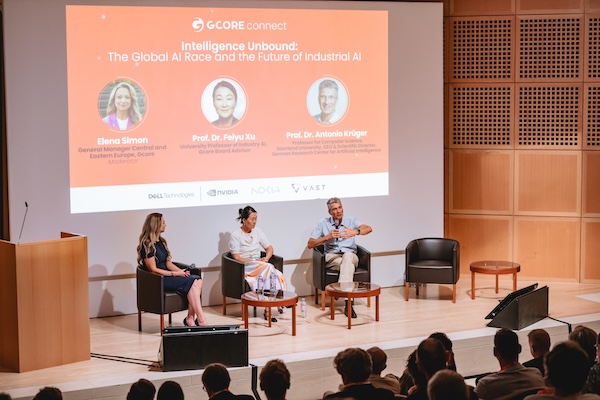
 Credit: GCore
Luxembourg-based provider of AI, cloud, network and security infrastructure, Gcore, hosted the inaugural edition of Gcore Connect on Monday 6 July 2026, at MUDAM in Luxembourg-Kirchberg, bringing together over 120 senior technology leaders, investors and government officials from more than 25 countries to debate the future of AI infrastructure and European digital sovereignty.
The forum featured government officials, investors and experts alongside Gcore’s board, including Dr Philipp Rösler (Former Vice Chancellor of Germany) and Dr Feiyu Xu (University Professor of Industrial AI). The event framed a critical consensus: Europe stands at a decisive technological inflection point where infrastructure sovereignty and targeted industrial policy must be prioritised to secure the continent's digital future.
European digital sovereignty & the industrial AI opportunity
During the forum, panels addressed the delicate balance between strict European regulatory compliance and global technological competitiveness. The core insight emerged that the AI race between the USA, China and Europe is reshaping the global balance of economic power. According to some experts, it might even be the next industrial revolution.
Prof Dr. Feiyu Xu (Gcore Board Advisor) and Prof Dr. Antonio Krüger (CEO and Scientific Director of German Research Centre for AI, DFKI) asserted that this "Industrial AI", built on engineering, manufacturing and data, represents Europe's true sovereign opportunity.
Samuel Weinbach (Chief Research Officer at Aleph Alpha) and Luxembourg tech pioneer-based entrepreneur Xavier Buck (Founder of EBRAND and EuroDNS), framed the same race differently, questioning who controls the models, the infrastructure data and how Europe can remain competitive.
Cybersecurity as national economic resilience
With AI systems increasingly integrated into critical infrastructure, security has transitioned from an IT concern to a geopolitical necessity. The panels concluded that securing the AI pipeline is now a fundamental pillar of national competitiveness and digital sovereignty. On a panel moderated by Alexander Pisemskiy (Founder of Veleci), Joerg Bienert (Managing Director of the Centre for Sovereign AI) and Taylor Wakefield (COO and Co-Founder of Teleport) analysed the expanding attack surfaces of distributed edge-cloud environments, urging enterprises to treat identity, trust and access governance as core strategic assets.
Capital flows and the next investment wave
The forum questioned where the next wave of private and institutional capital is being deployed, concluding that capital is rapidly moving upstream to target the physical constraints of AI—specifically energy grids, specialised data centres and high-capacity networks.
With AI in Europe entering a new phase where capital is rapidly shifting toward data centres, energy and AI-ready networks, infrastructure becomes the real bottleneck.
According to Dr Philipp Rösler, Europe stands at a rare, brief window of opportunity. He said: “The decision we make today will define the market environment for AI not only for Luxembourg but for entire Europe...It is critical to make the right choices now to remain open to the markets of the future. Bringing all stakeholders into the same room is essential to finding and driving forward solutions that benefit the entire European Union.”