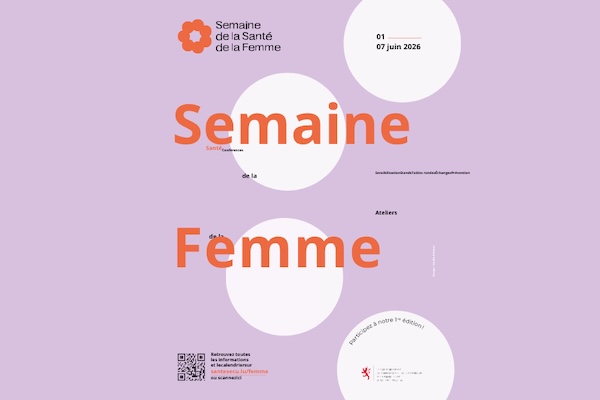
Luxembourg’s Ministry of Health and Social Security has announced the launch of the country’s first Women’s Health Week, taking place from Monday 1 to Sunday 7 June 2026.
The initiative coincides with World Women’s Health Day on Thursday 28 May 2026 and aims to improve awareness, information and public discussion around women’s health issues, while helping to address topics that remain underdiagnosed, underestimated or considered taboo.
Martine Deprez, Luxembourg’s Minister of Health and Social Security, commented: “Too often, women’s health is still not recognised for its true importance. With this first Women’s Health Week, we are sending a strong message: to speak openly about women’s health without taboos, strengthen prevention and improve access to information.”
Throughout the week, associations, public institutions and healthcare professionals across Luxembourg will organise conferences, workshops, awareness campaigns, cultural events and consultations.
According to the ministry, the programme aims to promote an inclusive and accessible approach to women’s health while creating opportunities for dialogue between specialists, healthcare professionals and the public. To see the full programme of events, visit santesecu.lu/femme.
As part of the initiative, the ministry will organise two public conferences on Saturday 6 June 2026 at the National School of Health, focusing on endometriosis and menopause. To register, visit https://santesecu.public.lu/fr/agenda/2026/juin/conferences-m3s-ssf.html.
The Health Directorate will also organise two lunchtime talks for healthcare professionals on Wednesday 3 June and Thursday 4 June 2026. The first will focus on menopause, perimenopause and cardiovascular diseases in women, while the second will address endometriosis, described by the ministry as a common but still widely underdiagnosed chronic gynaecological condition.
The week will also be accompanied by a national communication campaign including posters, radio spots, social media content, testimonies and awareness materials focusing on symptoms that are often minimised or ignored, said the ministry.