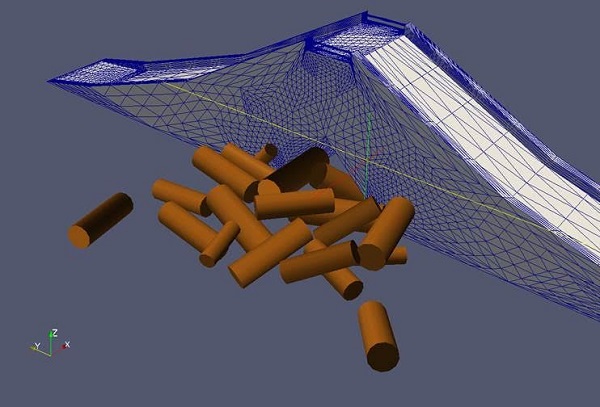
Fitting to the Grand Duchy's recent weather rampage, the University of Luxembourg has been working on a new project which draws on advanced simulation technology to reduce the impact of floods.
The project was developed to combat the dangers that flood can bring with them, such as the movement of trees, rocks or cars which can affect flood protection infrastructure. The University's new mathematical method simulates the flow of debris, thereby assessing its future mechanical impact on buildings and structures and enabling local water management authorities to predict flooding scenarios on rivers.
Entitled 'DebrisFlow: Impact of Debris Flow on Buildings and Structures during Flooding', the project involved scientists at the LuXDEM research team developing an algorithm dedicated to analysing various potential flood scenarios with the incorporation of the interaction of floating objects. The result is expected to be a software environment adept at foreseeing the outcomes of high water and identifiying vulnerable areas.
"We want to investigate what happens when the debris collides with bridges, buildings or flood protection installations," explained Professor Bernhard Peters, project leader and professor of Thermo- and Fluiddynamics at the Faculty of Science, Technology and Communication /FSTC). "The method can determine the mechanical loads the buildings are exposed to during a flood. however, it can also be used to adapt flood control facilities to these conditions from the outset so that they are able to withstand the impact."
Professor Peters further commented that the project could provide guidelines for forward planning and help strengthen counter-flood measures.
Having already been provided with the topographical data by regional water authorities, the team will be starting its research by investigating the rivers separating Luxembourg and Germany, including Moselle, Our and Sauer.
"Since you have a digital model of the actual landscape, you can see which way the water will take and where it is most likely that debris will damage the infrastructure," continued the project leader.
The project was first launched on 20 January 2016 and will be receiving financial support from the National Research Fund (FNR) over the next three years. Professor Peters is being joined by PhD students Yu-Chung Liao and Gabriele Pozzetti for the research project, which will also be supported by the 'Ponts et Chaussées' administration, the water management agencies in Luxembourg (Administration de la gestion de l’eau) and Trier (Struktur- und Genehmigungsdirektion Nord), the Luxembourg Institute of Science and Technology (LIST) and the Dresden University of Technology represented by Professor Jürgen Stamm.
Photo by University of Luxembourg (water debris)