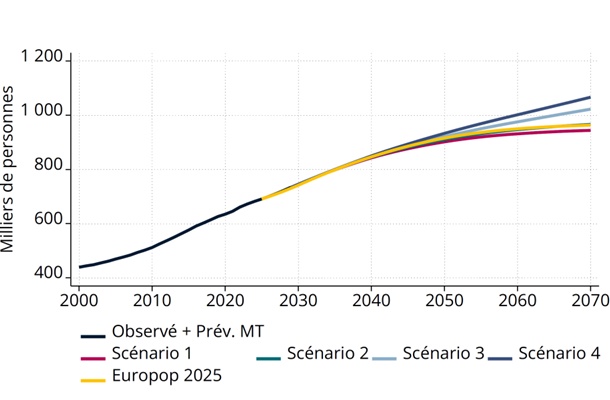
 Projected evolution of Luxembourg's population;
Credit: STATEC, Eurostat
Projected evolution of Luxembourg's population;
Credit: STATEC, Eurostat
According to new population projections published by STATEC, Luxembourg's population could approach the one-million mark by 2070.
STATEC has outlined four population growth scenarios, indicating that Luxembourg’s population could approach one million by 2070 (944,000 in the low-growth scenario and over one million in the high-growth scenarios).
According to Eurostat, the population could reach 962,500. Eurostat anticipates a phase of sustained population growth until the middle of the century, followed by a gradual slowdown - a trajectory comparable to STATEC’s low-productivity scenarios.
STATEC noted that its projections differ in their economic underpinnings. Whereas Eurostat projects migration flows by extrapolating past trends, STATEC links them directly to the fundamentals of the Luxembourg economy: the more attractive growth and wages are compared to neighbouring countries, the higher the net migration.
Migration is expected to remain the main driver of Luxembourg’s population growth over the forecast horizon; it has accounted for around 80% of the population increase over the past few decades.
STATEC noted that economic growth and population growth are closely linked in Luxembourg. Its model reflects this relationship: net migration is determined by the relative attractiveness of Luxembourg’s income compared to neighbouring countries, which is itself driven by productivity gains. On this basis, STATEC presented four scenarios, ranging from the most pessimistic (Scenario 1, low productivity) to the most optimistic (Scenario 4, high productivity). By 2070, the population is projected to reach 944,000 in Scenario 1, 966,000 in Scenario 2, 1,022,000 in Scenario 3 and 1,067,000 in Scenario 4. The population currently stands at approximately 691,000 (as of 31 December 2025).
Between now and the middle of the century, all projections, whether from STATEC or Eurostat, indicate a phase of population growth. The trend diverges from the mid-2050s onwards. In STATEC's projections, the population continues to grow in the higher productivity scenarios, exceeding one million inhabitants by 2070 (Scenarios 3 and 4). In the more pessimistic scenarios (Scenarios 1 and 2), the trajectory remains close to that projected by Eurostat. The latter anticipates near-stagnation from the mid-2050s onwards, with the population reaching 962,500 in 2070, following a trend similar to STATEC's Scenario 2.
The differences between STATEC's results and those of Eurostat are mainly explained by their respective approaches to projecting net migration (although minor differences also exist in fertility and mortality). Eurostat adopts an approach based on past trends, estimating net migration using the average of flows observed over the past ten years, adjusted towards a long-term value common to all EU countries. While robust for countries with more "standard" demographics, according to STATEC, this method does not capture the close link in Luxembourg between economic conditions and migration flows and may lead to revisions when recent reference years are unusual (such as during the COVID-19 years or periods of strong growth).
STATEC, by contrast, incorporates net migration into its eco-demographic model: flows of foreign workers reflect the relative attractiveness of Luxembourg’s income levels, which is itself determined by productivity gains relative to neighbouring countries. This approach anchors migration projections in economic fundamentals and makes them less sensitive to one-off shocks, resulting in more stable forecasts over time, STATEC noted.
In STATEC's scenarios, net migration is projected to range between 3,300 and 7,500 people in 2070, depending on the scenario. The Eurostat projection follows an intermediate trajectory: after peaking at around 10,000 people in 2031, the net migration balance would gradually decline to just over 3,000 people in 2070, a level close to STATEC’s low-growth scenario.