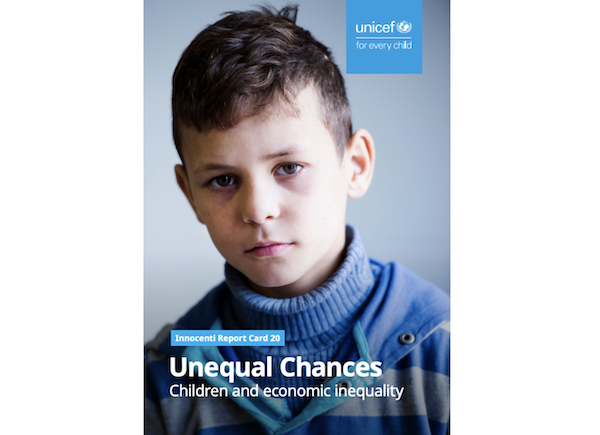
 Credit: UNICEF
On Tuesday 12 May 2026, UNICEF Luxembourg published its new report, “Innocenti Report 20: Unequal Chances – Children and Economic Inequality”, which examines the links between economic inequality and children’s physical health, mental well-being and educational outcomes in wealthy countries.
According to the report, which examines the relationship between economic inequality and child well-being across 44 OECD and/or high-income countries, income inequality and child poverty remain persistently high in most of the countries analysed.
“Inequality profoundly affects how children learn, what they eat and how they experience life,” said Bo Viktor Nylund, Director of UNICEF Innocenti. “To limit the worst impacts of inequality, we urgently need to invest more in the health, nutrition and education of children from the most disadvantaged communities.”
According to the report, children living in the most unequal societies are 1.7 times more likely to be overweight than children living in the most equal societies.
The analysis also establishes a link between economic inequality and educational performance, noting that countries with wider gaps between rich and poor tend to have overall lower academic results. According to the report, children in the most unequal countries are 65% likely to leave school without basic reading and mathematics skills, compared to 40% in the most equal countries.
The report traces several ways in which economic inequality translates into poorer outcomes for disadvantaged children. It notes that economic inequality shapes inequalities in the world around the child, including the home, neighbourhood and school resources, as well as in the child’s own world, relationships and activities.
UNICEF noted that children living in economically disadvantaged environments generally have access to fewer and lower-quality resources at home, in their neighbourhood and at school. This includes lower-quality housing, increased food insecurity, lower-quality local services and schools, and higher levels of environmental problems such as pollution.
The study also points to tangible differences in children’s daily lives, including poorer diets and lower levels of physical activity.
Children interviewed for the report also described feelings of exclusion linked to poverty, discrimination or lack of financial means to fully participate in social and school life.
UNICEF called on governments and stakeholders to act to reduce the impact of inequality on children’s well-being, particularly by reducing child poverty. Recommendations include improving social safety nets, labour market policies, access to affordable and quality early childhood services, investment in affordable housing and public infrastructure, reducing inequalities in education, ensuring equitable access to essential services, engaging children in policymaking and improving data collection and monitoring.
Regarding Luxembourg, the report notes that around 24% of children in the country live below the at-risk-of-poverty threshold.
It also states that income inequality increased between 2012 and 2022, with the P80/P20 ratio rising from 4.1 to 4.5 during that period.
However, Luxembourg is absent from several international comparisons in the report, particularly regarding children’s mental well-being, social skills and academic performance, due to a lack of comparable data from the PISA 2022 study.
UNICEF Luxembourg also recalled that it published the report “Age Spending and Child Poverty in Luxembourg” in 2025, which proposed recommendations aimed at reducing child poverty. The organisation also continues its work on youth mental health through the NetEleng initiative, which aims to raise awareness, provide information and support young people experiencing psychological difficulties.