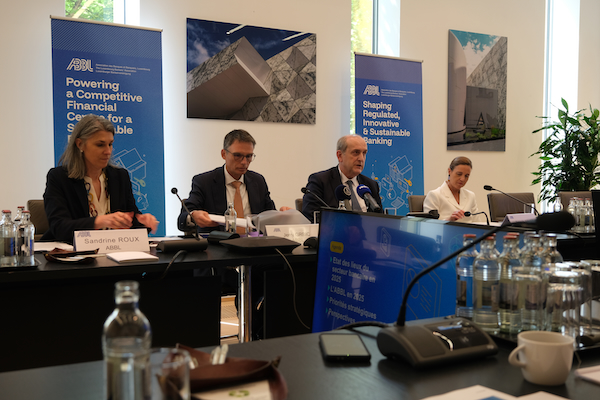
 (L-R) Sandrine Roux, ABBL; Jerry Grbic, ABBL; Yves Stein, ABBL; Ananda Kautz, ABBL.;
Credit: Steven Miller, Chronicle.lu
(L-R) Sandrine Roux, ABBL; Jerry Grbic, ABBL; Yves Stein, ABBL; Ananda Kautz, ABBL.;
Credit: Steven Miller, Chronicle.lu
On Thursday 7 May 2026, the Luxembourg Bankers' Association (ABBL) held a press conference at its offices in Luxembourg-Kirchberg during which it reported on the performance of Luxembourg’s banking sector in 2025.
The presentation, which focused on areas such as competitiveness, attractiveness, resilience and regulation, was provided by Yves Stein, Chairman of the ABBL, Jerry Grbic, CEO at the ABBL, Sandrine Roux, Secretary General at the ABBL, and Ananda Kautz, Member of the Management Board at the ABBL.
The ABBL’s assessment of the overall banking sector in 2025 displayed solid fundamentals but noted a gradual transition into a more demanding cycle and emphasised how the competitiveness of banks has a direct impact on the real economy, determining households’ access to credit, companies’ investment capacity and, more broadly, the country’s economic dynamism.
However, the ABBL reported that the challenge is even broader for Luxembourg as the banking sector remains one of the key drivers for the national economy, through job creation, investment and international attractiveness. In 2025 Luxembourg continued to attract international financial players but the ABBL noted thatthis attractiveness is linked to the country’s own fundamentals in areas such as access to housing, a clear regulatory environment, efficient infrastructure and economic stability, as well as offering competitive conditions to companies which make Luxembourg an attractive environment for sustainable investment and growth.
In terms of the sector’s performance, income from net interest dropped by 2.9% (€10,392,900,000) in comparison to 2024 (€10,698,800,000), whereas net fee and commission income increased by 2.2% (€6,393,600,000) in comparison to last year (€6,255,700,000). But despite operating income rising by 15.2%, total operating income remained flat at 0% in relation to 2024.
In terms of administrative costs, general expenses rose by 4.2% and profit before provisions and taxes reduced by 3.6%. Overall net profit was recorded at -5.4% (€6,846,000,000 versus €7,235,700,000), a drop Yves Stein attributed to increased investment in technological development, risk management and compliance.
Looking to 2026, the ABBL said the strength of Luxembourg’s financial centre increasingly depends on the country’s broader economic environment and its ability to remain an attractive place for companies and professionals to invest, grow and innovate. However, increasing regulatory complexity, fragmentation and reporting obligations continue to weigh on competitiveness and innovation and the ABBL stressed the importance of a more proportionate, coherent and innovation-friendly framework which is capable of supporting growth while preserving financial stability.
Despite the banking sector entering a “more demanding phase” and 2026 featuring a more unstable international environment, the ABBL emphasised that Luxembourg’s banking sector remains resilient, internationally attractive and its prosperity rests on a strong and resilient economy, which is dependent on its financial centre.
Yves Stein remarked: “Our first priority is competitiveness, it is also resilience, the strength of the banking sector.”
The ABBL said it will continue to actively contribute to European and national discussions, advocating for a more coherent and proportionate regulatory framework, supported by its proposals for smarter financial regulation. It will also support its members in implementing key frameworks such as the Digital Operational Resilience Act (DORA), while advancing work on cybersecurity and innovation.
The full ABBL for 2025 report can be viewed at https://www.abbl.lu/publications/abbl-annual-report-2025/.