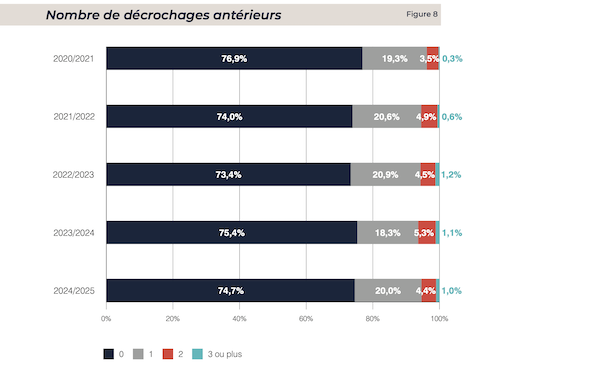
 Number of Previous School Dropouts;
Credit: Report “Early School Leavers and Inactive Youth in Luxembourg” for the 2024/2025 school year
Number of Previous School Dropouts;
Credit: Report “Early School Leavers and Inactive Youth in Luxembourg” for the 2024/2025 school year
On Tuesday 5 May 2026, Luxembourg’s Ministry of Education, Children and Youth published the latest edition of the report “Early School Leavers and Inactive Youth in Luxembourg” for the 2024/2025 school year.
According to the ministry, the report forms part of an ongoing effort to monitor early school leaving and aims to ensure detailed monitoring of the phenomenon and to deepen understanding of it.
The report is based on a detailed analysis of administrative data covering all pupils enrolled in the Luxembourg public school system. It makes it possible to track developments in early school leaving over the past five years, identify trends and better understand the profiles of the young people concerned, said the ministry, adding that the main objective is to provide a solid basis for understanding these dynamics and to adapt prevention and support policies.
In 2024/2025, the rate of early school leavers stood at 7.4% (1,714 pupils), compared with 8.2% (1,884 pupils) in 2023/2024. Over the past five years, the rate has shown slight changes, decreasing from 8.2% in 2020/2021 to 8.1% in 2021/2022 and 7.6% in 2022/2023, before rising again to 8.2% in 2023/2024 and falling to 7.4% in 2024/2025.
Furthermore, the analysis of re-enrolments shows that a significant proportion of young people return to education after a period of early school leaving, highlighting that such pathways are often not permanent. Excluding pupils who re-enrolled in the following school year, the effective early school leaving rate in 2024/2025 stands at 5.7%.
The effective early school leavers rate, which excludes pupils who re-enrolled the following year, also showed slight variations over the past five years, standing at 6.4% in 2020/2021, rising to 6.7% in 2021/2022, then decreasing to 5.8% in 2022/2023, increasing again to 6.3% in 2023/2024 and falling to 5.7% in 2024/2025.
According to the report, boys and pupils with a delay of two years or more are more likely to drop out. Moreover, early school leaving occurs more frequently in key transition years, particularly in 5e and 4e, which the ministry considers as an important stage in the orientation process. It particularly affects certain integration classes (ACCU, CLIJA, CIP, COP) and vocational training leading to the CCP certificate, added the ministry
The report also presents actions carried out by the National Youth Service (Service national de la jeunesse - SNJ) to support young people in situations of early school leaving or inactivity. These interventions cover the entire pathway, from prevention to reintegration, with measures adapted to the specific needs of young people, stated the ministry.
During the dropout phase, the SNJ systematically contacts the young people concerned based on lists provided by the ministry. In 2024/2025, 2,106 young people were contacted and offered personalised support aimed at returning to education, entering the labour market or finding a suitable alternative.
Targeted prevention actions are also carried out in schools, focusing on young people most at risk, particularly pupils in 5e moving towards vocational training, who often need to leave their original school and enrol in another to follow their chosen path. According to the report, between July and October 2025, 1,752 young people were supported by nineteen educational staff members to assist them with re-enrolment or access to apprenticeships.
The SNJ offers alternatives to inactivity, including voluntary service, workshops and internships. In 2024/2025, 599 young people participated in voluntary service (representing 3,315 cumulative participation over the year), 89 took part in practical workshops and 328 discovery internships were carried out in companies.