 Credit: STATEC
On the occasion of the International Day for the Eradication of Poverty on 17 October 2022, Luxembourg's statistics agency STATEC published a report on work and social cohesion 2022 which includes a list of ten key figures.
According to STATEC, Luxembourg's social cohesion is under pressure in part because it is facing one crisis after another. The ten key figures published are:
€3,608 - The minimum budget for a couple with one child aged 0-6 is €3,608. The minimum budget for a couple with three children is €5,186. Direct allowances cover 100% of the minimum needs during early childhood. Direct benefits cover almost three-fourths of the budget for 8-14 year olds, but more than 46% of the budget for adolescents. REVIS offers good protection for households with children and it exceeds the minimum budget in almost all cases.
€332 - €744 - The direct minimum budget for children tends to increase with their age and varies from €332 to €744 per month.
36% - Pre-committed expenditure represents on average 36% of the household budget. For the 10% of the least well-off households, this pre-committed expenditure even represents almost half of their disposable income. In 2021, the average real disposable income per month per household amounts to €4,185.
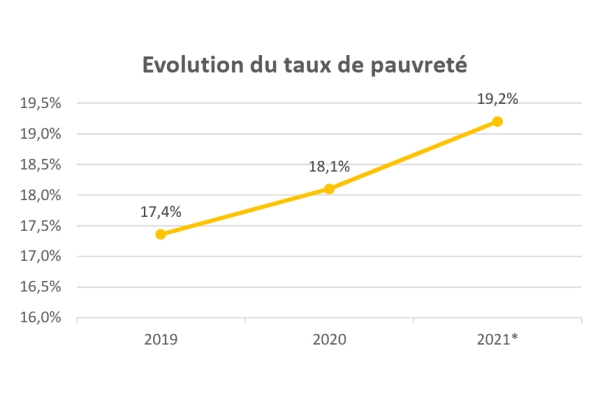
19.2 % - The poverty threshold in Luxembourg (60% of the median standard of living) is €2,177 per month per adult. By way of comparison, in 2021, 115,980 people were living below the at-risk-of-poverty threshold. The at-risk-of-poverty rate falls to 7.3% if wealth and consumption are taken into account, alongside disposable income.
46% - Luxembourg's social and fiscal system is very distributive with the least well-off households benefiting more from social benefits than they contribute through their compulsory contributions.
Benefits represent 46% of the gross income of the 10% of the least well-off households, compared to only 11% of that of the most well-off households.
5.3% - At 5.3% in 2021, the harmonised unemployment rate is falling and remains below the European average of 7.0%. This puts Luxembourg in ninth place in the European Union. In the second quarter of 2022, a record number of vacancies are available, which proves the recruitment difficulties of companies and testifies to a mismatch between supply and demand.
34% - In the second quarter of 2022, 34% of the workforce teleworked. The public administration, financial and insurance sectors are experiencing an exceptional surge in teleworking. Luxembourg is at the forefront of teleworking in the European Union, after the Netherlands and before Switzerland and Finland.
0% - According to the Gender Pay Gap, equal pay for men and women is achieved on average in Luxembourg. The median salary for women is even higher than for men. However, significant gaps remain in some sectors of activity. Women still have a lower employment rate and make more use of part-time work than men, which has an impact on their income and pensions.
x4 - In Luxembourg, demographic growth is mainly due to international immigration (mainly from the European Union). Since the beginning of the year, the number of Ukrainian nationals has multiplied by four (x4). More and more Luxembourgers are leaving the country and settling mainly in one of the three neighbouring countries.
15% - 15% of employees feel discriminated against at work while in contacts with colleagues and/or customers. This share rises to 24% in the hotel and catering industry. Seven out of ten immigrants have not encountered any obstacles in getting a job that is suitable for their level of education. Only 6% of immigrants have very little knowledge of the country's languages.
Further information on the report is available online via: https://statistiques.public.lu/en/actualites/2022/stn47-tcs.html.