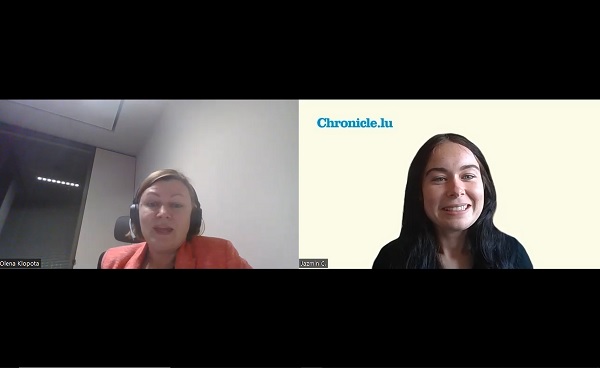
 L-R: Olena Klopota, General Secretary of LUkraine asbl; Jazmin Campbell, journalist at Chronicle.lu;
Credit: Chronicle.lu
L-R: Olena Klopota, General Secretary of LUkraine asbl; Jazmin Campbell, journalist at Chronicle.lu;
Credit: Chronicle.lu
Chronicle.lu recently sat down with Olena Klopota for a video interview to learn about her role within LUkraine asbl, why demonstrations matter and the non-profit organisation’s position on Russia’s recent illegal annexation of four Ukrainian territories.
Originally from Ukraine and having worked in five (now six) countries, Olena arrived in Luxembourg last year and sought out the Ukrainian community in her new host country. She had heard a bit about LUkraine asbl but it was not until 24 February 2022, when Russia launched a full-scale invasion of Ukraine, that she became directly involved in the non-profit, first as the committee member responsible for demonstrations and more recently as General Secretary.
Speaking about her new role as General Secretary of LUkraine asbl, she stated: “My main responsibility is that the association is successful in terms of operations, in terms of […] compliance, because we’re getting big and that’s great, and we really want to be sure that we are absolutely honest, transparent, compliant and ethical towards our people and companies who donate to us as well as beneficiaries”.
"Protests and demonstrations are absolutely key"
Recalling the non-profit’s immediate response to the invasion back in February, and how she initially got involved in LUkraine asbl, Olena explained: “We all gathered in a heartbeat in Place de Clairefontaine, which we now call ‘our place’, where we normally hold protests on Saturdays. I met people and I really wanted to get involved and I started helping here and there. […] Doing something actually helps a lot to push through the day when you need to check your phone, whether there were bombings, how is your family, how are your parents. And then you just get sucked in”.
LUkraine asbl organised weekly protests on Saturdays between 24 February and the end of May 2022 and, as Olena shared, the non-profit plans to continue with monthly demonstrations. Addressing the importance of such activities, she said: “I feel like definitely humanitarian aid [and] support for refugees are key absolutely to save lives, to save people’s mental health and so on. But protests are something that bring awareness to a wider scope rather than just a smaller scope of affected people”.
Olena went on to stress the need to raise awareness through such demonstrations. “Going to the streets and showing the local residents what is the real truth, what is the pain we’re going through, sharing it, and helping also Ukrainians who came to Luxembourg to share it, it helps inside and outside”, she said. “Russian propaganda is very strong […]. Ours is mainly volunteer-based and if you don’t do it, who else will do it? How will standard Luxembourg residents know what is happening in the occupied territories, how will they know about the terrible situations that we find in liberated places like near Kyiv or now in Kharkiv region or Donetsk region”. She elaborated that local residents and voters might ask their governments for additional support for Ukraine once they know more about this reality. “For me, protests and [demonstrations] are absolutely key”.
Concerning the decision to scale back LUkraine asbl’s weekly protests, Olena explained: “The graph of [the public’s] interest in Ukrainian topics, in the war is going down. It’s normal human behaviour, unfortunately, it gets a routine to see someone killed in Ukraine. It’s a sad reality”. She added that LUkraine asbl is regrouping its activities to have “a wider scope of events” aimed at also showing a different side of Ukraine to Luxembourg’s residents. For instance, over the summer months, the non-profit set up Ukrainian stands at various municipal festivals. “While we still speak about the situation, it shows not just the pain, but it shows how beautiful Ukraine can be: the culture, the food, the crafts, and I think that it’s very important that people see Ukraine from different [angles]”, explained Olena. She hoped that others would see the beauty of Ukraine, not least through an upcoming photo exhibition organised by LUkraine asbl, and want to support this country and visit it after the war and its reconstruction.
The non-profit will also continue with monthly demonstrations. “Now, with […] the more escalated, evolving situation, definitely we will start [organising] protests, not every Saturday again, but at least once a month, we will be there on the streets with different topics, whether it is really a protest against certain activities done by Russia or whether it is a [demonstration] to support or even to thank, for example Luxembourgers, for their support, for their continued bearing with us, and the host families”, noted Olena. “It’s different but I feel like the more often and more we will have blue and yellow on the streets, the more people will remember ‘these guys [Ukrainians] are not that far from us, just a few thousand kilometres and they suffer a lot and we can help them and maybe someday there will be a situation when someone else is in need and they will help’”.
Russia's illegal annexation of Ukrainian territories
On Saturday 1 October 2022, LUkraine asbl held its most recent protest in Luxembourg City, this time to voice opposition against Russia’s illegal annexation of four territories (Donetsk, Luhansk, Kherson and Zaporizhzhia) in eastern Ukraine last week. On this subject, Olena said: “I feel like these sham referendums were really less impactful than the first one, which was Crimea, where we just stopped breathing. It was even hard to perceive that it was possible because there are international laws, there are certain conventions that everyone who is a part of these conventions is supposed to follow. […] We were really waiting for a strong reaction from western democracies to react to this absolute unfairness, especially in such a difficult period when Ukraine was living through the Revolution of Dignity [in February 2014] actually protecting and defending their choice, their vision to go towards European development, to go home to Europe. After that, we know that Donbas happened so east of Ukraine was occupied and then, just before the war, they were announced also a part of Russia, so I feel like since then, it stopped mattering that much what Putin decides because we know that it’s unlawful, and now the world knows”.
She also argued that the so-called referenda and annexations seemed more like an attempt of Russian President Vladimir Putin “to show to HIS nation, inside of the country, that they have certain victories, which his nation tends to believe”. She added: “But I don’t feel that it [had] a big impact on the western world. What [had] a big impact was his speech. […] It’s very clear who he is addressing and what message he wants to send. And when he speaks about certain threats and people say ‘Oh no, that’s impossible in the civilised world’, well we’re not living in the civilised world anymore; we’re living in the barbaric world with a barbaric neighbour and it is possible and it is very important to listen to him, because his speech was not addressed to Ukraine. […] It was addressed very clearly to the European Union and to the USA, and he was stating his demands and he was threatening with nuclear weapons”.
“So, it’s his last call, more or less – what else can he do? Now he knows that with Ukraine he doesn’t have any chances, so he […] threatens the western democracies to stop supporting Ukraine”, she continued. “But I hope that western democracies understand now. At least I know that our closest neighbours, like the Baltic countries, like Poland, like Slovakia, [know] that he’s not going to stop. He clearly delimited his area of desired influence. […] This threat is real: [either] he is being stopped or he is going to stress and create a mess in Europe until he gets what he wants, or not”.
Olena added that she hoped the western world would react much more strongly to these acts of aggression than it did to the war in Georgia in 2008 and the annexation of Crimea in 2014. “In 2008, the world didn’t react. In 2014, with Crimea, the world reacted, but mildly. Because I mean, economy, money, gas… And that’s what we have now. So, if the world is not very strong [...] in [its] position, next is Poland, and Poland is another 40 million people and the same quantity of refugees is not something this world can take”, she warned.
LUkraine asbl's ongoing and upcoming activities
Returning to the subject of LUkraine asbl’s activities and future plans in Luxembourg, Olena noted that the entire team are currently fully committed to their soon-to-be launched national fundraising campaign. “We really hope it’s going to be successful. It’s a great call to action”, she stated. Looking forward to the end of November / beginning of December 2022, LUkraine asbl will organise its budget planning meetings to “identify which specific projects we want to develop further within our resources and possibilities”. As Olena explained, these projects will fit within the non-profit’s three main pillars: emergency response and humanitarian aid for Ukraine; supporting Ukrainian refugees and helping them integrate in Luxembourg; the future Ukrainian cultural hub.
On the second pillar, she noted: “We have enormous support [from] the local people, starting from the host families, which are for me absolute heroes”. Concerning the hub, she explained that its development is still in the early stages, although there is already a Ukrainian library and there are plans to open a Ukrainian school for children “very soon”. The latter is based on the concept of the successful “Super U” summer camp. “You’re changing by preserving”, she noted. “You change yourself, you learn something new, you learn about a new country, but you still preserve your [Ukrainian] identity”. Olena added that the non-profit hopes to set up a creative networking area in the hub, one that connects artists from Ukraine, Luxembourg and other countries.
A personal dream of Olena’s, after the national fundraising campaign, is to eventually launch a “Ukrainian Week” or a “Ukrainian Month” with activities that appeal to a wide range of people. The idea would be to organise “some political lectures or some visits of writers, cinema screenings, […] music festivals. Something that finds an interest for every person”, she explained. “This is my big idea and we will see how we will be able to implement it”.