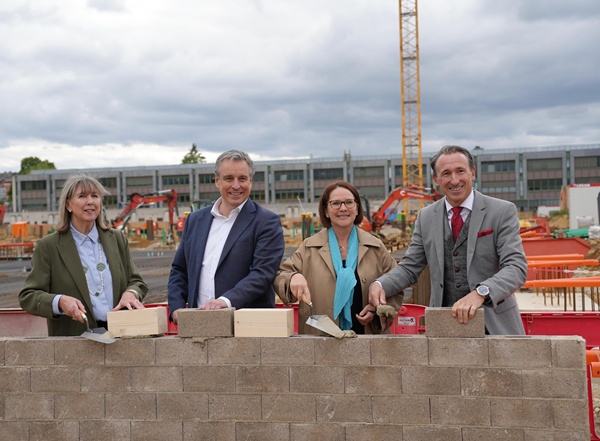
 (L-R) Lydie Polfer, Mayor of City of Luxembourg; Claude Meisch, Luxembourg's Minister of Education, Children and Youth; Yuriko Backes, Luxembourg's Minister for Mobility and Public Works; Mike Borschette, Director of Bouneweger Lycée Luxembourg;
Credit: MMTP
(L-R) Lydie Polfer, Mayor of City of Luxembourg; Claude Meisch, Luxembourg's Minister of Education, Children and Youth; Yuriko Backes, Luxembourg's Minister for Mobility and Public Works; Mike Borschette, Director of Bouneweger Lycée Luxembourg;
Credit: MMTP
On Tuesday 19 May 2026, Luxembourg's Minister for Mobility and Public Works, Yuriko Backes, together with the Minister of Education, Children and Youth, Claude Meisch, laid the foundation stone for the new Bouneweger Lycée Luxembourg, in the presence of Luxembourg City Mayor Lydie Polfer and the school's director, Mike Borschette.
According to the ministries involved, Bouneweger Lycée Luxembourg offers a broad range of educational programmes, including lower-level classical secondary education, general secondary education, vocational training programmes and a two-year advanced technician's diploma (BTS). The future campus is designed to accommodate around 2,150 students and 200 teachers.
Conceived as both a place of learning and a living space, the future campus aims to provide a stimulating, inclusive environment adapted to the daily needs of students and educational staff.
"With this new construction, we are choosing a paedagogical approach resolutely focused on interaction and collaboration, in order to facilitate the integration of each student and to sustainably strengthen the cohesion of the educational community," Minister Backes said. "The future Bonnevoie school campus is a place designed to concretely meet the needs and expectations of both students and teachers, fully integrating sports activities. Through this modern infrastructure, students will thrive in a motivating, inclusive and connected environment where they can flourish and build their future."
The project incorporates specialised facilities adapted to this diverse educational offering. Facilities include workshops dedicated to food-related professions (butchery, charcuterie, baking and pastry-making), as well as spaces for institutional and professional catering. Training restaurants will also allow students to develop service-oriented skills in real-life conditions.
The secondary school will also include workshops dedicated to metallurgy, electricity and electronics training. In addition, the complex will feature a sports centre with a swimming pool, four indoor sports fields, a dojo and a fitness room.
Special attention will be given to lower-level classes through a "cluster" system, designed to support students transitioning from primary to secondary education, while promoting close supervision and more individualised learning paths.
The new complex, together with existing infrastructure, will form the Bonnevoie school campus. According to the authorities, the site has been designed to encourage active mobility and strengthen connections between surrounding neighbourhoods. The access layout is also intended to ensure a high level of safety by clearly separating pedestrian and vehicle traffic.
The school will benefit from strong transport links thanks to a tram stop, numerous bus lines and its proximity to both Luxembourg's central railway station and Howald station, which serve as multimodal transport hubs. The campus will also be easily accessible by bicycle via the cycle path network.
Minister Meisch stated: "The modern infrastructure of the new Lycée Bouneweg Luxembourg fully embodies our vision of a forward-looking school where every student can learn, thrive and find their place in the world of tomorrow. Thanks in particular to its collaborative spaces, welcoming common areas, innovative technological environments and specialised workshops, the future school campus will support the success of all students."
The minister continued: "Designed with a cluster-based approach for the lower grades, the school will benefit from a layout that fosters learning, interaction and collaboration. Because today, learning is no longer just about transmitting knowledge: it's also about stimulating creativity, developing teamwork and allowing young people to grow together."
The architectural programme is structured into three distinct entities:
- the main secondary school building with its common areas and food workshops;
- the workshops dedicated to technical trades;
- and the sports centre.
According to the authorities, this organisation allows the buildings to be adapted to the specific needs of each activity, while facilitating the management of spaces and their daily use.
The project also incorporates a paedagogical approach intended to foster interaction and collaboration. Meeting spaces are planned on each level to encourage interdisciplinary exchanges and facilitate movement throughout the site. A large, two-level atrium will house the main shared functions, while wide staircases designed as tiered seating areas will create gathering spaces at the heart of the building. The interconnectedness of areas such as the dining halls, multipurpose room and student lounge is also expected to generate synergies between the various activities.
The construction choices, combining concrete and wood structures, prioritise the modularity and adaptability of the buildings in order to accommodate evolving educational needs. Particular attention is also being paid to sustainability, including the use of responsible materials and renewable energy sources such as photovoltaic panels, heat pumps and green roofs. The project further incorporates solutions such as recycled concrete and the reuse of demolition materials, with the aim of reducing the environmental footprint of the future campus.
The 3.8-hectare site will comprise a total gross floor area of 50,000 m² and a total gross volume of 276,500 m³, including 93 classrooms, 33 specialty rooms and 28 workshops, seven of which are designated as heavy-duty workshops.
The project owner is the Public Building Administration under Luxembourg's Ministry of Mobility and Public Works.