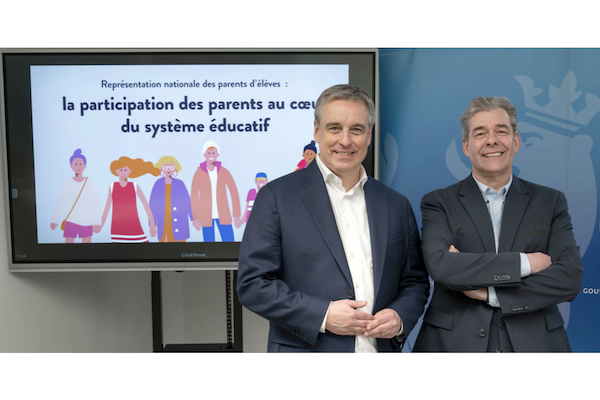
 (L-R) Claude Meisch, Luxembourg’s Minister of National Education, Children and Youth; Alain Massen, President of the National Representation of Parents;
Credit: MENEJ
(L-R) Claude Meisch, Luxembourg’s Minister of National Education, Children and Youth; Alain Massen, President of the National Representation of Parents;
Credit: MENEJ
On Wednesday 25 February 2026, Luxembourg’s Ministry of National Education, Children and Youth announced new measures to strengthen support for the National Representation of Parents, ahead of the body’s third mandate following the elections on Saturday 28 February 2026.
According to the ministry, the National Representation was established to reinforce parental participation and ensure that parents can make their voices heard at the highest level on school-related matters. Speaking at a press conference, Minister Claude Meisch, alongside the outgoing President of the National Representation of Parents, Alain Massen, highlighted the essential role of parent representatives within the education system.
“A modern education system is built with parents. Their ideas, skills, commitment and experience enrich reflection on education policy. Parent representatives play an essential role. By actively participating in school life, whether at local, regional or national level, they directly contribute to the success and well-being of all pupils,” Minister Meisch stated.
Alain Massen added: “Since 2020, we have consolidated a structured dialogue between parents, schools and the ministry, translating families’ experiences into concrete improvements, from inclusion to digital practices. The next term must further strengthen this participation so that every pupil can benefit from equal opportunities.”
According to the ministry, established by the law of 1 August 2018, the National Representation of Parents has strengthened the partnership between schools and parents. Democratically elected from around 1,000 parent representatives in public and private education, it represents parents’ interests before the ministry and issues opinions on matters affecting pupils and parents, as well as on draft legislation and educational initiatives. The body has been consulted, among others, on the ALPHA – zesumme wuessen project, support measures for children with special educational needs in primary education and the Screen-Life-Balance strategy, including the ban on smartphone use in primary schools, regulation of smartphone use in secondary schools, the promotion of analogue activities and the framework for the use of artificial intelligence in schools.
The ministry explained that the election of the National Representation follows a three-level process: local, sectoral and national. Representatives are first elected in each primary school, secondary school and specialised competence centre; they then elect two sectoral representatives per regional directorate, secondary school and competence centre. The sectoral representations subsequently appoint, from among their members, the national representation for a three-year term.
After two mandates (2020-2022 and 2023-2025), parental participation is now firmly established within Luxembourg’s school system. At the end of the most recent term in 2025, more than 1,000 parents were involved at local level and 145 at sectoral and regional level.
The ministry also announced that the legal framework governing parent representation will be adapted to further consolidate and strengthen parental participation within the education system. Networking between local, regional and national representatives will be reinforced, in compliance with data protection regulations, to enable the National Representation to fully carry out its role.
As part of closer cooperation between formal and non-formal education, the mandate of the National Representation will be extended to include educational and childcare services for schoolchildren, such as after-school care facilities and school day-care centres.
In addition, the composition of the National Representation will be adjusted. From 2029, it will include five representatives from primary education (instead of four), five from secondary education (instead of six) and two representatives of parents of pupils from competence centres. The number of representation leave days allocated to the President will increase from eight to twelve days per year.
Further information is available at www.elteren.lu.