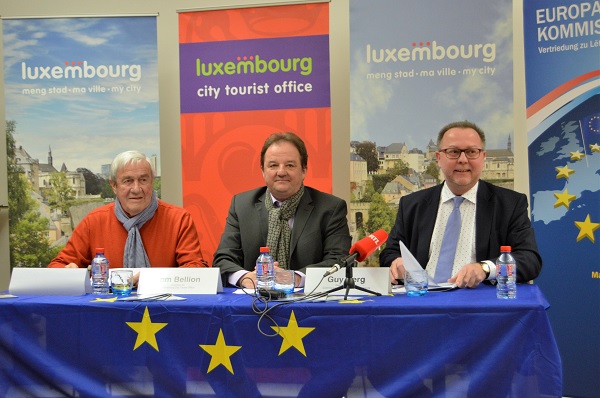
On Wednesday 17 February 2016, the Luxembourg City Tourist Office (LCTO) and the representation of the European Commission in Luxembourg unveiled a new tourist brochure and guide designed to highlight the Grand Duchy as a European capital.
As one of the six founding countries of the European Union, the Grand Duchy has been integral to its evolution and, in turn, the EU has acted as an important component in the political, economic, urban and touristic development of Luxembourg City.
It is this point which the new tour and accompanying brochure, arising from a partnership between the LCTO and European Commission, wishes to highlight. Entitled 'Luxembourg, European Capital: A Continuous Commitment', this pamphlet allows visitors to explore jurisdictional and financial institutions headquartered in Luxembourg. Examples in the Kirchberg district include the Secretariat-General of the European Parliament, which acts as a legislator for the 751 members of the EU; EU Statistical Office Eurostat, which provides reliable and objective statistics to institutions, governments and decision-makers in Member States; the Court of Justice, constituting 28 judges and nine advocates-general to ensure EU law is correctly and uniformly applied; the Court of Auditors, which monitors EU income and expenditure; and the European Investment Bank, which supports regional development through loans and the competitiveness of European industry.
There are also sites to be seen in the city centre, such as the town hall; Cercle Cité; Villa Vauban, the Maison de l'Union européenne and the former seat of the High Authority. Visitors are also able to trace the history of founding father of the EU, Robert Schuman, through the architecture of the institutions which shaped him: his rented home in the Ville Basse, the former building of his school the Athénée, as well as the Robert Schuman au Bock Parlodrome and Monument dedicated to his memory.
The brochure is available in the three languages of French, German and English from the LCTO information centre in Place Guillaume II and online at www.lcto.lu/publications.
Visitors are able to explore the European heritage of Luxembourg through the map provided in the brochure, or by participating in a guided tour offered by the LCTO. To book a tour or find out more information, contact +352 4796 2709 or guides@lcto.lu, or visit www.lcto.lu. Tours cost €90 for two hours, €115 for three hours and have a maximum capacity of 25 people.
Photos by Sarah Graham