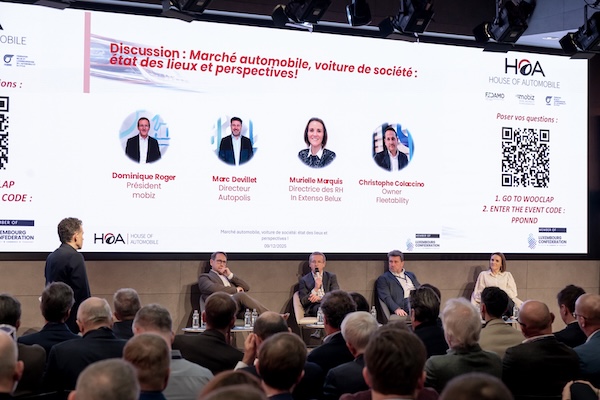
 (L-R) Christophe Colacino, Fleetability; Dominique Roger, mobiz; Murielle Marquis, in Extenso Belux; Marc Devillet, Autopolis;
Credit: HOA
(L-R) Christophe Colacino, Fleetability; Dominique Roger, mobiz; Murielle Marquis, in Extenso Belux; Marc Devillet, Autopolis;
Credit: HOA
On Wednesday 10 December 2025, the House of Automobile (HOA) reported on the automotive conference “Automotive Market, Company Cars: Current Situation and Perspectives”, which took place at the Chamber of Commerce in Luxembourg-Kirchberg on Tuesday 9 December.
According to the HOA, the conference, held in collaboration with the ACL (Automobile Club du Luxembourg) and automoto, brought together more than 250 key stakeholders from the automotive sector and was attended by Luxembourg Minister for the Economy, SMEs, Energy and Tourism, Lex Delles, and Luxembourg’s Minister of Finance, Gilles Roth.
At the event, the HOA presented the results of two market surveys conducted in November 2025 among over 13,000 private individuals and 355 companies. The HOA said these studies highlighted a profound evolution of the Luxembourg automotive market, as well as several factors that could slow the energy transition if no adaptation of the fiscal framework is implemented.
HOA stated that both Minister Delles and Minister Roth expressed strong interest in the study’s findings and emphasised the importance they attach to the automotive sector within the Luxembourg economy. They indicated that the insights from these surveys would provide valuable input for their future work on fiscal, economic and mobility policies.
The HOA study showed that, while interest in electric powertrains continues to grow, 37% of private individuals remain undecided about their next vehicle. Conversely, drivers who have already switched to fully electric vehicles report high satisfaction and, in the majority of cases, plan to remain with electric cars.
The study highlighted that adoption patterns differ significantly depending on the mode of financing, with electric vehicles being more common in company fleets and increasingly in private leasing, which the HOA said is experiencing strong growth and appears to be an especially attractive option for private individuals. They emphasised that private leasing reassures users regarding technological risks and uncertainties about future vehicle values, while providing a more predictable budget and is now a genuine accelerator of the transition to electric mobility.
In relation to recent fiscal measures – notably the increase of the benefit-in-kind (BIK) rate to 2% and new VAT rules – the studies highlighted concerns, with the majority of companies considering these changes problematic. The HOA said it had observed a concerning side effect: when a driver loses access to a company car and switches to a private purchase, they opt in most cases for an internal combustion engine, which they retain on average for more than eight years, compared with three to four years for a company car. They said this behaviour risks not only reducing new vehicle registrations in the coming years but also slowing the electrification of the car fleet.
The survey also confirmed that company cars remain a crucial factor in the attractiveness of the Luxembourg labour market. More than seven in ten respondents considered them an important benefit for attracting and retaining talent, with this rising to eight in ten among the 24 to 44 age group, a target group deemed critical for the country’s competitiveness.
In light of these findings, the HOA called for stabilisation of the fiscal framework, a review of the BIK increase, adaptation of VAT rules and multi-year visibility for incentives such as the Klimabonus. It also stressed the need to maintain a favourable environment for company cars, which play a key role in fleet renewal and the dissemination of electric powertrains. Furthermore, the HOA highlighted the importance of accelerating the rollout of charging infrastructure, particularly in collective housing and workplaces.
The HOA reiterated its commitment to working closely with authorities to reconcile the energy transition with economic attractiveness and the competitiveness of Luxembourg and positioned itself as a constructive dialogue partner, capable of providing data, expertise and a comprehensive vision of mobility challenges.