On Tuesday 16 December 2025, Luxembourg's Ministry of Health and Social Security announced that the country is preparing to take part in its first Dry January® initiative.
Dry January® is a collective and supportive challenge that involves taking a one-month break from alcohol consumption, from 1 to 31 January. Now a global annual event with millions of participants, it will be officially launched for the first time in the Grand Duchy on 1 January 2026. The public will be invited and encouraged to take on the challenge of consciously abstaining from all alcohol for at least the entire month of January. This initiative aims to remind people that no level of alcohol consumption is without risk.
The concept originated in the United Kingdom in 2013 at the initiative of Alcohol Change UK. In Luxembourg, it is being implemented by the Directorate of Health, the Fondation Cancer, the National Addiction Prevention Centre (CNAPA), arcus asbl - Quai 57 and the Centre Thérapeutique Useldange (CTU), with the support of the Ministry of Health and Social Security.
The objective is to raise public awareness of the effects of alcohol on health, reduce alcohol consumption in Luxembourg and help individuals become more aware of their drinking habits. The ministry noted that alcohol is the second leading preventable risk factor for cancer, after tobacco. According to the Health at a Glance report published in 2023 by the Organisation for Economic Co-operation and Development (OECD), 7% of all deaths in Luxembourg in 2019 were attributable to alcohol. This corresponds to one person dying approximately every 30 hours from the direct or indirect consequences of risky alcohol consumption.
Even a temporary break from alcohol can offer numerous physical and mental benefits, including better sleep, clearer skin, increased energy, improved concentration and mood, as well as reduced stress. It can also encourage people to reflect on their drinking habits, adopt a more balanced lifestyle in the long term and significantly increase their chances of permanently reducing or even completely stopping alcohol consumption, the ministry added.
A recent French study, JANOVER, highlighted that temporary alcohol abstinence campaigns represent promising and cost-effective initiatives for promoting behavioural change and improving overall public health.
The ministry also emphasised that taking part in a community challenge increases the likelihood of success.
"It's not about prohibition or guilt-tripping, but about inviting everyone to genuinely re-evaluate their relationship with alcohol and discover the benefits of a month without alcohol," explained Dr Claude Besenius, Director of the CTU.
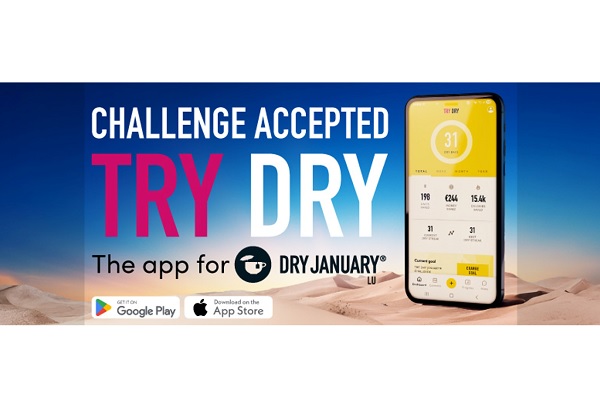
To support participants throughout the month, the official Try Dry® app, developed by Alcohol Change UK, is available free of charge on iOS and Android in three languages (French, German and English). The app allows users to track their progress day by day, visualise savings, monitor health benefits and receive personalised encouragement.
The public is also invited to register on dryjanuary.lu to receive regular support messages with practical tips and advice, or to follow the "Dry January Luxembourg" Facebook page.
"Although this challenge is traditionally undertaken in January, everyone can choose the month that suits them best to start and enjoy the same benefits. And why not make a habit of reducing consumption in a sustainable way?" encouraged Luxembourg's Minister of Health and Social Security, Martine Deprez.
In previous years, the Fondation Cancer led a similar initiative in January or February under the name "Sober Buddy Challenge".