 ALBA infographic;
Credit: ALBA 2023
ALBA infographic;
Credit: ALBA 2023
On Tuesday 3 March 2026, Luxembourg's Ministry of Health and Social Security announced the publication of the 2023 report on infant and young child feeding.
As part of efforts to promote breastfeeding and healthy eating, supported by the ministry, the Directorate of Health, in collaboration with the national committee for the promotion and support of breastfeeding, has been conducting periodic surveys since 1987 to monitor infant feeding practices in Luxembourg.
The 2023 "L'alimentation de nos bébés" (ALBA) report presents the results of the sixth national survey on breastfeeding and the feeding practices of infants and young children aged 0 to 24 months residing in Luxembourg. This survey aims to provide an objective assessment of the evolution of breastfeeding and infant feeding practices by examining the risk and protective factors associated with exclusive breastfeeding up to six months, as well as those linked with continued breastfeeding up to one year of age.
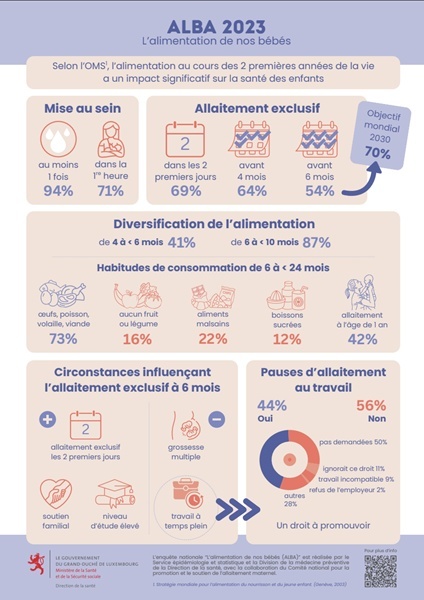
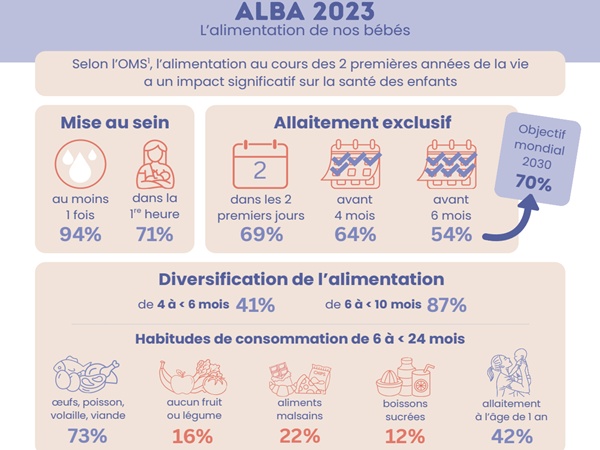
According to the ministry, the report highlights "promising" results, notably an increase in breastfeeding rates over the past decade. The study shows that a large majority of children included in the survey were breastfed at least once after birth, increasing from 90% in 2015 to 94% in 2023. Moreover, in line with national and World Health Organization (WHO) recommendations, nearly seven out of ten infants (71%) were breastfed immediately or within the first hour after birth. More than half of infants (54%) were exclusively breastfed at six months and more than two out of five (42%) were still being breastfed at one year.
"The first 1,000 days of a human being's life are of crucial importance in terms of prevention. This stage obviously begins with a healthy and balanced diet during pregnancy. After birth, particular attention must be paid to managing infant feeding, especially promoting and supporting breastfeeding," stated Martine Deprez, Luxembourg's Minister of Health and Social Security. "This report provides a source of evidence allowing us to assess the evolution of habits since the implementation of the survey in question and to guide our awareness-raising efforts in the coming months."
However, the ministry also noted some points of concern. Among babies aged six to eleven months, 5.5% consumed sugary drinks and 6% ate unhealthy foods (high in sugar, salt or fat). These figures increase with age: 15.5% of children aged twelve to 23 months drank sugary drinks while nearly 30% consumed unhealthy foods.
According to the ministry, the report provides "essential" insights for national policy development and action guidance in this area. The availability of factual information on predictors of breastfeeding can help policymakers and public health professionals design targeted programmes for at-risk groups. For example, mothers with a secondary education diploma were found to be less likely to exclusively breastfeed their child until six months than those with a higher education diploma. Similarly, mothers working full-time were less likely to exclusively breastfeed their baby than mothers who did not work.
While Luxembourg benefits from generally supportive breastfeeding practices and a maternity leave system that encourages breastfeeding, socially disadvantaged mothers or those working full-time require targeted support, noted the ministry, adding that these findings underscore the need for ongoing efforts to improve feeding practices for infants and young children.
The report is available (in French) online at https://santesecu.public.lu/fr/publications/e/etude-alba-2023-alimentation-bebe.html