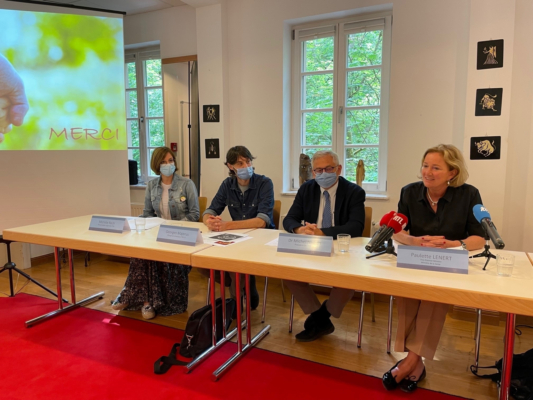
 (L-R) Michèle Rech, CTM Nursing Manager; Georges Majerus, Managing Director of CTM; Dr Michel Nathan, Chairman of the Board of Directors of the CHNP; Paulette Lenert, Minister of Health;
Credit: MSAN
(L-R) Michèle Rech, CTM Nursing Manager; Georges Majerus, Managing Director of CTM; Dr Michel Nathan, Chairman of the Board of Directors of the CHNP; Paulette Lenert, Minister of Health;
Credit: MSAN
On Thursday 19 May 2022, Luxembourg's Minister of Health, Paulette Lenert, and the Chairman of the Board of Directors of the Neuro-Psychiatric Hospital Center (Centre hospitalier neuro-psychiatrique - CHNP), Dr Michel Nathan, presented the concept of the new "parent-child" project at the Manternach Therapeutic Centre (Centre thérapeutique Manternach - CTM).
Since 2014, the CTM has been receiving more and more requests from parents of young children to undergo therapy. Over the past few years, the CTM team has also accompanied an increasing number of pregnant women with a problem of addiction to illicit substances. To meet this growing demand and provide an offer that meets the specific needs of this target population, the CTM team has developed the “parent-child” project. Also, the CTM is the only therapeutic centre at the national level and in neighboring countries that welcomes pregnant women and parents substituted for methadone with their children.
“This programme is often the only chance for the drug-addicted parent to stay close to their child and avoid a breakup, or even the placement of the child. Thanks to the agreement recently signed between the Rehaklinik and the Ministry of Health, this project now has a legal framework and its own funding, essential elements for improving parent-child supervision within the CTM.", underlined Dr Nathan.
The current law on health insurance does not provide for any support for children who accompany their parents to therapy. In neighboring countries such as Germany or Belgium, such coverage exists and the CNS reimburses a rate equivalent to that provided for by the respective law.
Between 2019 and 2021, twelve women were welcomed at the CTM, including ten with their child and two pregnant women. The ages of the children varied between four weeks and three years. Currently, the therapeutic centre has four places as part of the parent-child project, an increase in capacity would necessarily require an expansion of the premises.
Currently, a mother accompanied by her child is spending a month at the CTM for a stabilisation and integration phase. This phase allows to get to know and observe the parent-child relationship. Then the child support measures (nursery) and parent support (external services) are put in place. This also allows parents to participate in therapeutic workshops, psychotherapeutic groups, to have individual interviews with their psychologists and to learn how to organise their daily life. It also aims to help parents increase their skills and resources, and to support them in their efforts to create an environment for their child that promotes their development at all levels.
A second mother was recently welcomed, whose return of her child is in the preparation phase. Two parents are currently on the waiting list.
The CTM also works closely with the Central Social Assistance Service (Service central d'assistance sociale - SCAS).
“Our main concern must be the well-being of the child, but also of the parents. In order to avoid the placement of the child in a home or a foster family, the SCAS/Juvenile Court can oblige a drug-addicted parent to undergo therapy. Following this therapy in the company of their child is doubly beneficial: it strengthens the parent-child bond and minimises the risk of relapse,” said Minister Lenert.
Thanks to the CTM's parent-child project, two returns of children previously placed in a home and a foster family were able to take place in 2021. "It is precious moments like these that show us to how the parent-child bond is beneficial for therapeutic success. Accompanying the child improves and stabilises the parent in his programme and strengthens their recovery”, said Michèle Rech, care manager of the CTM. “Especially since, beyond the therapy itself here at the Syrdall Schlass, we also provide follow-up for parents and their children.” For this, the CTM collaborates with several external partners, who provide follow-up to families (JDH parenting service, Families first, Crèche Kiddies, Early rehabilitation, maternity services, etc.) This internal and external support network reinforces stabilisation and also minimises the risk of relapse.
The Manternach Therapeutic Centre for people dependent on illegal substances is a unit of the Rehaklinik of the CHNP and can accommodate up to 25 people, possibly undergoing methadone substitution treatment.
The multidisciplinary team offers individualised therapeutic care, adapted to the specific needs of the dependent person with the aim of increasing, as far as possible, the quality of life and allowing an independent and abstinent life.