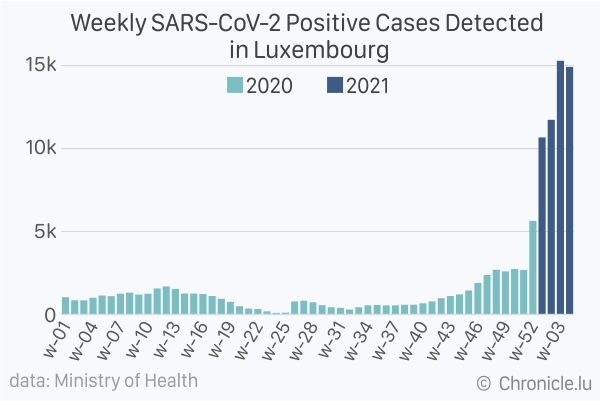
Luxembourg's Ministry of Health, together with the National Health Laboratory (Laboratoire National de Santé - LNS) and the Luxembourg Institute of Science and Technology (LIST), has issued a COVID-19 retrospective for the week of 24 to 30 January 2022.
During this period, the number of people testing positive for COVID-19 decreased from 15,293 to 14,918 cases (down 2%).
Among the 14,918 new infections, the incidence rate is 3,717 per 100,000 unvaccinated people and 1,782 per 100,000 people with a full vaccination schedule.
The number of PCR tests carried out decreased from 42,151 the week before to 39,136 last week.
239 people reported a positive rapid antigenic test for the reference week (down from 312 for the week before), bringing the total number of positive results from such tests performed by a healthcare professional to a total of 1,758. Note that positive rapid antigen tests are not taken into account in calculating the positivity rate.
As of 30 January 2022, the number of active infections stood at 30,764 (up from 27,375 as of 23 January 2022) and the number of people having recovered from the virus increased from 114,752 to 126,269. The average age of people diagnosed with COVID-19 is 28.3 years old.
Seven new COVID-19-related deaths were reported last week. The average age of those who died is 81 years old.
In hospitals, the number of confirmed COVID-19 patients in normal care increased from 58 to 68 over one week. The number of COVID-19 patients in intensive care decreased from fourteen to ten. The average age of hospitalised patients was 48.
Positivity rate & incidence rate
For the reference period, the effective reproduction rate (RT eff) was down 0.88 compared to 1.27 the previous week, while the positivity rate on all the tests carried out (prescriptions, contact tracing) increased from 36.28% to 38.12%.
The incidence rate decreased to 2,350 cases per 100,000 inhabitants over 7 days, compared to 2,409 cases per 100,000 inhabitants for the previous week.
Reinfections as well as certified self-tests in schools were included in the calculation of incidence rates. Compared to the previous week, the incidence rate increased among 60-74 year olds (up 7%) followed by 75 years and older (up 6%). A decrease is recorded among 15-29 year olds (down 6%) and 45-49 year olds (down7%). The lowest incidence rate is recorded in the age group 60-74 year olds with 795 cases per 100,000 inhabitants while the highest incidence rate is recorded among 0-14 year olds with 6,074 cases per 100,000 inhabitants.
Quarantines & isolations
During the week, 35,797 people were in isolation (up 21%) and 10,250 in quarantine (down 32%).
Transmission
With the increase in the number of cases, it is difficult to determine all probable source of contamination of the week.
The family circle (40.0%) remains the most frequent source followed by work (5.5%) and the aid and care sector (3.2%). The rate of contaminations for which the source is not clearly attributable decreased to 41.6%.
Vaccinations update
For the week of 24 to 30 January 2022, a total of 22,593 doses were administered. 1,481 people received a first dose, 2,762 a second and 17,948 people received an additional dose compared to a full schedule, bringing the total number of vaccines administered as of 31 January to 1,229,701.
475,495 people have a complete vaccination schedule, which corresponds to a vaccination rate of 79% compared to the vaccineable population (therefore the 5 years or older population).