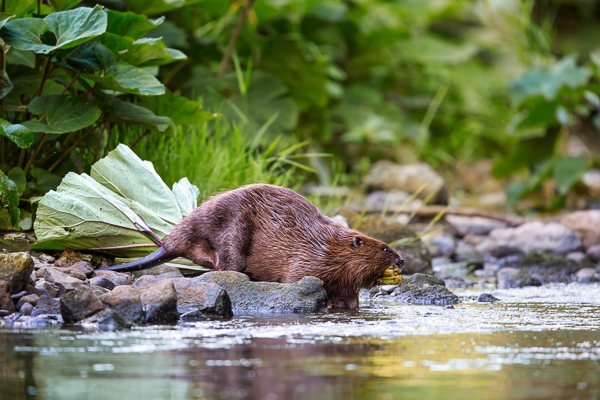
The Eurasian beaver is the second largest rodent in the world and was once widely spread throughout Europe. However, due to intensive hunting for their coveted fur and flesh, the population has been reduced from over one million to about 1,000 animals across Europe.
Once on the brink of extinction, the beaver, a protected species under European and Luxembourg law, is seeing a growth in population, including around the Greater Region and Luxembourg. At the moment, they occupy some 20 known sites in Luxembourg.
As a semiaquatic animal, the beaver lives in self-constructed kitchens on waterways. Attentive observers may notice some clues which indicate the presence of beavers. For example, trees, deadwood, or beaver dams or castles can be found among beaver reeds. As a pure vegetarian, the beaver only feeds on plant material. Wherever they settle down, they actively shape their environment by building dams and regulating the water level. This in turn provides other species, such as insects, amphibians or birds, new habitat. In this way, a species-rich biotope often arises through the building activities of the beaver.
Despite the positive impact on biodiversity and health of the water, beavers can also come into conflict with human interests. In agriculture, e.g. damage to crops (albeit minimally) or the irrigation of surfaces through dam construction may be cause for concern. However, such conflicts are mostly solvable.
In the light of these challenges, the Ministry of Sustainability and nature administration have recently held the first meeting of the monitoring group for the preparation of an action and management plan for dealing with beavers in Luxembourg. Participants in this working group are both governmental institutions and various stakeholders from the fields of agriculture, forestry, nature conservation, fisheries, water management and infrastructure. In the coming months, these stakeholders will continue to meet regularly to define future beaver management in Luxembourg.
Anyone spotting a likely beaver site is asked to please report it to the Nature Administration, by email: biber@anf.etat.lu, or telephone: 40 22 01 516. Early knowledge of the sites makes it possible, in many cases, to prevent possible conflicts by providing targeted information to the residents.